 how-to
How to Avoid Budget Overruns on Construction Projects
Table of Contents
- Why Construction Budget Overruns Happen
- Step 1: Establish a Detailed Project Baseline and Budget
- Step 2: Implement Construction Project Contingency Planning
- Step 3: Control Scope Creep and Managing Construction Scope Creep
- Step 4: Establish Real-Time Financial Monitoring and Reporting
- Step 5: Implement Owner's Representation Services for Oversight
- Step 6: Vet Subcontractors and Manage Procurement Strategy
- Conclusion
- Frequently Asked Questions
Last Updated: September 2, 2026
Construction projects rarely stay on budget. Scope creeps. Materials cost more than anticipated. Labor becomes scarce. A $5 million project turns into $5.8 million before anyone realizes what happened (peer-reviewed research). The owner absorbs the loss, the contractor blames unforeseen conditions, and everyone leaves frustrated.
This guide from Vincenzo Consulting, LLC covers proven strategies to avoid budget overruns on construction projects. With over 35 years of leadership experience in construction oversight, we've learned that preventing overruns isn't about luck, it's about discipline, visibility, and proactive management from day one.
Why Construction Budget Overruns Happen
Budget overruns result from predictable failures in planning, communication, and control. Inadequate project estimation tops the list: teams rush through budgeting, leaving gaps in cost assumptions. They underestimate labor hours, fail to account for material escalation, or overlook site-specific challenges.
Scope creep is equally destructive. A client requests "just one small change," then another, then three more. Each modification seems minor in isolation, but collectively they represent substantial unbudgeted work. Without formal change management, these additions consume contingency funds and push timelines.
Poor subcontractor vetting creates another vulnerability. Teams hire based on lowest bid rather than capability and reliability. When a subcontractor underperforms, rework costs multiply exponentially.
Real-time visibility gaps allow problems to compound undetected. Monthly reports submitted weeks after month-end are useless for cost control. By the time overruns surface, significant damage is already done.
Inadequate documentation and contractual clarity leave room for disputes. Vague contract terms invite contractor interpretation favoring themselves. Ambiguous specifications lead to rework when deliverables don't match expectations.
Finally, insufficient owner's representation means the owner's interests go undefended. Without dedicated oversight aligned with the owner's objectives, cost discipline erodes.
Step 1: Establish a Detailed Project Baseline and Budget
A strong project baseline is non-negotiable. This isn't a rough estimate, it's a comprehensive, line-item budget built from detailed specifications and realistic assumptions.
Start with complete design documentation. Every element must be specified: materials, dimensions, finishes, and performance standards. Vague specifications invite cost surprises. "Calacatta marble countertops, custom cabinetry with soft-close hinges, and integrated Miele appliances" is measurable and priceable; "high-end kitchen" is not.
Obtain detailed quantity takeoffs from drawings and specifications. Count every item: square footage of flooring, linear feet of framing, number of fixtures, volume of concrete. Precision here prevents estimation errors that compound throughout the project.
Build the budget from actual vendor quotes and historical labor rates. Contact suppliers for material costs and research prevailing wage rates for your region and trade. Accuracy at this stage prevents substantial downstream surprises.
Include all cost categories: materials, labor, equipment, subcontractor fees, permits, insurance, bonds, and overhead. Establish a realistic contingency reserve, not padding, but a disciplined allocation for legitimate unforeseen conditions. A straightforward commercial build might justify 5-8% contingency; a complex renovation with unknown subsurface conditions might require 10-15% (aia.org).
Document all assumptions underlying the budget. Note material prices as of a specific date, flag items subject to escalation, and record labor productivity assumptions. When circumstances change, you can adjust the budget intelligently rather than reactively.
Baseline the budget formally with all stakeholders. The owner, architect, general contractor, and major subcontractors must agree on the budget and understand its assumptions. A shared baseline prevents later disputes about whether costs are "overruns" or "planned additions."
Step 2: Implement Construction Project Contingency Planning
Contingency planning is where discipline separates controlled projects from chaotic ones. A contingency fund without a management process is just money waiting to be spent.
Define contingency categories explicitly. Allocate specific reserves for known risks: material price escalation, labor productivity variations, site condition surprises, permit delays, and design clarifications. When a contingency item is triggered, it's drawn from its designated pool.
Establish clear approval thresholds. Small contingency draws might require only the project manager's sign-off. Draws above a certain threshold require owner approval. Major draws might require formal change order and stakeholder review. This structure prevents contingency erosion through death by a thousand cuts.
Create a contingency tracking log. Every draw is documented: date, category, amount, reason, and approval authority. This log becomes the historical record of how the project's budget evolved and why.
Distinguish between contingency draws and change orders. A contingency draw addresses an unforeseen condition within the project scope as originally defined. A change order modifies the scope itself. Scope changes often trigger additional costs beyond the direct change, including design revisions, schedule impacts, and coordination overhead.
Protect contingency reserves from casual depletion. Once contingency is spent, it's gone. A project that burns through contingency by 70% completion has no cushion for remaining risks. Review contingency status at every project meeting and investigate if depletion is tracking faster than project completion percentage.
Step 3: Control Scope Creep and Managing Construction Scope Creep
Scope creep is the silent budget killer. Controlling scope requires clear processes and firm boundaries.
Define the scope of work in writing before construction begins. The contract documents, drawings, specifications, and scope statement define exactly what's included. Everything else is outside scope. When a client asks for an addition mid-project, you can reference the scope document and discuss it as a change, not as an oversight.
Implement a formal change management process. Every scope modification goes through the same process: written request, scope impact assessment, cost and schedule impact analysis, owner approval, and formal change order execution. This process forces stakeholders to consider whether the change is truly necessary.
Assign a single point of accountability for scope decisions. When multiple people can approve scope changes, chaos results. One clear authority prevents conflicting decisions.
Document all scope clarifications and decisions in writing. If the owner and contractor agree that a certain specification means X rather than Y, that's a scope clarification and it gets documented. Written records prevent later disputes about what was actually agreed.
Schedule regular scope review meetings with all stakeholders. Walk the project, discuss any questions about scope interpretation, and address potential scope creep before it happens. Many scope issues emerge from ambiguous specifications or differing interpretations.
Establish a change order process with clear cost and schedule impacts. When a change is requested, the contractor provides a change order specifying the scope addition, cost impact, schedule impact, and other project effects. The owner can then make an informed decision.
Track all approved changes and their cumulative impact. A spreadsheet showing each change order and cumulative total keeps everyone aware of how scope modifications are affecting the budget.
Step 4: Establish Real-Time Financial Monitoring and Reporting
Monthly budget reports submitted weeks after month-end are useless for cost control. Real-time visibility is essential for catching problems while they're still correctable.
Implement a project management system with live cost tracking. Modern construction software integrates purchase orders, invoices, time tracking, and equipment logs. As transactions occur, they update the budget automatically. The project manager sees current spend in real time.
Establish weekly cost meetings with the general contractor and major subcontractors. Review actual spend against budget for each trade. Discuss any variances: Why is excavation running over? Are we tracking to budget on framing? Early detection of variances allows corrective action before they metastasize.
Create a cost variance report that highlights any line item running more than 5% over budget (pmi.org). Understanding the cause allows targeted response: Is it a scope addition? A site condition surprise? Inefficient execution?
Maintain a cumulative cost forecast for project completion. As the project progresses, actual spend and remaining commitments provide visibility into final cost. If the forecast shows completion above budget, you have time to implement cost controls.
Compare actual labor productivity against budgeted assumptions. If the budget assumed 8 hours per task and actual execution is taking 10 hours, multiply that variance across hundreds of tasks and the impact is significant. Identifying productivity gaps allows corrective action.
Track material costs against escalation assumptions. If the budget assumed 3% material escalation and actual escalation is running 6%, that's a substantial variance. Early detection allows scope adjustments or value engineering to offset the impact.
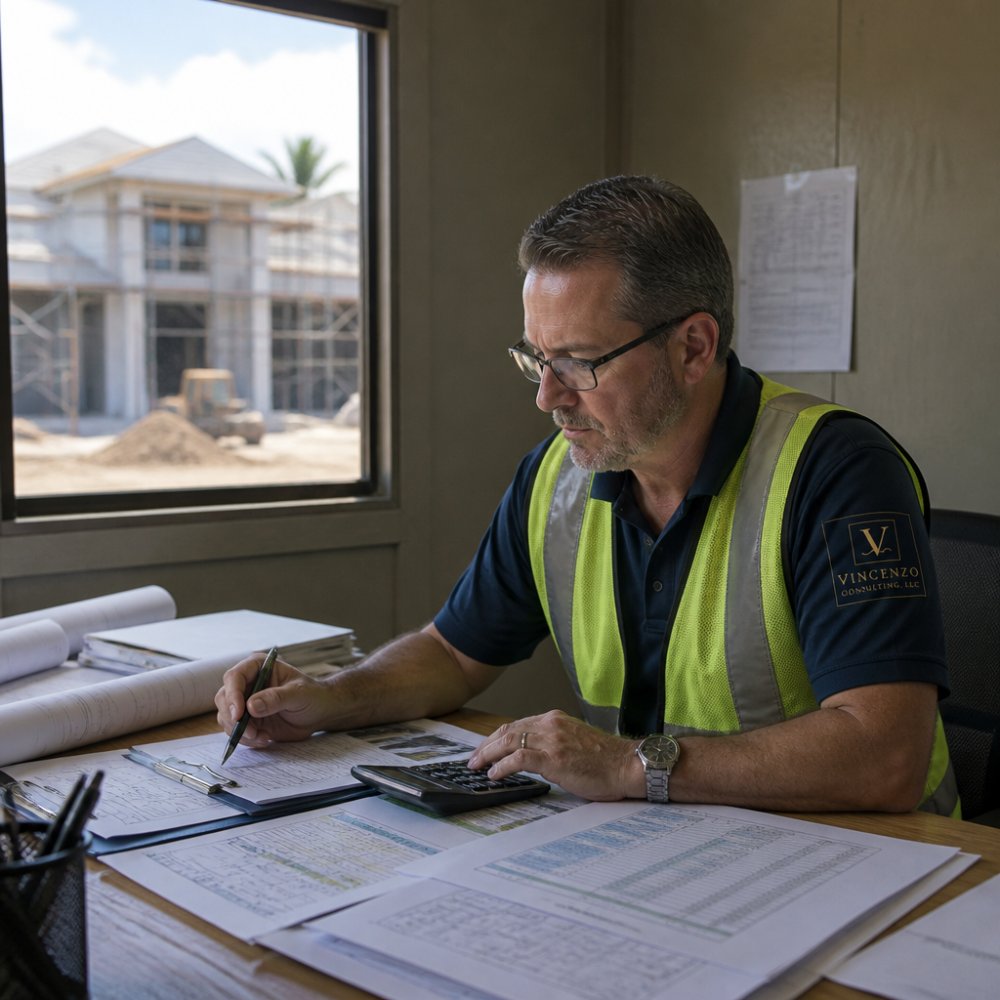
Establish a single source of truth for project financials. All stakeholders, owner, architect, general contractor, subcontractors, reference the same budget, actual spend, and forecast. Conflicting numbers create confusion and undermine discipline.
Step 5: Implement Owner's Representation Services for Oversight
The owner's interests and the general contractor's interests are not always aligned. The contractor wants to maximize profit. The owner wants to control cost and protect quality. Without dedicated owner's representation, the contractor's priorities tend to dominate.
Owner's representation means an independent advocate for the owner's objectives throughout the project lifecycle. This person (or team) is hired by the owner, reports to the owner, and is accountable for protecting the owner's interests.
The owner's representative reviews all major decisions: contractor selections, change orders, schedule adjustments, quality issues, and cost variances. They have authority to escalate concerns to the owner and recommend corrective action. Critically, they're not on the contractor's payroll, so they can push back without fear of retaliation.
Owner's representation provides continuous on-site presence. The representative attends daily stand-ups, walks the project regularly, and maintains direct visibility into execution. They catch problems early: a subcontractor cutting corners, a material delivery delayed, a crew working inefficiently.
The owner's representative coordinates among all stakeholders. Architects, contractors, subcontractors, and inspectors all have different priorities. The owner's rep ensures alignment around the owner's objectives and resolves conflicts before they escalate.
Documentation is critical. The owner's representative maintains comprehensive project records: daily logs, meeting minutes, change order justifications, quality issues and resolutions, and cost tracking. These records are invaluable for project close-out and post-project analysis.
At Vincenzo Consulting, LLC, our owner's representation services provide exactly this oversight. With over 35 years of construction experience, we understand how projects drift off budget and we know how to prevent it. We maintain rigorous financial discipline, ensure scope clarity, and advocate relentlessly for the owner's interests throughout the project lifecycle.
Step 6: Vet Subcontractors and Manage Procurement Strategy
Subcontractor performance directly impacts budget outcomes. A subcontractor who underestimates, cuts corners, or lacks execution capability creates cascading costs. Vetting and management are essential.
Establish clear subcontractor selection criteria. Price is one factor, but not the only one. Evaluate: relevant experience on similar projects, crew stability and productivity, quality reputation, safety record, financial stability, and responsiveness. A contractor 20% cheaper but prone to rework costs more in the end.
Request references from recent projects of similar scope and complexity. Call those references and ask specific questions: Did they finish on time? Did they stay within budget? Did they maintain quality? Would you hire them again?
Review financial stability. A subcontractor facing cash flow problems cuts corners or abandons the project. Request financial statements or credit reports for major subcontractors.
Conduct pre-construction meetings with all major subcontractors. Review the scope, specifications, schedule, and budget with them. Discuss site conditions, access, coordination with other trades, and any special requirements. A subcontractor who understands expectations upfront performs better than one who learns on the fly.
Establish clear contractual terms. The contract specifies scope, price, schedule, quality standards, payment terms, and dispute resolution. Ambiguous contracts create disputes; clear contracts create accountability.
Manage subcontractor performance actively. Weekly progress meetings, quality inspections, and schedule tracking keep subcontractors accountable. Track subcontractor change orders carefully, many budget overruns result from uncontrolled changes. Every change order must be reviewed, approved, and documented.
Establish payment terms that incentivize performance. Retainage (holding back a percentage of payment until project completion) creates accountability.
Conclusion
Avoiding budget overruns on construction projects requires discipline across six interconnected areas: understanding root causes, establishing a detailed baseline, planning for contingencies, controlling scope, maintaining real-time visibility, and implementing rigorous oversight.
Construction is inherently uncertain. Material costs fluctuate. Site conditions surprise. Unforeseen conditions emerge. The difference between a controlled project and a chaotic one isn't the absence of challenges, it's how those challenges are anticipated, managed, and resolved.
At Vincenzo Consulting, LLC, we've spent over 35 years helping owners protect their vision and preserve long-term property value through disciplined project execution. Our white-glove owner's representation ensures financial discipline, scope clarity, and accountability throughout the project lifecycle.
Vincenzo Consulting, LLC
White-Glove Construction Oversight & Owner's Representation
Over 35 years of executive leadership in construction project accountability.
📍 [Visit our website for more information]
📧 [Contact us for a confidential consultation]
| Strategy | Focus Area | Expected Outcome |
|---|---|---|
| Detailed baseline budgeting | Accurate cost estimation | Realistic budget with documented assumptions |
| Contingency planning | Risk allocation and discipline | Controlled contingency management with clear approval thresholds |
| Scope management | Change control process | Reduced scope creep and clear change documentation |
| Real-time financial monitoring | Cost visibility and early detection | Weekly variance identification and corrective action capability |
| Owner's representation | Independent oversight and advocacy | Continuous on-site presence with stakeholder alignment |
| Subcontractor vetting | Performance accountability | Qualified contractors with proven track records |
Frequently Asked Questions
Q: What are the most common causes of construction budget overruns?
A: The primary causes include inadequate initial project estimation, scope creep from design changes, material price escalation and supply chain disruptions, labor productivity delays, and poor cost variance tracking. Insufficient contingency reserves and weak change management processes also contribute significantly. Rework due to quality issues or design conflicts can consume a portion of project budgets. Establishing rigorous documentation standards and real-time project visibility helps identify and address these issues before they compound into major overruns.
Q: How much should I allocate for construction project contingency planning?
A: Contingency reserves typically range from 5-15% of the total project budget, depending on project complexity and risk profile. Ultra-luxury residential and complex commercial projects often warrant a higher percentage due to higher specification standards and design sensitivity. Infrastructure projects with environmental permitting may require a higher percentage. The contingency fund should be managed separately from the base budget and allocated only for legitimate change orders, unforeseen conditions, or documented cost increases. Regular risk assessment and budget baseline reviews allow you to adjust reserves as the project progresses.
Q: How does managing construction scope creep prevent cost overruns?
A: Scope creep, unauthorized design changes, additional features, or expanded work, is one of the largest drivers of budget overruns. Effective management requires a formal change management process with written change orders, impact analysis, and stakeholder approval before work begins. Clear contractual obligations and design documents establish the baseline scope. Regular stakeholder communication and project oversight ensure changes are documented and priced accurately. Without disciplined scope control, small modifications accumulate into significant cost and schedule impacts that erode the contingency fund and delay project delivery.
Q: What role does owner's representation services play in preventing cost overruns?
A: Owner's representation services provide independent oversight of financial controls, subcontractor performance, and project delivery. A dedicated representative ensures alignment of scope, budget, and schedule with your objectives, monitors cost variance against the budget baseline, and advocates for the owner's interests during disputes or change negotiations. This white-glove approach catches problems early through on-site visibility, rigorous documentation review, and real-time reporting. For complex or high-value projects, owner's representation significantly reduces the risk of cost overruns by establishing accountability and preventing miscommunication between stakeholders.
This article was written using GrandRanker