 ultimate-guide
How to Manage Luxury Home Construction: 2026 Guide
Table of Contents
- What Luxury Home Construction Management Actually Requires
- Pre-Construction Planning: Design, Permits, and Deliverables
- Managing Custom Home Building Budget and Financial Risk
- Luxury Home Construction Timeline: Phases and Milestones
- Site Supervision, Quality Control, and Subcontractor Management
- Owner's Representative in Luxury Construction: Why It Matters
- Digital Tools, Communication Logs, and Project Documentation
- Sustainable Finishes, Smart Home Integration, and Post-Construction Warranty
Last Updated: August 28, 2026
What Luxury Home Construction Management Actually Requires
Luxury home construction is one of the most complex capital undertakings a private owner or family office will execute. The stakes are personal, reputational, and long-term. At Vincenzo Consulting, LLC, we work with high-net-worth owners who have learned that building a custom estate requires fundamentally different management discipline than standard residential construction.
The core challenge: ultra-luxury projects involve compressed decision-making windows, elevated bespoke specifications, and a contractor ecosystem unaccustomed to answering directly to owners. Without structured oversight, even talented general contractors drift on scope, schedule, and quality.
Managing luxury home construction requires command over five interlocking disciplines: pre-construction planning, budget and financial risk management, schedule governance, site supervision and quality control, and systematic documentation. Miss any one, and the others unravel.
Management Discipline | Primary Risk If Neglected | Key Output |
|---|---|---|
Pre-construction planning | Scope creep, permit delays | Approved drawings, permit set |
Budget and cost control | Overruns, change order exposure | Cost ledger, contingency fund |
Schedule governance | Timeline drift, carrying costs | Phase milestone schedule |
Site supervision | Quality failures, rework | Inspection logs, punch lists |
Documentation and communication | Disputes, unresolved decisions | Decision log, RFI tracker |
Pre-Construction Planning: Design, Permits, and Deliverables
The most expensive mistakes in luxury home construction happen before ground is broken. Pre-construction either sets the project up for disciplined execution or failure.
Architectural Design and Scope Definition
Architectural design in high-end construction is an iterative negotiation between owner vision, structural reality, and budget. The most common mistake is approving schematic designs before scope is fully priced. That gap between design intent and construction cost spawns change orders.
A complete pre-construction deliverable package includes:
- Schematic design drawings and owner-approved design development documents
- Construction documents with full specifications for luxury finishes and systems
- Preliminary cost estimation tied directly to construction documents, not square footage averages
- Material sourcing plan for long-lead items such as custom millwork, stone, and imported fixtures
Scope must be locked before the general contractor is engaged. Any ambiguity becomes a negotiating lever for the contractor later.
Building Permits and Regulatory Requirements
Permitting concentrates schedule risk. For custom estates, the permit set often includes structural, mechanical, electrical, plumbing, and environmental submissions. According to U.S. Census Bureau construction permit data, permit timelines vary significantly by jurisdiction, and high-value custom homes frequently trigger additional plan review cycles.
Building codes enforced by local authorities having jurisdiction (AHJ) govern structural integrity, fire separation, energy efficiency, and accessibility. Owners must track permit status; that responsibility belongs to the owner's team, not the design team.
Pre-construction regulatory checklist:
- Full permit set submitted and AHJ review timeline confirmed
- Zoning variances or special use permits identified and applied for
- HOA or architectural review board approvals secured
- Environmental or coastal commission reviews initiated where applicable
- Utility connection approvals confirmed with local providers
Managing Custom Home Building Budget and Financial Risk
Managing a custom home budget requires proactive financial discipline that anticipates exposure before it materializes.
Cost Estimation, Change Orders, and Contingency Planning
Credible cost estimation for luxury custom homes is built trade by trade, not from per-square-foot multipliers. High-end construction involves bespoke finishes, custom fabrication, and specialty subcontractors whose pricing bears no resemblance to production home benchmarks.
Change orders are the greatest source of budget overruns in high-end construction. They become destructive when untracked, verbally approved, or processed without formal cost analysis. Every change order should include:
- Written description of scope change
- Cost impact broken down by labor and materials
- Schedule impact in calendar days
- Owner signature before work proceeds
Contingency planning is non-negotiable. Most experienced construction managers recommend eight to fifteen percent contingency reserve for luxury projects, though the right figure depends on scope complexity, construction document completeness, and contractor track record. The contingency is a managed reserve with formal approval for each draw.
Budget Transparency and Financial Risk Mitigation
Budget transparency means the owner can see committed cost, incurred cost, projected final cost, and remaining contingency at any point. That visibility requires a cost ledger updated weekly, not monthly summaries in contractor pay applications.
Financial risk mitigation includes:
- Requiring payment and performance bond from the general contractor on projects above appropriate thresholds
- Structuring contracts with schedule of values that front-load owner use, not contractor cash flow
- Including retainage provision, typically ten percent held until substantial completion
- Verifying subcontractor lien waivers before each owner payment is released
According to American Institute of Architects contract documents guidance, the AIA A201 General Conditions provides a widely adopted framework for managing these obligations. Owners should work with legal counsel to ensure contract terms reflect project complexity.
Luxury Home Construction Timeline: Phases and Milestones
A luxury home construction timeline is a living document governing procurement, subcontractor mobilization, and owner decisions simultaneously.
The typical phase structure for a custom estate includes:
- Pre-construction (three to six months): Design finalization, permitting, contractor selection, and long-lead procurement
- Site work and foundation (one to three months): Grading, excavation, foundation pour, and waterproofing
- Structural framing and enclosure (two to four months): Framing, roofing, windows, and exterior envelope
- Mechanical, electrical, and plumbing rough-in (two to three months): All systems before insulation and drywall
- Insulation, drywall, and interior rough finishes (two to three months): Includes home automation and audio-visual rough-in
- Luxury finishes installation (three to six months): Flooring, cabinetry, millwork, tile, fixtures, and lighting
- Final inspections and punch list (one to two months): AHJ inspections, system commissioning, and owner walkthrough
Timeline management requires tracking milestones against baseline schedule and identifying float erosion before it becomes delay. A two-week framing slip cascades into six-week delays in finish trades if subcontractor mobilization windows are missed.
Site Supervision, Quality Control, and Subcontractor Management
The gap between specification and execution is where luxury construction earns or loses value. Site supervision is active, technical, and continuous.
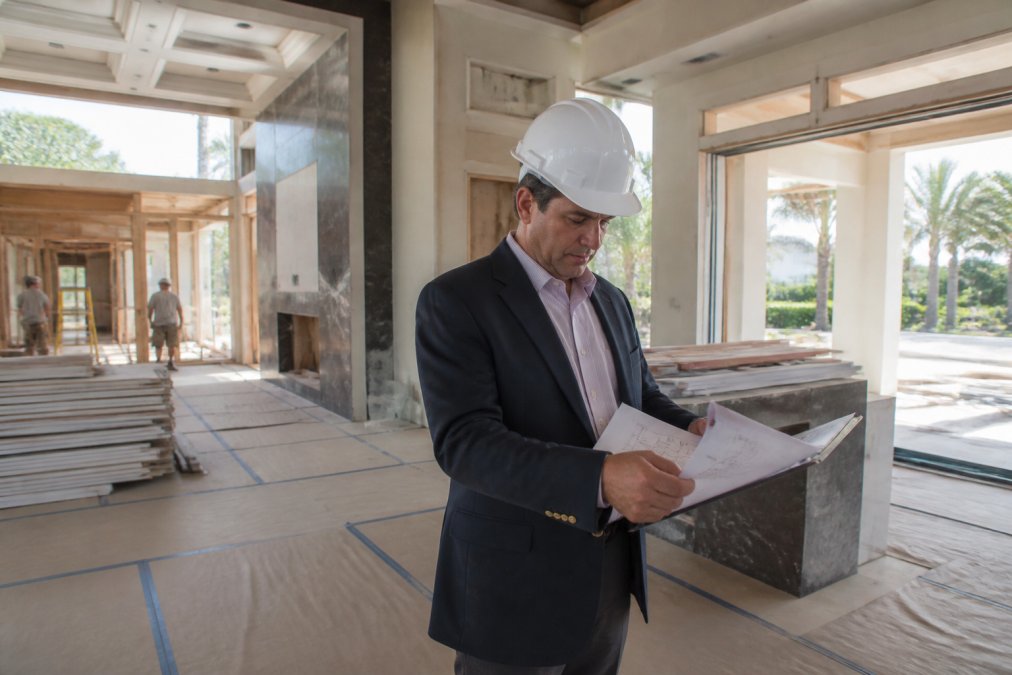
Quality assurance requires the owner's team present at critical inspection points: foundation, framing before enclosure, rough-in before drywall, and finish inspections at each trade completion. Relying solely on general contractor self-reporting is insufficient for high-end construction.
Subcontractor management is the general contractor's responsibility, but the owner's team must verify execution. Key indicators include:
- Subcontractors mobilizing on schedule per construction schedule
- Material deliveries coordinated to avoid site congestion and finish damage
- Work sequencing that protects completed trades from damage
- Documented inspections at each subcontractor scope completion
A common mistake is allowing the general contractor to approve their own subcontractors' work without independent verification. For structural elements, waterproofing, and specialty finishes, third-party inspection is worth the investment.
Owner's Representative in Luxury Construction: Why It Matters
An owner's representative is the owner's independent advocate on every project decision, from contract negotiation through final closeout.
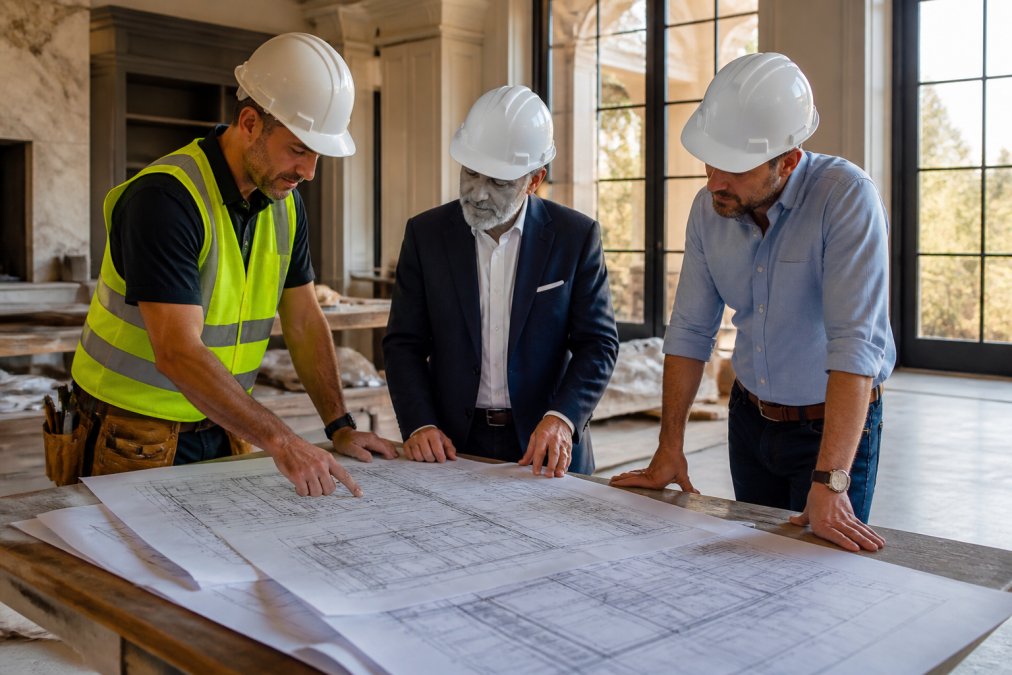
The owner's representative role is distinct from general contractor and architect. The contractor's interest is maximizing margin and minimizing scope. The architect's obligation is design intent. The owner's representative's sole obligation is protecting the owner's vision, budget, and schedule.
For first-time custom home builders, the owner's representative is critical. Without independent construction management expertise, owners depend on contractor framing of every issue, cost, and decision, a structural conflict of interest.
The Vincenzo Consulting, LLC team, led by Paul V. Facchina Jr. with more than 35 years of executive leadership across ultra-luxury residential, commercial, and infrastructure projects, provides this function. The firm's approach is discreet, disciplined, and built around financial accountability, ensuring scope, budget, and schedule remain aligned with owner objectives throughout the project lifecycle.
According to Construction Management Association of America professional standards, the owner's representative function includes scope, cost, schedule, quality, and contract administration. These require authority, presence, and technical depth.
Digital Tools, Communication Logs, and Project Documentation
Documentation disputes, not construction defects, are the most common source of project litigation. A well-documented project is a protected project.
Cloud-based project management tools allow the owner's team to track submittals, requests for information, change orders, and inspection reports in real time with complete audit trails. The key is configuring the platform to capture decisions that matter.
A complete project documentation system includes:
- Decision log: Every owner decision with date, options considered, and selected direction
- RFI tracker: All requests for information with response dates and resolution status
- Change order log: Every change order by number, description, cost impact, schedule impact, and approval status
- Submittal log: All material and finish submittals with review and approval status
- Meeting minutes: Weekly owner-contractor-architect meetings documented and distributed within 24 hours
- Photo documentation: Dated site photographs at each phase tied to the inspection log
Client communication protocols should be established at project kickoff. The owner should receive weekly project status reports covering schedule, budget, open issues, and upcoming decisions. Surprises in luxury construction are almost always documentation failures.
Sustainable Finishes, Smart Home Integration, and Post-Construction Warranty
Two areas often underweighted in construction guides are smart home integration and post-construction warranty management.
Sustainable finishes are increasingly specification requirements. Low-VOC paints, sustainably sourced hardwoods, and energy-efficient glazing affect long-term home health and resale positioning. Owners should require material documentation confirming compliance with specified sustainability standards. The U.S. Green Building Council LEED certification standards provides a framework for evaluating sustainable material and system performance in residential construction.
Smart home integration is technically complex. Audio-visual, home automation, lighting control, security, and HVAC systems must be coordinated during rough-in, not retrofitted after finish work. Treating smart home systems as finish-phase add-ons misses the opportunity to run conduit cleanly before walls close.
Post-construction warranty management protects long-term property value. A well-structured closeout package includes:
- Contractor's one-year correction period warranty
- Extended manufacturer warranties for major systems: roofing, HVAC, windows, and appliances
- Documented commissioning report for all mechanical, electrical, and smart home systems
- Maintenance schedule for systems requiring periodic service
Owners treating closeout as formality discover deferred maintenance issues within two to three years that could have been addressed under warranty. Commissioning all systems before final payment is released is essential.
Managing luxury home construction with required discipline demands executive-level oversight, technical knowledge, and authority to hold every party accountable. Vincenzo Consulting, LLC brings more than 35 years of leadership experience to this challenge, providing owner's representation that protects your vision, budget, and long-term property value from pre-construction through final closeout. Contact Vincenzo Consulting, LLC to discuss your project and establish the oversight structure it deserves.
Frequently Asked Questions
What are the most common pitfalls in luxury home construction management?
The most frequent pitfalls include inadequate pre-construction planning, poorly defined scopes that invite costly change orders, insufficient budget contingency reserves, and weak subcontractor oversight. Owners who skip dedicated project documentation and decision logs often face disputes that delay the schedule. Engaging an experienced owner's representative early in the process closes most of these gaps before they escalate into financial or structural problems.
How does an owner's representative add value to a luxury build?
An owner's representative in luxury construction serves as the client's dedicated advocate, independent of the general contractor and design team. They enforce budget transparency, verify that project milestones are met, review change orders before approval, and maintain decision logs that protect the owner's interests. For high-net-worth clients building a first custom estate, this role provides executive-level oversight without requiring the owner to manage day-to-day site logistics personally.
How do you maintain financial discipline during a luxury custom home build?
Managing a custom home building budget requires a detailed cost estimate before breaking ground, a contingency fund, and a formal change order process that documents every scope modification in writing. Monthly budget reconciliation against actual spend, combined with value engineering reviews at key project milestones, keeps costs predictable. Owners should require their construction manager or owner's representative to provide regular financial reporting throughout the project lifecycle.
How do you ensure quality control in high-end residential construction?
Quality assurance in luxury home construction depends on consistent site supervision, not just final inspections. Assign a dedicated representative to conduct regular site walks, verify that materials match approved specifications, and document any deviations immediately. Require third-party inspections at structural milestones and before luxury finishes are installed. Clear contractual obligations tied to quality benchmarks, combined with a formal punch-list process at project closeout, protect structural integrity and long-term property value.
This article was written using GrandRanker