 ultimate-guide
Managing Complex Infrastructure Project Risks in 2026
Table of Contents
- Why Complex Infrastructure Projects Fail: The Real Cost of Unmanaged Risk
- An Infrastructure Project Risk Assessment Framework That Works
- Mitigating Financial Risk in Construction: Contingency Budgets, Contractual Liability, and Cost Controls
- Construction Project Accountability Strategies for Multi-Stakeholder Builds
- AI-Driven Predictive Risk Modeling and Supply Chain Volatility
- Behavioral and ESG Risks: The Blind Spots Most Teams Miss
- Conclusion
- Frequently Asked Questions
Last Updated: September 16, 2026
Why Complex Infrastructure Projects Fail: The Real Cost of Unmanaged Risk
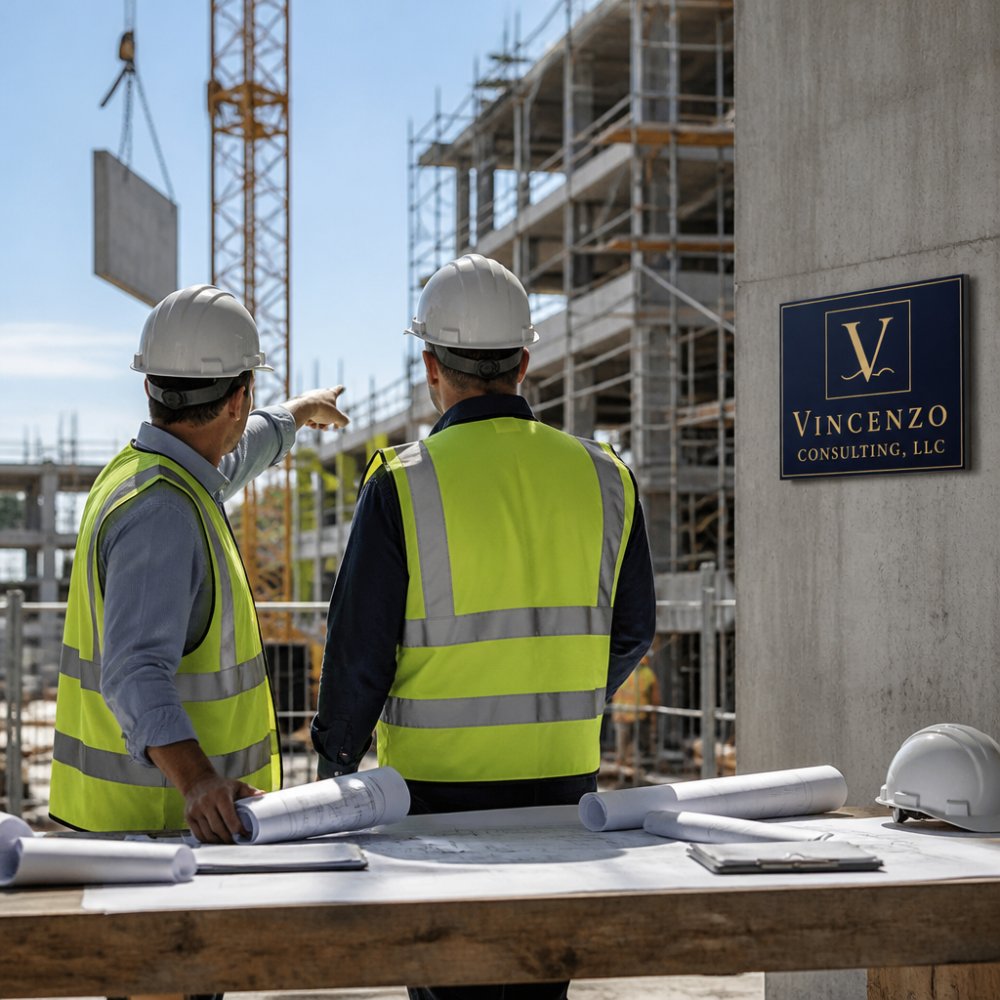
Managing complex infrastructure project risks separates a project that closes on schedule from one that bleeds capital for years. At Vincenzo Consulting, LLC, we understand that owners can lose control not because contractors are incompetent, but because the risk picture isn't managed from day one. Infrastructure project risks compound: a permitting delay can become a schedule variance, then a cost overrun, then a contractual dispute.
An Infrastructure Project Risk Assessment Framework That Works
An infrastructure project risk assessment framework is a repeatable process for identifying, scoring, and assigning ownership to threats across the full project lifecycle. It works when it runs continuously, not as a one-time workshop.
Qualitative and Quantitative Assessment Methods
Qualitative assessment ranks risks using a probability-impact matrix and expert judgment. It's fast, cheap, and adequate for early screening.
Building and Maintaining a Risk Register
A risk register is a living document listing every identified risk with its score, owner, mitigation strategy, and status. It fails when it becomes a filing cabinet.
Mitigating Financial Risk in Construction: Contingency Budgets, Contractual Liability, and Cost Controls
Mitigating financial risk in construction starts with a contingency budget sized to actual exposure, not a flat percentage. Owners who default to a round number often underfund the risks that matter most.
| Risk Type | Control Mechanism | Owner |
|---|---|---|
| Cost overrun | Central contingency reserve | Owner |
| Schedule variance | Milestone gates, liquidated damages | Project director |
| Scope creep | Change-order approval threshold | Governance board |
| Contractor default | Performance bonds, retainage | Contracts lead |
Construction Project Accountability Strategies for Multi-Stakeholder Builds
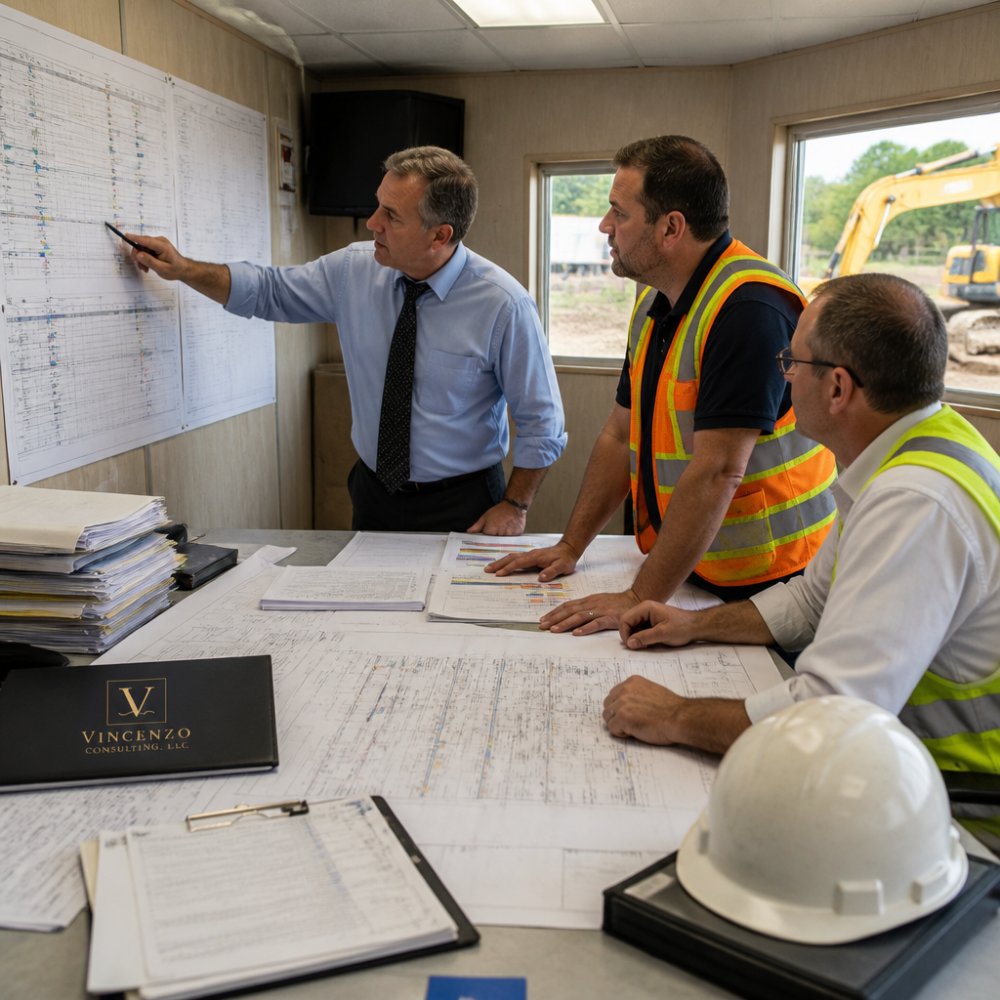
Construction project accountability strategies work when decision rights are explicit and every deliverable has one named owner. Shared accountability is no accountability.
Project Governance and Decision Rights
Project governance defines who decides what, at what threshold, and by when. Without it, decisions stall or get made twice.
A practical structure most owners adopt:
- Tier 1, Project director: day-to-day trade coordination, field changes under a defined dollar threshold, schedule recovery within float.
- Tier 2, Governance board: change orders above the threshold, design deviations, contingency releases, contract amendments.
- Tier 3, Owner executive: scope changes, capital reallocation, termination decisions, settlement authority on disputes.
A Responsibility Assignment Matrix That Actually Gets Used
Accountability collapses when roles are described in prose. Use a responsibility assignment matrix, often called a RACI chart, to assign one of four roles to every major deliverable and risk:
- Responsible: the person who does the work.
- Accountable: the single person who answers for the outcome. Only one per item.
- Consulted: subject-matter input, two-way communication.
- Informed: kept current, one-way communication.
Interface and Seam Management
On multi-stakeholder builds, the highest-risk interfaces are usually:
- Design-to-construction handoff, constructability gaps that surface after mobilization.
- Owner-to-contractor scope boundary, ambiguous scope that both sides assume the other owns.
- Permitting agency coordination, review cycles that run longer than the schedule assumes.
- Utility and third-party tie-ins, work controlled by parties outside the contract.
Assign a named interface owner for each seam. That person owns the coordination calendar, the information exchange, and the escalation trigger if a counterparty misses a commitment.
Dispute Resolution Before Disputes Arrive
Build the dispute ladder into the contract before mobilization:
- Step 1: field-level resolution between superintendents within a set number of days.
- Step 2: project director and contractor executive negotiation.
- Step 3: mediation with a neutral third party.
- Step 4: binding dispute resolution as specified in the contract.
Each step needs a defined time limit and decision-maker. Standing dispute review boards, common on large transportation and water projects, resolve issues while work continues rather than after it stops.
Stakeholder Engagement as a Risk Control
At Vincenzo Consulting, LLC, we help owners build these governance structures before mobilization, not after the first dispute. Reach us at [email] or visit [website] to discuss your project.
AI-Driven Predictive Risk Modeling and Supply Chain Volatility
AI-driven predictive risk modeling uses historical project data and live signals to flag emerging threats before they hit the schedule. It extends traditional analysis rather than replacing it.
How Predictive Models Actually Work
A predictive risk model ingests three classes of data:
- Historical project data, past schedules, cost curves, change-order logs, and claim histories from comparable builds.
- Live operational signals, procurement lead times, weather feeds, crew productivity, equipment telemetry, and inspection results.
- External signals, supplier financial health, commodity price movement, freight and logistics conditions, and regulatory dockets.
The model learns patterns that precede known failure modes, a supplier's delivery slippage, a schedule's float erosion, a cost curve's divergence from plan, and surfaces them as early warnings. The output is a probability band: a range of likely completion dates with confidence intervals, refreshed as new data arrives.
Where AI Adds Value Beyond Monte Carlo
Monte Carlo simulation remains the workhorse for quantitative risk analysis, modeling thousands of cost and schedule outcomes to produce a probability distribution rather than a single guess. AI-driven modeling complements it in three ways:
- Continuous updating. Monte Carlo runs on a snapshot. Predictive models refresh as new data arrives, so the distribution reflects today's conditions, not last quarter's.
- Unstructured data. Predictive models can read contract language, RFI logs, meeting notes, and inspection reports, sources a spreadsheet cannot process.
- Leading indicators. Monte Carlo tells you the range of outcomes. Predictive models flag the specific events most likely to push you toward the bad end of that range.
Supply Chain Volatility: The Hardest Variable
Supply chain volatility remains the hardest variable to plan around. Long-lead equipment, specialized labor, and imported materials all carry timing risk a fixed schedule ignores. The post-pandemic pattern, extended lead times, single-source dependencies, freight disruption, has not fully normalized, and projects that assume it has are exposed.
Build flexibility into procurement strategy:
- Qualify secondary suppliers for every critical long-lead item before the primary supplier slips.
- Stage delivery windows rather than fixed dates, and price the schedule around a range.
- Buy early on items with the longest and most volatile lead times, even if storage costs rise.
- Track supplier financial health as a leading indicator, not a lagging one.
- Model logistics risk for imported materials, including port congestion and customs delays.
Building a Predictive Risk Capability Without a Data Science Team
Most owners do not need to build models from scratch. A practical starting sequence:
- Standardize your data. A clean risk register, consistent cost coding, and structured change-order logs are prerequisites. Without them, no model works.
- Start with leading indicators. Track a small set of measurable signals, float erosion, RFI volume, procurement slippage, and set thresholds that trigger review.
- Pilot on one project. Apply predictive tools to a single high-risk project before scaling across a portfolio.
- Integrate with governance. Route model outputs into the same governance meetings that review the risk register, so predictions drive decisions rather than sit in a dashboard.
The Register Is Still the Backbone
Vincenzo Consulting, LLC helps owners stand up predictive risk capabilities that fit their existing governance. Contact us at [email] or visit [website] to learn more.
[Logo] Vincenzo Consulting, LLC [website] [email]
Behavioral and ESG Risks: The Blind Spots Most Teams Miss
Two risk categories sit outside most registers entirely: behavioral factors and ESG exposure.
Conclusion
Complex infrastructure project risks rarely fail from a single cause. They fail when identification, financial controls, governance, and emerging threats are managed in isolation. A living risk register, a contingency budget tied to real exposure, and clear decision rights hold a project together when pressure builds. Treat behavioral and ESG exposure as seriously as cost and schedule.
Frequently Asked Questions
What are the primary categories of risk in large-scale infrastructure projects?
Most infrastructure project risks fall into five categories: financial (cost overruns, funding gaps), schedule (delays, weather, permitting), technical (design errors, integration failures), contractual (liability disputes, scope creep), and external (regulatory changes, supply chain disruption). Each category requires its own mitigation strategies and dedicated tracking within a risk register. Projects that assess all five categories during the planning phase consistently outperform those that focus only on cost and schedule.
How does owner's representation mitigate financial risk in infrastructure development?
An owner's representative provides independent oversight of the general contractor's billing, change orders, and schedule claims. This third-party scrutiny catches cost overruns before they compound, enforces contractual liability terms, and keeps the contingency budget intact. For capital projects where a 5% overrun can mean millions, having a dedicated advocate who answers only to the owner changes the entire financial trajectory of the build.
What role does stakeholder alignment play in reducing project risk?
Misaligned stakeholders are one of the most underestimated sources of infrastructure project risks. When investors, architects, contractors, and regulators operate from different assumptions about scope, budget, or timeline, decisions stall and rework multiplies. Structured stakeholder engagement, including regular alignment sessions and a single source of truth for project data, reduces the probability of costly mid-project pivots and keeps project governance intact.
How can rigorous financial discipline prevent scope creep in complex projects?
Scope creep rarely arrives as one large change. It accumulates through small, unapproved additions that each seem harmless. Financial discipline means every change order goes through a formal review tied to the original design parameters and budget. When an owner's representative enforces that process, contractors know that unapproved work will not be paid for, and the incentive to expand scope without justification disappears.
What are the best practices for maintaining schedule integrity in infrastructure builds?
Schedule integrity depends on three practices: realistic baseline scheduling that accounts for permitting and procurement lead times, weekly progress tracking against that baseline, and early warning systems for schedule variance. Monte Carlo simulation can model how delays in one phase cascade into others. When variance exceeds a defined threshold, the team activates contingency plans rather than waiting for the schedule to collapse.
How do you manage multiple stakeholders on a complex infrastructure project?
Start by mapping every stakeholder's interests, decision authority, and communication preferences. Establish a project governance structure with clear escalation paths so that disagreements do not stall progress. Hold regular alignment meetings with a fixed agenda covering budget, schedule, and risk status. Document every decision and distribute it to all parties. The goal is not consensus on every point but clarity on who decides what and when.