 comparison
Colliers Project Leaders Alternative for Owners
Table of Contents
- Why Owners Seek a Colliers Project Leaders Alternative
- Direct Comparison: Top Project Leadership Alternatives for Owners
- Independent Selection Criteria for Project Leadership Partners
- Owner's Representative Services for Luxury Homes
- Hiring an Owner's Representative Checklist
- Benefits of Boutique Project Management Firms
- Frequently Asked Questions
Last Updated: September 28, 2026
Why Owners Seek a Colliers Project Leaders Alternative
Owners managing complex capital projects often discover that large, multi-service firms deliver scale but not intimacy. A Colliers Project Leaders alternative for owners typically means a smaller, more accountable partner who answers directly to the person funding the build. This guide from Vincenzo Consulting, LLC examines when a switch makes sense and who the strongest options are.
The pattern is consistent. An owner hires a global firm, gets a capable but stretched team, and watches decisions slow down.
Direct Comparison: Top Project Leadership Alternatives for Owners
Most "alternative" pages rank firms by brand size. That is the wrong axis for an owner. What matters is how a firm's delivery model maps to your project's scale, decision speed, and tolerance for risk. The matrix below scores four common models against the criteria owners actually feel on site.
| Evaluation Dimension | Global Program Firm | Corporate Portfolio Firm | Advisory-Only Firm | Boutique Owner's Representative |
|---|---|---|---|---|
| Typical project size fit | Multi-year, multi-site capital programs | Recurring corporate rollouts | Governance and audit engagements | Single high-value, complex builds |
| Decision speed | Slow, layered approvals | Moderate, account-based | Moderate, engagement leads | Fast, principal decides |
| Who owns the budget conversation | Assigned program team | Account manager | Advisory lead | Named principal |
| Site presence | Rotational staff | Regional PMs | Periodic visits | Weekly, principal-led |
| Change-order authority | Committee review | Regional sign-off | Recommendation only | Defined in engagement letter |
| Conflict-of-interest exposure | Can self-perform adjacent services | Can steer to preferred vendors | May recommend affiliated consultants | Independent by design |
| Best-fit owner profile | Public agencies, institutional developers | Corporate occupiers, retail chains | Boards needing financial oversight | Private owners, family offices, luxury developers |
How to Read the Matrix for Your Project
Start with project size and duration. Programs measured in years and multiple sites reward the process depth of a global firm. Projects measured in months and one site reward the responsiveness of a boutique.
Vincenzo Consulting, LLC: White-Glove Owner Representation
Vincenzo Consulting, LLC is led by Paul V. Facchina Jr. with more than 35 years of executive leadership. The firm provides discreet owner's representation for ultra-luxury residential, complex commercial, and infrastructure work.
Vincenzo Consulting, LLC https://vincenzoconsultingllc.com info@vincenzoconsultingllc.com
Independent Selection Criteria for Project Leadership Partners
Most selection guides hand you a list of questions. That is not enough. You need a way to score answers, verify claims, and detect conflicts before you sign. The framework below is built for owners, not for firms pitching to owners.
The Seven Criteria That Separate Firms
- Principal accountability. Ask for the name of the individual who will personally sign off on change orders above a defined threshold. If the answer is a role rather than a person, the accountability is diluted.
- Budget variance reporting. Ask to see a sample monthly variance report from a past project, redacted if necessary. A firm that tracks variance will have one ready. A firm that does not will describe the process in adjectives.
- Site presence cadence. Get the number of scheduled site visits per month in writing, plus who attends. "Regular site presence" is not a cadence.
- Change-order authority. Confirm the dollar threshold at which your representative can approve, reject, or must escalate. Undefined authority is how scope creep enters a project.
- Conflict-of-interest policy. Ask whether the firm, its affiliates, or its principals hold any ownership, referral fee, or equity interest in contractors, suppliers, or design firms on your shortlist. Get the answer in writing.
- Reference verification depth. Request three references from projects of similar type, scale, and completion date, then ask each reference what went wrong, not what went right.
- Insurance and liability structure. Confirm professional liability coverage limits and how claims are handled if the representative's decision causes a delay or cost overrun.
How to Score Firms Without Relying on Reputation
Build a simple weighted scorecard. Assign each criterion a weight based on what your project cannot tolerate. A luxury residential build might weight site presence and finish-quality oversight heavily. An infrastructure program might weight governance and reporting depth.
The Conflict-of-Interest Test Most Owners Skip
Independence is structural, not rhetorical. Ask each firm to disclose any financial relationship with contractors, subcontractors, suppliers, or design professionals who may bid on your project. Also ask whether the firm receives any form of compensation from vendors beyond your engagement fee.
Certifications and Credentials Worth Verifying
Credentials are a floor, not a differentiator. Verify that the firm and its named principal hold relevant professional credentials and current licenses in the jurisdiction where your project is built. Then go one step further: ask for evidence of continuing education or recent project audits. A credential earned a decade ago says less than a documented recent review of the firm's own work.
A Shortlist Scoring Template
Use this structure to compare finalists side by side:
- Named principal and decision threshold, verified in writing?
- Sample variance report provided?
- Site visit cadence and attendee named?
- Change-order authority stated in dollars?
- Conflict-of-interest disclosure signed?
- Three comparable references contacted?
- Liability coverage confirmed?
A firm that answers all seven with documentation is a low-risk selection. A firm that answers four or five with narrative is a project risk you are choosing to accept.
Vincenzo Consulting, LLC https://vincenzoconsultingllc.com info@vincenzoconsultingllc.com
Owner's Representative Services for Luxury Homes
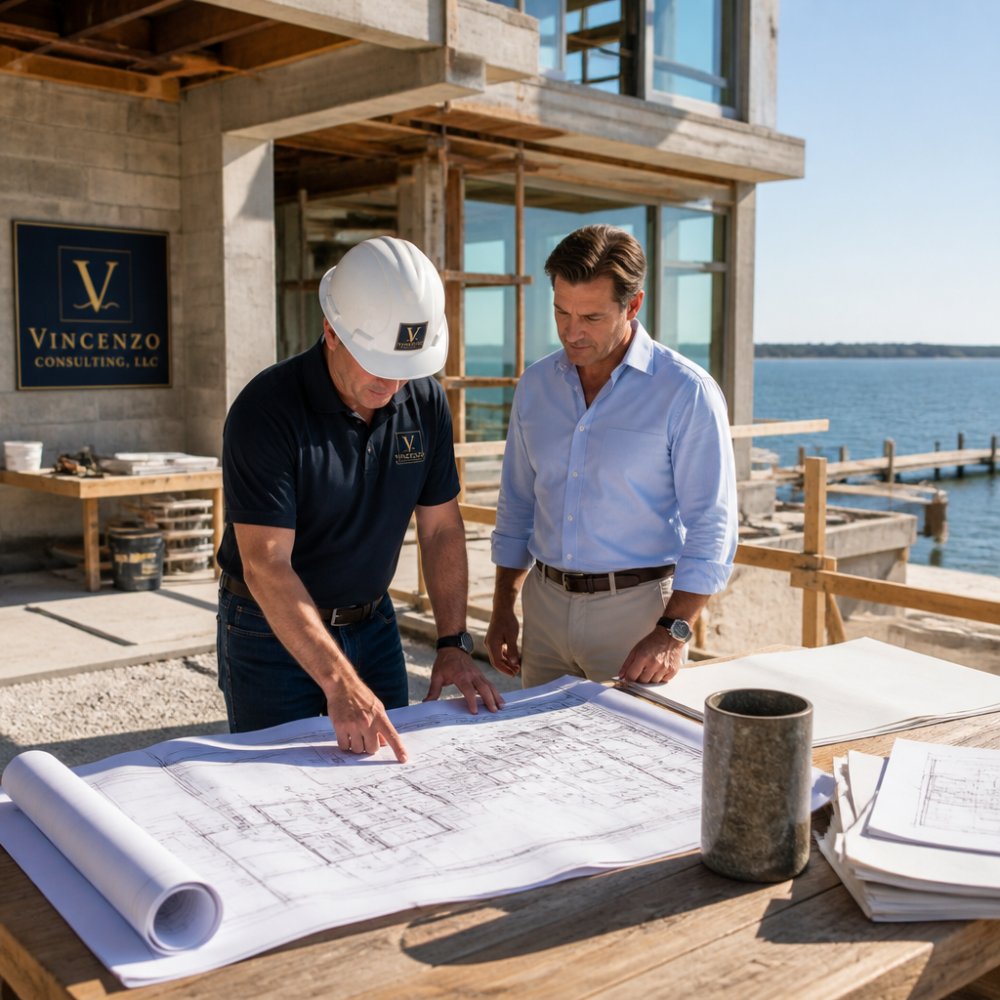
Owner's representative services for luxury homes cover the full lifecycle of a high-value custom build, from feasibility and design coordination through construction oversight and closeout.
Hiring an Owner's Representative Checklist
Run this checklist before you sign any engagement letter.
- Confirm the named principal who will lead your project, not just the firm
- Request three references from projects of similar type and scale
- Ask how budget variance is tracked and reported monthly
- Clarify decision authority when contractor disputes arise
- Verify on-site visit frequency and documentation standards
- Review the fee structure against the scope of oversight
- Confirm how they handle permitting and regulatory coordination
- Ask what happens if the project goes over budget
Benefits of Boutique Project Management Firms
The benefits of boutique project management firms come down to focus and accountability. A smaller firm cannot hide behind layers, so the person accountable to you is the person doing the work.
Frequently Asked Questions
What is the difference between a project manager and an owner's representative?
A project manager coordinates day-to-day construction activities on behalf of the contractor or builder. An owner's representative acts exclusively in the owner's interest, overseeing the entire project lifecycle from feasibility studies and procurement strategy through commissioning and closeout. This distinction matters because an owner's rep provides independent oversight, budget control, and accountability that a contractor-employed project manager cannot. For capital projects, having a dedicated owner's advocate prevents scope creep and ensures quality assurance standards are met.
When should a property owner hire an independent construction consultant?
Hire an independent construction consultant before breaking ground, ideally during feasibility studies or value engineering. Early involvement lets them shape procurement strategy, establish project governance, and set budget control frameworks before contractors are selected. For ultra-luxury residential or complex commercial builds, waiting until construction starts means critical decisions about contract administration and resource allocation are already locked in. An owner's representative services engagement from the planning phase typically delivers the strongest risk mitigation and asset performance outcomes.
How does boutique owner representation differ from institutional project management?
Boutique firms provide direct access to senior leadership, personalized attention, and discretion that large institutional firms often cannot match. With a boutique owner's representative, you work with the principal rather than being handed to a rotating team of junior staff. This matters for high-net-worth individuals and family offices overseeing confidential capital projects. The benefits of boutique project management firms include faster decision-making, deeper stakeholder engagement, and a service model built around protecting the owner's vision rather than scaling volume.
How do you evaluate the right project leadership partner for complex developments?
Start with a hiring an owner's representative checklist that covers track record on budget adherence, depth of multi-disciplinary team expertise, and experience with your specific project type. Ask for references from three recent projects and verify how they handled cost overruns or contractor disputes. Evaluate whether their advisory services extend to regulatory compliance, infrastructure planning, and operational readiness. The strongest partners demonstrate accountability in construction through documented outcomes, not just brand reputation. Confirm their authority to make decisions when issues arise mid-project.
What are the benefits of white-glove construction oversight for luxury residential projects?
White-glove construction oversight protects your vision and preserves long-term property value through rigorous financial discipline and strategic guidance. For ultra-luxury residential builds, this means on-site presence to catch problems early, careful management of specialty trades, and coordination of design intent across architects, engineers, and contractors. It also means discreet representation if you prefer not to be directly involved in day-to-day disputes. The result is predictable project delivery, quality assurance at every phase, and a finished estate that matches the original scope and budget.