 comparison
Owner Representative vs General Contractor Roles
Table of Contents
- Owner Representative vs General Contractor: Core Differences
- How the Two Roles Interact on a Job Site
- When to Hire an Owner Representative
- Benefits of Hiring an Owner Representative
- Managing General Contractor Performance
- Fee Structures and Liability: What Competitors Miss
- Conclusion
- Frequently Asked Questions
Last Updated: September 30, 2026
Owner Representative vs General Contractor: Core Differences
The owner representative vs general contractor relationship is the most misunderstood structure in construction. One party builds; the other protects the owner's interests while the building happens. Confusing the two costs owners money, time, and control.
The Owner's Representative: Your Advocate
An owner's representative acts as the owner's eyes, ears, and voice across the entire project lifecycle. This role manages budget oversight, schedule adherence, and stakeholder advocacy without ever swinging a hammer.
- Independent review of contractor invoices and pay applications
- Coordination between architects, engineers, and the builder
- Risk management and early warning on scope creep
- Documentation of every decision for project closeout
The General Contractor: Your Builder
A general contractor is the firm responsible for the physical execution of construction, including site supervision, subcontractor management, and day-to-day labor coordination. The GC prices the work, hires the trades, and delivers the built asset.
- Directs subcontractors and daily site activity
- Manages permits, inspections, and safety compliance
- Controls means and methods of construction
- Carries the contractual obligation to build
How the Two Roles Interact on a Job Site
On a well-run site, the two roles sit on opposite sides of the table by design. The general contractor leads construction execution while the owner representative verifies that execution matches the contract, budget, and schedule. The relationship is not adversarial for its own sake, it is a structural check that keeps the owner's interests represented in every decision.
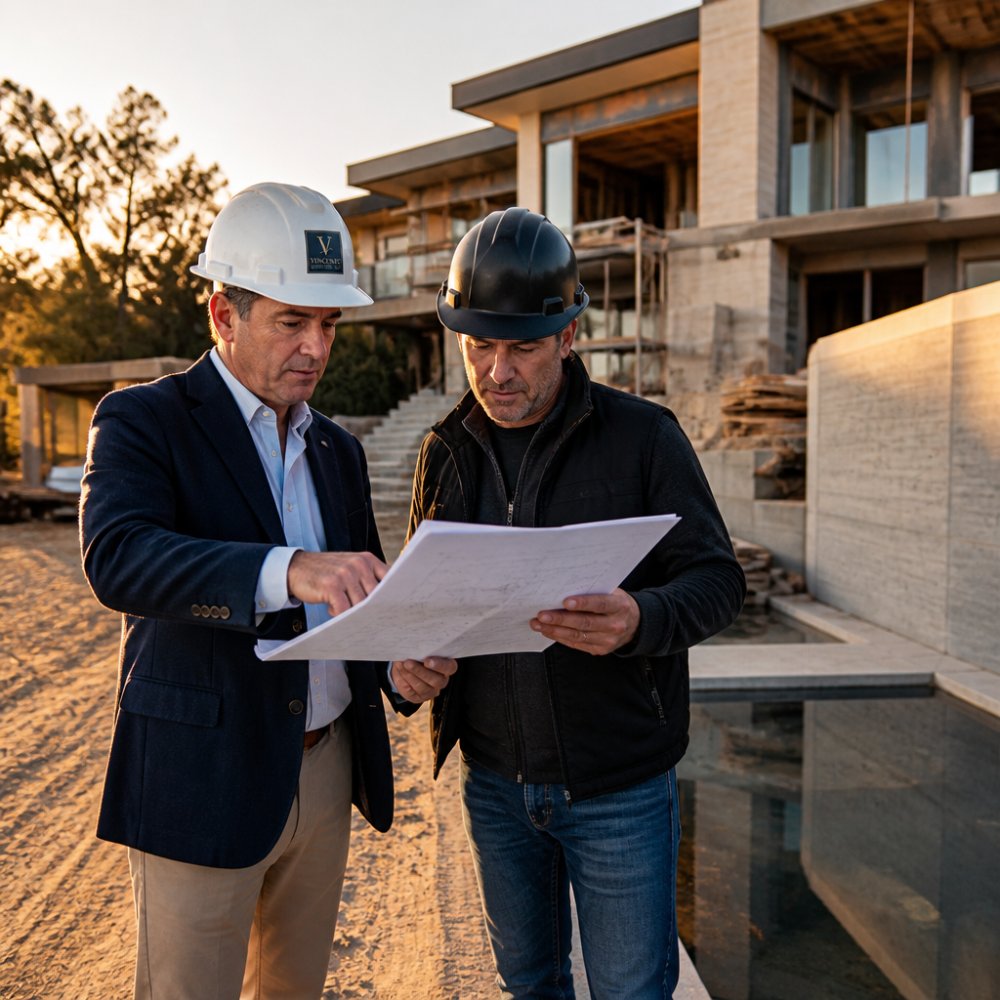
In practice, the interaction runs on a predictable rhythm:
- Weekly progress meetings. The GC's project manager presents percent-complete by trade, upcoming look-ahead activities, and open issues. The owner representative challenges the numbers against the schedule of values and the baseline schedule.
- Monthly pay application review. The representative audits the GC's requisition line by line, stored materials, retainage, and prior payments, before recommending approval to the owner.
- Submittal and RFI logs. The representative tracks turnaround times. A growing backlog of unanswered RFIs is an early signal that the drawings were never fully coordinated.
- Joint walkthroughs. The representative and GC superintendent walk the site together at defined milestones to document installed work, punch items, and safety observations.
- Change order processing. Every scope change moves through a written proposal, a cost and time impact review, and a signed authorization before work proceeds.
The Chain of Command Rule
The owner representative does not direct trades. Issuing instructions directly to a subcontractor breaks the contractual chain of command, exposes the owner to liability for means and methods, and creates conflicting directives the GC can later use to justify delay claims. Instead, the representative raises issues through the GC's project manager and documents the response in writing. If the GC fails to act, the representative escalates to the owner, not to the trades.
Conflict Resolution Protocols
Most role comparisons skip this entirely, and it is where projects actually go wrong. Disputes between an owner representative and a GC typically fall into four buckets: disputed change order pricing, schedule extension requests, quality or defect disagreements, and payment withholding. The fix is to write an escalation ladder into both contracts before mobilization:
- Field level. The owner representative and GC project manager attempt resolution within a defined window, usually five business days.
- Executive level. Unresolved items escalate to the GC's principal and the owner (or the owner's representative firm principal) for a documented decision.
- Neutral review. For technical disputes, concrete strength, MEP coordination, structural modifications, both parties agree in advance on a third-party engineer or inspector whose finding is binding.
- Formal dispute resolution. Mediation, then arbitration or litigation per the contract's dispute clause. The American Institute of Architects (AIA) family of contract documents includes standard dispute resolution provisions that many owners adopt as a starting point.
How Technology Bridges the Two Roles
Digital project management platforms, Procore, Autodesk Construction Cloud, and similar tools, have changed how these roles share information. Both parties now work from a single source of truth for RFIs, submittals, daily reports, and change orders. Building Information Modeling (BIM) takes this further: the owner representative can review a coordinated 3D model for clash detection and as-built documentation, catching conflicts that paper drawings hide.
When to Hire an Owner Representative
Hire an owner representative when the project's financial exposure, complexity, or personal stakes are high enough that you cannot supervise the builder yourself. For a simple renovation, that may not apply. For a capital improvement in the tens of millions, it almost always does.
Benefits of Hiring an Owner Representative
The benefits of hiring an owner representative center on control: control of cost, control of quality, and control of the information you use to make decisions. Owners who skip this step often discover problems only after the concrete is poured.
- Budget oversight that flags overruns before they compound
- Quality assurance against the contract documents
- A single point of accountability reporting only to you
- Continuity when your own attention moves to the next deal
Managing General Contractor Performance
Managing general contractor performance means measuring the GC against the contract, not against their own narrative. That requires documented baselines for cost, schedule, and quality, then regular comparison against them. The owner representative's job is to build those baselines before mobilization and enforce them consistently.
The Performance Baseline
Start with three documents that must exist before the first shovel hits the ground:
- Schedule of values. A line-item breakdown of the contract sum by trade or work package. Every pay application is measured against it.
- Baseline schedule. A CPM (critical path method) schedule with milestones, float, and dependencies. Progress is measured against this, not against a revised schedule the GC produces after a delay.
- Quality benchmarks. Defined standards for workmanship, testing, and inspection, referencing the specifications, not verbal expectations.
Fee Structures and Liability: What Competitors Miss
Fee structures and liability exposure differ sharply between the two roles, and most comparisons skip this entirely. A general contractor typically prices work as a lump sum, cost-plus, or guaranteed maximum price (GMP), with profit and overhead built into the contract and markup applied to change orders. An owner representative usually works on a fixed fee, hourly rate, or percentage of project cost, and critically, does not earn markup on construction, which removes the incentive to inflate scope.
| Factor | Owner Representative | General Contractor |
|---|---|---|
| Primary duty | Protect the owner's interest | Deliver the construction |
| Typical fee model | Fixed fee, hourly, or percentage | Lump sum, cost-plus, or GMP |
| Liability scope | Professional and advisory | Construction and warranty |
| Insurance carried | Professional liability | General liability, workers' comp, bonding |
| Reports to | The owner | The owner, under the build contract |
Documentation Discipline
Every performance conversation should be traceable. Daily reports, meeting minutes, and inspection logs form the record that supports, or defeats, a claim. The owner representative's value here is not just catching problems but proving they were raised in writing at the time. A pattern of documented notices is what protects an owner in mediation or arbitration.
Fee Structures and Liability: What Competitors Miss
Fee structures and liability exposure differ sharply between the two roles, and most comparisons skip this entirely. A general contractor typically prices work as a lump sum, cost-plus, or guaranteed maximum price, with profit built into the contract. An owner representative usually works on a fixed fee, hourly rate, or percentage of project cost.
| Factor | Owner Representative | General Contractor |
|---|---|---|
| Primary duty | Protect the owner's interest | Deliver the construction |
| Typical fee model | Fixed fee, hourly, or percentage | Lump sum, cost-plus, or GMP |
| Liability scope | Professional and advisory | Construction and warranty |
| Insurance carried | Professional liability | General liability and bonding |
| Reports to | The owner | The owner, under the build contract |
Conclusion
The owner representative vs general contractor distinction comes down to allegiance. The contractor builds and is paid to build; the representative watches the build and is paid to protect you. Owners who understand that split negotiate better contracts, catch problems earlier, and finish with fewer surprises.
Frequently Asked Questions
What is the primary difference between an owner representative and a general contractor?
An owner representative works exclusively for the project owner, managing budget, schedule, and quality while advocating for the owner's interests. A general contractor is hired to execute the physical construction work and manages subcontractors, procurement, and site supervision. The owner representative oversees the general contractor's performance, ensuring contractual obligations are met and the owner's vision is protected throughout the project lifecycle.
Do I need an owner representative if I have already hired a general contractor?
Yes, especially for complex or high-value projects. A general contractor focuses on construction execution, not on protecting your financial interests. An owner representative provides independent budget oversight, reviews change orders, monitors schedule adherence, and ensures quality assurance. This separation of duties prevents conflicts of interest and gives you a dedicated advocate who answers only to you, not to the construction team.
How does an owner representative protect the project budget?
An owner representative reviews all cost estimation, change orders, and contractor invoices before approval. They conduct value engineering analysis, track spending against the original budget, and identify potential overruns early. By managing procurement and vendor coordination independently, they prevent unnecessary costs and ensure every dollar aligns with the owner's objectives. This financial discipline preserves long-term property value and keeps the project within approved limits.
Can a general contractor perform the duties of an owner representative?
No. A general contractor has a financial interest in the construction contract and cannot objectively oversee their own work. The owner representative role requires independence to manage risk, enforce quality assurance, and advocate solely for the owner. Combining both roles creates a conflict of interest that can lead to unchecked costs, schedule delays, and compromised quality. These functions must remain separate for proper accountability.
How do owner representatives and general contractors typically get paid?
Owner representatives usually work on a fixed fee, hourly rate, or percentage of project cost, depending on scope and complexity. General contractors are paid through a lump-sum contract, cost-plus arrangement, or guaranteed maximum price. Payment structures reflect their distinct roles: the owner representative is compensated for oversight and advocacy, while the general contractor is paid for construction execution, materials, and subcontractor management.