 how-to
How to Ensure Accountability in Industrial Projects
Table of Contents
- Why Industrial Project Accountability Fails Without Owner Control
- Build an Accountability Framework Before Mobilization
- Construction Project Accountability Strategies That Hold Up Under Pressure
- An Industrial Project Risk Management Framework for Multi-Vendor Execution
- KPIs for Industrial Construction Execution: What to Track Weekly
- Digital Tools, Automation, and Transparency in Project Governance
- Conclusion: Accountability Is a System, Not a Promise
- Frequently Asked Questions
Last Updated: October 2, 2026
Why Industrial Project Accountability Fails Without Owner Control
Industrial accountability is the practice of assigning clear ownership, decision rights, and reporting duties for every task in a project so that results can be traced to a specific person.
Most industrial projects do not fail because of bad contractors.
Accountability is not a promise made at kickoff. It is a system you build before the first shovel hits the ground.
Below, we break down the framework, the reporting structures, and the KPIs that keep industrial projects on track.
Build an Accountability Framework Before Mobilization
The strongest accountability frameworks are built before mobilization, not after problems appear. Waiting until the first delay or cost overrun means you are negotiating authority you should have defined in writing months earlier.
A workable framework answers three questions up front:
- Who owns each deliverable?
- Who reports to whom, and how often?
- What happens when a deadline slips?
Get these on paper before contracts are signed. Once crews are on site, use shifts to whoever controls the schedule.
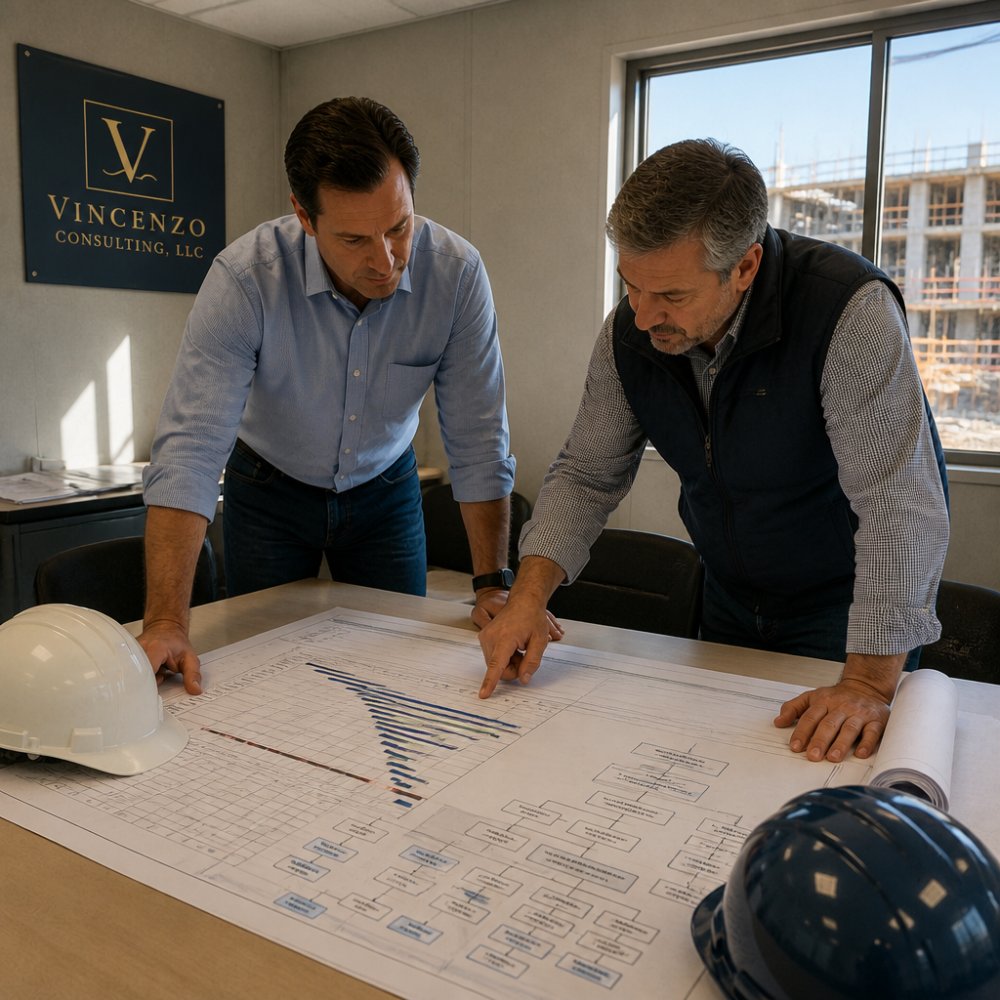
Define Task Ownership and the Chain of Command
Every task needs one name attached to it. Not a department. Not a committee. One person.
A clear chain of command means each trade, vendor, and consultant knows exactly who approves their work and who they answer to.
A common mistake is letting task ownership live only in a spreadsheet the owner never sees. Put it in the contract, the schedule, and the weekly report.
Set Reporting Structures and Feedback Mechanisms
Reporting structures decide how fast problems surface. A weekly written report with a short review call works better than a monthly deck nobody reads.
Feedback mechanisms matter just as much. Field crews often spot issues weeks before they hit a formal report. Give them a simple way to flag risks, and route those flags to someone with authority to act.
Construction Project Accountability Strategies That Hold Up Under Pressure
Construction project accountability strategies only matter when the project is under stress. Anyone can run a clean meeting in month one. The test comes when a steel delivery slips or a subcontractor walks off the job.
Three practices hold up under pressure:
- Written decision logs. Every verbal instruction gets confirmed in writing within 24 hours.
- Single points of approval. Change orders route through one owner's representative, not five voices.
- Consequence clauses. Contracts state what happens when milestones slip, before they slip.
The owner's representative role exists for exactly this reason. Someone has to sit on the owner's side of the table with the authority to say no.
An Industrial Project Risk Management Framework for Multi-Vendor Execution
An industrial project risk management framework ties every identified risk to a named owner and a deadline. A risk register without owners is just a list of worries.
On multi-vendor industrial builds, risk compounds. One vendor's delay becomes another vendor's overtime. A framework that works across vendors includes:
- A shared risk register all parties can see
- Named owners for each risk item
- A weekly review of open risks with target close dates
- Escalation paths when a risk crosses a cost or schedule threshold
Set Escalation Thresholds, Not Just Escalation Paths
Most frameworks name an escalation path but never define when to use it. That is why escalations stall. Write the trigger into the contract.
A workable pattern is a three-tier threshold:
| Trigger | Escalates To | Response Window |
|---|---|---|
| Any risk open more than 14 days | Vendor project manager | 48 hours |
| Schedule variance over 5 working days on a critical path activity | Owner's representative | 24 hours |
| Cost variance over 2% of a work package, or any safety stop-work | Owner's executive sponsor | Same business day |
Thresholds do the arguing for you. When the number is hit, the escalation is automatic, no one has to decide whether the issue is "big enough" to raise.
Accountability Across Cross-Border and Multi-Vendor Supply Chains
This is where most published frameworks stop, and where industrial projects actually break. When fabrication happens overseas, engineering sits in one time zone, and installation happens on site in another, the chain of command has to survive the handoffs.
Four practices hold up:
- One accountable party per interface. Every vendor-to-vendor handoff, drawings, fabricated modules, tested equipment, gets a single named owner on the receiving side who signs off on acceptance. Shared ownership at an interface is the same as no ownership.
- A written decision-rights matrix. Map who approves scope changes, who approves schedule recovery plans, and who approves quality deviations. Publish it in every vendor's contract so no one can claim they did not know.
- Overlapping coverage windows. Schedule at least two hours of daily overlap between the owner's representative and each major vendor's project manager. Without overlap, decisions wait a full day, and a week of waiting becomes a month of slippage.
- A single source of truth for revisions. Document control lives in one system, not in each vendor's inbox. When two vendors build to two different drawing revisions, the owner pays for both.
Tie Risk to Safety and Compliance
Accountability and risk management are the same conversation on an industrial site. A near-miss that no one owns becomes an incident. A permit condition that no one tracks becomes a stop-work order.
Route safety observations, permit expirations, and inspection findings through the same risk register as schedule and cost items. Give each one a named owner and a close date.
Close the Loop
A risk framework only works if risks actually close. Require every open risk to carry a target close date, and review the aging list weekly. Risks that sit open past their target date should escalate automatically under the thresholds above. The goal is not a clean register, it is a register where nothing quietly rots.
KPIs for Industrial Construction Execution: What to Track Weekly
KPIs for industrial construction execution should fit on one page and be reviewed every week. If a metric cannot change a decision, drop it.
The metrics that matter most:
| KPI | What It Tells You | Review Frequency |
|---|---|---|
| Schedule variance | Days ahead or behind plan | Weekly |
| Cost variance | Spend vs. budget by work package | Weekly |
| Open RFIs | Unresolved questions blocking crews | Weekly |
| Change order volume | Scope creep trend | Weekly |
| Safety incidents | Site risk and compliance | Weekly |
| Submittal approval time | Design and procurement lag | Biweekly |
Track the trend, not the snapshot. A single week of schedule variance means little. Four straight weeks of slippage means the plan is wrong, not the crew.
Digital Tools, Automation, and Transparency in Project Governance
Digital accountability tools have changed what owners can see and when. Shared dashboards, cloud-based schedules, and automated photo documentation mean the owner no longer waits for a monthly report to know what happened on site.
Most published guidance on industrial accountability stops at theory. This section covers the tool categories that actually carry accountability on a live project, and the rules that keep the data trustworthy.
The Four Tool Categories That Carry Accountability
- Project management information systems (PMIS). Platforms that hold the schedule, the RFI log, the submittal register, and the change order log in one place. When every party works from the same system, "I never saw that" stops being a defense.
- Building information modeling (BIM) and digital twins. Model-based coordination catches clashes and scope gaps before fabrication. Assign a named model owner per discipline so model updates have an accountable source.
- Enterprise resource planning (ERP) and cost systems. Cost-loaded schedules tied to the ERP show committed vs. actual spend by work package. This is where cost variance becomes visible before the invoice arrives.
- Field documentation tools. Mobile photo, video, and inspection apps that timestamp and geotag progress. These replace the disputed daily report with a record both sides can see.
Data Integrity Rules That Make the Tools Trustworthy
A dashboard is only as honest as the data feeding it. Four rules keep it honest:
- One system of record per data type. If the schedule lives in two places, it lives in neither. Pick the system of record and make every other view a read-only mirror.
- Timestamped entries only. Manual back-dating destroys the audit trail. Configure tools so entries lock once submitted.
- Named owners on every record. Every RFI, submittal, and change order carries a responsible party in the system, not just in a meeting note.
- Read access for the owner. The owner's representative should see the same live data the vendors see. Transparency changes behavior before anyone has to ask a question.
How Automation Changes the Human Side of Accountability
Automated reporting does not remove the human element, it moves it. Three shifts matter:
- Alerts replace status meetings. When the system flags a missed milestone the day it happens, the weekly meeting shifts from reporting to deciding.
- Exception-based review replaces full review. Owners stop reading every line and start reviewing only the items the system flags. That is faster, but it means the thresholds must be set carefully, a badly tuned alert system hides problems instead of surfacing them.
- The audit trail becomes the record. When every instruction, approval, and revision is logged, accountability is documented by default. The trade-off is that sloppy data entry now creates a permanent, visible record of the sloppiness.
Transparency Is the Real Prize
When every vendor knows the owner can see the same data they see, reporting gets more honest. That said, tools do not create accountability.
The owner's representative role is where digital oversight meets human judgment.
Vincenzo Consulting, LLC helps owners build accountability systems that survive contact with a live industrial project. Learn more at [website], or reach us at [email].
Conclusion: Accountability Is a System, Not a Promise
Industrial project accountability comes down to structure, not good intentions. Define ownership before mobilization, enforce it through written reporting, and track it with a short list of weekly metrics that actually change decisions.
Owners who build that system early protect their budget, their schedule, and their vision. Owners who skip it spend the back half of every project negotiating problems they could have prevented.
The framework is not complicated. It just has to exist before the pressure arrives.
Frequently Asked Questions
What are the core components of accountability in large-scale industrial projects?
Accountability in industrial development rests on four components: a named owner for every deliverable, a documented chain of command, a reporting structure that surfaces bad news early, and consequences tied to performance metrics. Without all four, responsibility scatters across contractors and consultants. An owner's representative typically formalizes these components in a project governance charter before mobilization begins, so every party knows who answers for what.
How does owner's representation improve project accountability?
An owner's representative sits between you and the general contractor, reviewing invoices, verifying progress against deliverables, and flagging scope creep before it compounds. That independent layer prevents the situation where the contractor grades its own work. For industrial projects with multiple vendors, the representative also coordinates handoffs so no task falls between contracts. The result is disciplined execution with a single point of accountability reporting directly to you.
How do you measure performance and accountability during construction execution?
Track KPIs for industrial construction execution weekly: schedule variance, cost-to-complete against budget, open RFIs, safety incident rates, and percent of deliverables signed off. Pair each metric with a named owner. When a metric drifts, the owner presents a corrective plan at the next review. This cadence turns performance metrics into a working accountability tool rather than a monthly report nobody acts on.
What are the primary risks to accountability in industrial development?
The biggest risks are unclear task ownership, verbal change orders, delayed reporting, and multi-vendor handoffs where responsibility blurs. Cross-border or multi-vendor projects magnify all four. An industrial project risk management framework addresses them by requiring written change management, a single reporting structure, and compliance checks at each project lifecycle stage. Risk mitigation through accountability means problems surface while they are still cheap to fix.