 how-to
Luxury Residential Construction: Ensuring Quality Assurance
Last Updated: October 27, 2026
Quick Summary
Ensuring quality assurance in luxury residential construction is the owner's job, delegated with discipline. Quality assurance is the owner-led system of planning, standards, and independent checks that prevents defects before they are built in, while quality control is the inspection that catches what slipped through.
- Build the construction quality assurance plan before mobilization, not after the first pour.
- Require every subcontract to carry the same quality requirements as the prime agreement.
- Verify concealed work before it disappears behind a wall and visible work against an approved mock-up.
- Close a punch list item only when an independent verifier re-inspects, retests, and signs off.
- Schedule seasonal checks at the first heating and cooling cycle and after the first heavy rain.
Table of Contents
- Why Quality Assurance in Luxury Residential Construction Starts With the Owner
- Quality Assurance Versus Quality Control on a Custom Estate
- How to Build a Construction Quality Assurance Plan Before Ground Breaks
- Holding Contractors and Subcontractors to Written Quality Standards
- The Luxury Home Construction Quality Control Checklist for Each Stage
- Using a Residential Construction Inspection Checklist on Site
- Building the Construction Punch List for Luxury Homes and Closing It Out
- What to Ignore in Luxury Construction Quality Assurance
- Bringing in Owner's Representation for Your Next Estate
- Frequently Asked Questions
Why Quality Assurance in Luxury Residential Construction Starts With the Owner
Ensuring quality assurance in luxury residential construction is not a contractor's job. It is the owner's job, delegated with discipline.
Most owners assume the builder protects them. They don't.
Quality assurance is the owner-led system of planning, standards, and independent checks that prevents defects before they are built in.
Here is the distinction that matters: QA is the plan you write before ground breaks.
Quality Assurance Versus Quality Control on a Custom Estate
Confusing quality assurance with quality control is the most common and most expensive mistake on a luxury build.
Quality assurance is proactive.
Quality control is reactive. It covers site inspection, testing, checklists, and the final review that confirms the work matches the standard.
A useful way to hold the difference:
- QA asks "how will we prevent defects?"
- QC asks "did a defect get through?"
- QA lives in project documents and contracts
Luxury projects need both, in that order. Skip QA and your QC team has nothing to measure against except opinion.
How to Build a Construction Quality Assurance Plan Before Ground Breaks
A construction quality assurance plan defines the standards, responsibilities, review points, and documentation for the entire project. Build it before mobilization, not after the first pour.
- Define project scope and performance criteria. Write down what the finished estate must do, not just what it must look like.
- Translate design specifications into measurable standards. "High-quality finish" is not a standard. A written tolerance is.
- Assign responsibility by trade. Every standard needs a named party who owns it.
- Set stage-gate review points. No phase advances without a documented sign-off.
- Build the documentation trail. Submittals, approvals, test records, and photos, filed as work happens.
- Define corrective action. State how a deviation is logged, fixed, and closed.
For a deeper walkthrough, see our guide to implementing a construction quality control plan.
Watch out: a QA plan written by the contractor and approved without owner review protects the contractor. Read every line.
Holding Contractors and Subcontractors to Written Quality Standards
Written standards only work when they are enforceable, inside the contract, not in a binder nobody opens. Three things make standards stick:
- They are specific. Material specifications name the product, the supplier, and the acceptable substitute process.
- They carry consequences. Rework is at the contractor's cost, and the contract says so plainly.
- They are verified independently. Someone who does not report to the builder checks the work.
What most guides miss is the subcontractor layer. The general contractor's quality commitment means little if the waterproofing or electrical subcontractor never received the standard. Require flow-down: every subcontract must carry the same quality requirements as the prime agreement. Weekly quality reviews, one shared defect log, and a single point of authority for sign-off prevent the "I thought they approved it" conversation that costs months.
Two companion pieces go deeper: ensuring compliance in luxury residential building projects and managing general contractor accountability issues.
The Luxury Home Construction Quality Control Checklist for Each Stage
A luxury home construction quality control checklist should be stage-specific, because the risks change as the build moves. One generic list applied to everything catches nothing well.
| Stage | Primary Focus | Hold Point Before Work Is Concealed | Measurable Criterion |
|---|---|---|---|
| Pre-construction | Plan, specs, contracts | QA plan signed off before mobilization | Every specification line has a named verifier |
| Foundation and structure | Structural integrity, waterproofing | Engineer's inspection on record before backfill | Reinforcement spacing and embedment match stamped drawings |
| Rough-in | Electrical, plumbing, insulation | Concealed work photographed and signed before close-up | Pressure test and insulation R-value documented per room |
| Envelope | Waterproofing, flashing, windows | Water test documented before cladding | No moisture intrusion after a controlled water test |
| Finishes | Workmanship, tolerances, premium finish | Mock-up approved before full installation | Joint alignment, reveal width, and stone match within written tolerance |
| Systems | Building performance, controls | Commissioning test results before handover | Each system passes its sequence of operation test |
| Closeout | Final review, documentation | Punch list fully closed before final payment | Every logged item re-inspected with photo evidence |
The pattern is simple. Concealed work gets verified before it disappears behind a wall. Visible work gets verified against an approved mock-up. No phase advances without a documented sign-off at its hold point.
Luxury-Specific Finish Tolerances
Most checklists stop at "high-quality finish." That is not a standard. On a custom estate, write tolerances the trades can actually measure:
- Stone and slab work: book-matched veining aligned across adjacent slabs, with no visible lippage at seams.
- Custom millwork: consistent reveal gaps at cabinet doors and drawer fronts, checked with a feeler gauge rather than by eye.
- Lighting: fixture alignment and trim flushness verified against the reflected ceiling plan before drywall close-up.
These criteria separate a luxury QA plan from a production-housing checklist. Put them in writing, attach them to the trade scope, and inspect against them at the mock-up stage.
Stage-Gate Inspections Across the Full Build
A stage-gate inspection is a formal pause where work cannot proceed until a named party signs off. Sequence them so no critical work is ever concealed without evidence:
- Design and procurement gate: specifications, submittals, and long-lead material approvals locked.
- Framing gate: structural inspection and engineer sign-off before enclosure.
- Enclosure gate: waterproofing and flashing water-tested before cladding.
- Services gate: rough-in pressure tests and photographs before drywall.
- Finishes gate: mock-up approved before full installation.
- Commissioning gate: systems tested and balanced before handover.
- Handover gate: punch list closed and documentation delivered.
Each gate needs three things: a written criterion, a named signer, and a filed record. If any of the three is missing, the gate is not closed.
Independent Third-Party Inspections
An independent inspector or owner's representative earns their place at the gates where the builder has the most incentive to move fast: enclosure, rough-in concealment, and commissioning. Their findings should feed the same defect log the builder uses, not a separate report filed and forgotten. The value is a check on the party whose schedule and margin depend on the work passing.
Using a Residential Construction Inspection Checklist on Site
A residential construction inspection checklist is a field tool, and it only earns its place if it is short enough to be used on site.
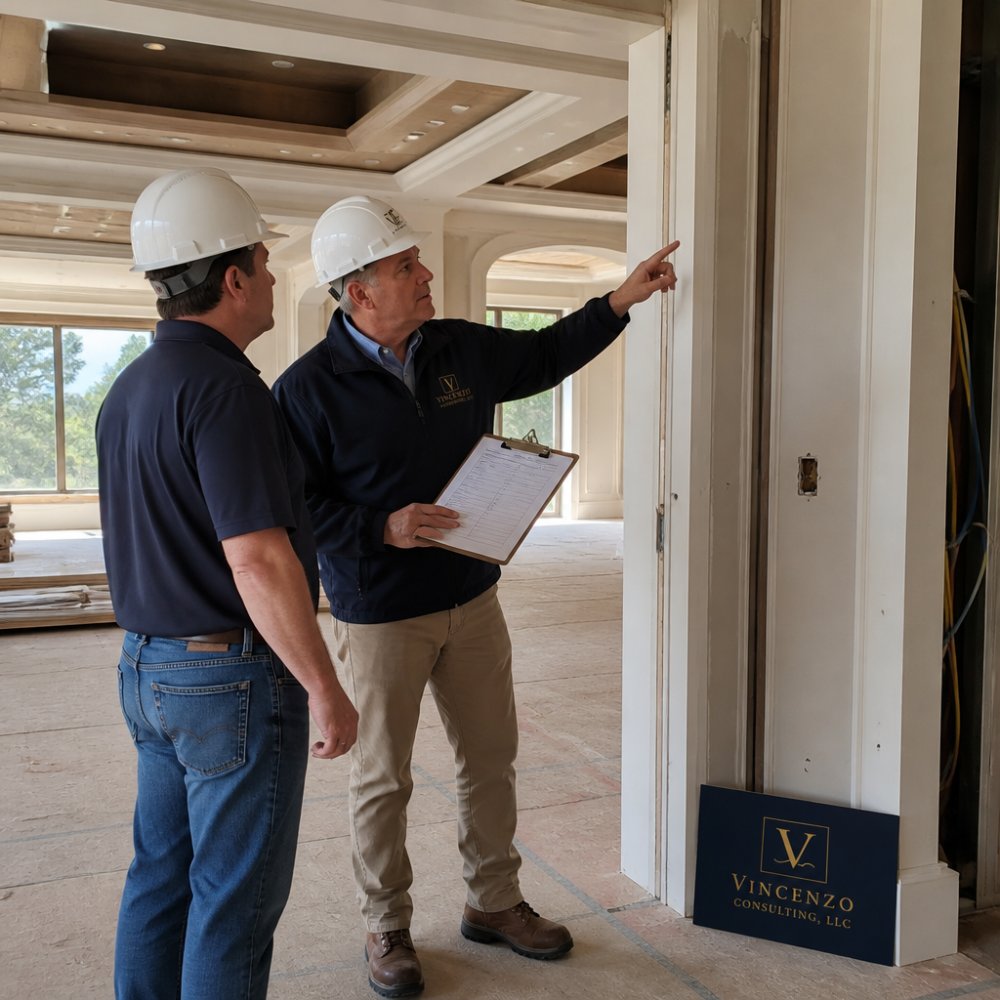
- Inspect against the written standard, not against memory
- Photograph every finding with a location reference
- Log the finding the same day, in the same shared system
The biggest mistake is treating inspection as a courtesy walk. It is evidence collection. If it is not documented, it did not happen, and it will not survive a dispute.
Keep the checklist tied to the stage table above. One page per stage, ten to fifteen items, no filler.
Building the Construction Punch List for Luxury Homes and Closing It Out
A construction punch list for luxury homes is a defect register with teeth, not a scrap of paper handed over at the walkthrough. Luxury closeout fails for one reason: defects are found but never formally closed. The fix is a defect log workflow with responsibility, deadlines, evidence, retesting, and sign-off on every item.
The Defect Log Workflow
Every finding moves through the same five steps, in the same shared system:
- Log: record the finding the same day, with a location reference and a photograph.
- Classify: assign a severity and a trade owner.
- Assign: set one named party and one due date. No shared ownership.
- Fix and evidence: the trade corrects the work and submits a photo of the fix matched to the original finding.
- Verify and close: an independent verifier re-inspects, retests where needed, and signs off.
An item is not closed when the trade says it is fixed. It is closed when the verifier signs.
Severity Definitions That Drive Priority
Severity sets the order of work and the level of evidence required:
- Critical: affects safety, structural performance, or building envelope. Fix and retest before any other work proceeds. Examples include waterproofing failures, structural deviations, and electrical or gas safety issues.
- Major: affects function, durability, or a system's sequence of operation. Fix before handover, with retesting where the system is involved.
- Cosmetic: affects finish appearance only. Fix before final payment, but never dropped.
Evidence, Retesting, and Sign-Off
Every closed item needs a matched pair: the original finding photo and the post-fix photo, filed under the same item number. Where a system is involved, retesting is required, not just a visual check. A repaired waterproofing detail gets a repeat water test. A corrected control sequence gets a repeat commissioning test. The verifier's signature is the only thing that closes the item.
Closeout Authority and Retention
Hold a retention or closeout condition until the list is verified complete, the single most effective lever an owner has. Name one party with authority to declare the list closed, independent of the builder's schedule pressure. The final review is not a single walk but a re-inspection of every logged item, with photos matched to the original finding. Only then does the list close.
Post-Occupancy and Warranty Follow-Up
Closeout is not the end of quality verification. Schedule seasonal checks at the first heating and cooling cycle and after the first heavy rain, because envelope and HVAC defects often surface only under real load. Route warranty requests through the same defect log so patterns become visible. Occupant feedback is quality data, and tracking it closes the loop most punch lists leave open.
What to Ignore in Luxury Construction Quality Assurance
Not everything on a generic QA list belongs on a luxury estate.
Ignore checklists built for production housing.
Ignore inspection counts as a measure of quality.
Ignore verbal approvals. If it is not written and signed, it is a future argument.
Ignore the urge to add standards you cannot verify.
What you should not ignore: independent third-party inspections, systems commissioning, and post-occupancy warranty follow-up.
Bringing in Owner's Representation for Your Next Estate
Owner's representation is hiring an independent advocate who manages quality, cost, and schedule on the owner's behalf, with authority written into the contract.
This is where Vincenzo Consulting, LLC works. Led by Paul V.
You can review our expert oversight for luxury estate projects, or read what the owner's representative role in real estate development actually involves before you decide.
The takeaway is straightforward.
Frequently Asked Questions
What does quality assurance mean in residential construction?
Quality assurance is the planned system of reviews, standards and inspections that prevents defects before they happen, rather than catching them after installation. On a custom home it covers design specifications, material approvals, subcontractor requirements and stage-gate sign-offs. Quality control is the day-to-day testing and inspection that confirms the work matches those standards.
What should a construction quality assurance plan include?
A workable construction quality assurance plan names the quality standards for every trade, sets inspection points at each stage, assigns who signs off, and defines how deviations and rework get documented. It should reference the design specifications, project documents and applicable building codes, and it needs a communication protocol so the construction team reports issues before walls close. Add a defect log with severity levels and a closeout process.
How often should quality inspections take place during home construction?
Inspection frequency should follow the build sequence, not the calendar. Critical checkpoints include foundation and waterproofing, framing and structural integrity, rough-in electrical and plumbing, insulation, and each finish stage before the next trade covers the work. On a luxury home, add inspections before drywall, before stone and millwork installation, and at systems commissioning. A residential construction inspection checklist tied to these milestones keeps nothing dependent on memory.
How can homeowners document construction defects and corrective work?
Document every defect with a dated photo, a location, a description and a severity rating, then log the responsible trade and the corrective action taken. A construction punch list for luxury homes should separate cosmetic items from functional and safety issues. Close each item only when the owner or representative has seen the corrected work.