 blog
blog
7 Steps to Successful Industrial Project Oversight
Table of Contents
- Step 1: Define Project Objectives and Success Criteria Before Mobilization
- Step 2: Establish Project Governance and Accountability From Day One
- Step 3: Build a Construction Project Oversight Checklist and Baseline
- Step 4: Apply Construction Project Risk Management Before Problems Escalate
- Step 5: Enforce Industrial Construction Project Management Controls in the Field
- Step 6: Standardize Construction Project Reporting for Faster Decisions
- Step 7: Manage Commissioning, Handover, and Post-Project Evaluation
- Why Industrial Project Oversight Fails Without an Owner's Advocate
- Frequently Asked Questions
Last Updated: October 12, 2026
Step 1: Define Project Objectives and Success Criteria Before Mobilization
Industrial project oversight starts with a written definition of what "done" actually means. According to Project Management Institute guidance on project initiation, projects that skip formal objective-setting tend to drift on scope and budget. This guide from Vincenzo Consulting, LLC walks through the seven steps we use to keep industrial builds on track.
A useful objective answers three questions: what gets built, when it must be ready, and how much it can cost. Vague goals like "modernize the plant" give no way to measure progress. Sharp goals do.
Turning Owner Goals Into Measurable Criteria
- Scope: What is included, and what is explicitly excluded
- Schedule: Key milestones with firm dates
- Budget: Total authorized spend and contingency
- Quality: Standards the finished work must meet
- Safety: Requirements tied to the site and the work
Write each criterion so a third party could verify it. "Substantial completion by March 1" works. "Finish soon" does not.
Step 2: Establish Project Governance and Accountability From Day One
Governance is the decision-making structure that keeps a project moving. It defines who approves changes, who signs off on spending, and who resolves disputes. Without it, small issues sit unresolved until they become expensive ones.
Set the structure before mobilization, not after the first problem. A simple model works well:
- Owner's representative: Guards the owner's interests daily
- Project manager: Runs the schedule, budget, and contractors
- Steering group: Approves major changes and spending
- Single point of accountability: One person owns each deliverable
Name the people, not the departments. A role with no name behind it gets ignored.
Step 3: Build a Construction Project Oversight Checklist and Baseline
A construction project oversight checklist is a written list of the items you verify at each project phase. The baseline is the approved scope, schedule, and budget you measure against. Together they turn oversight from guesswork into a repeatable process.
Build the checklist once, then reuse it. It should cover every phase from initiation to closeout.
What Belongs on the Oversight Checklist
| Phase | Checklist Item | Frequency |
|---|---|---|
| Initiation | Objectives and success criteria signed off | Once |
| Planning | Baseline scope, schedule, and budget approved | Once |
| Execution | Field progress vs. schedule reviewed | Weekly |
| Execution | Cost report vs. budget reviewed | Monthly |
| Closeout | Punch list and handover documents complete | Once |
Add your own items for permits, inspections, and safety. The checklist should match how the project actually runs.
Step 4: Apply Construction Project Risk Management Before Problems Escalate
Construction project risk management is the practice of finding threats early and deciding how to handle them before they cost money or time. Most overruns trace back to risks that were visible weeks earlier and ignored.
Run a formal risk review at the start and repeat it monthly. For each risk, record:
- What could go wrong
- How likely it is
- What it would cost if it happened
- Who owns the response
Rank risks by impact, then act on the top items first. A risk register that sits in a drawer changes nothing. One that drives weekly decisions changes everything.
Step 5: Enforce Industrial Construction Project Management Controls in the Field
Industrial construction project management controls are the daily checks that keep field work aligned with the plan. They cover schedule, cost, quality, and safety in one loop.
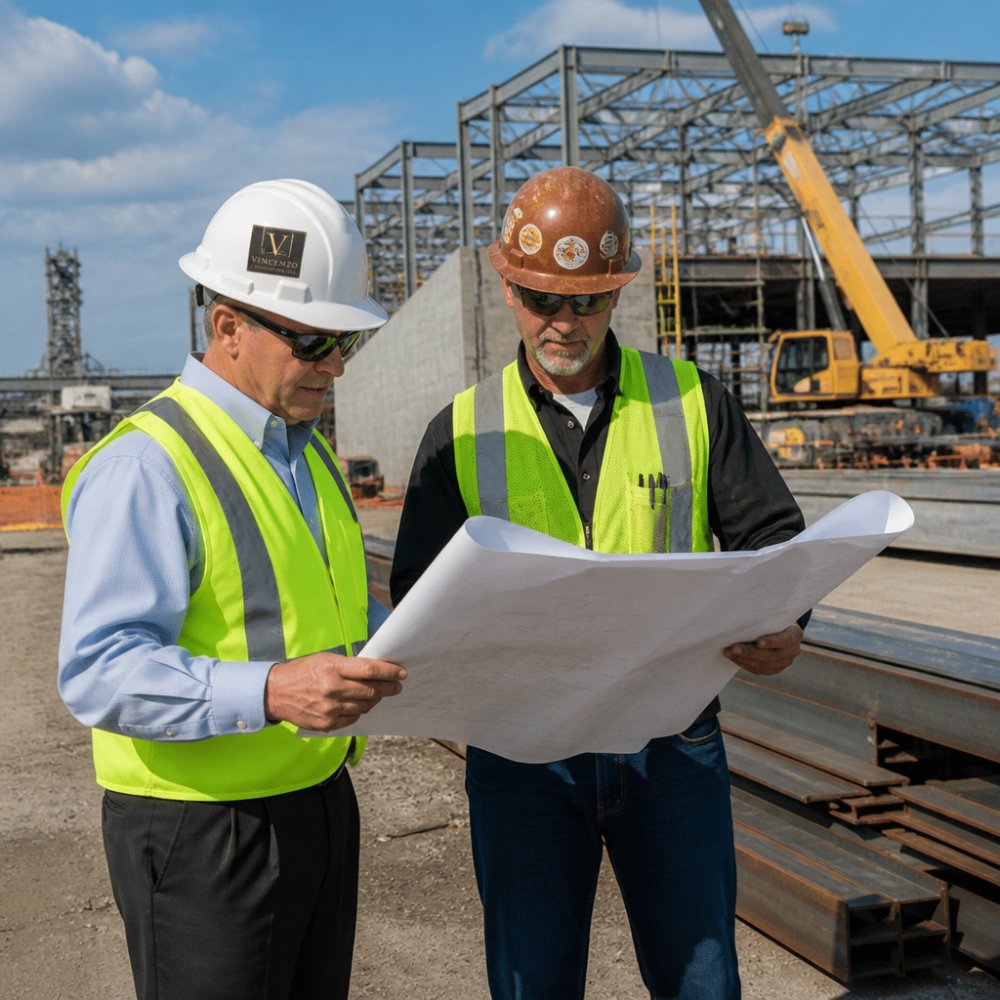
The controls that matter most:
- Schedule checks: Compare actual progress to the baseline each week
- Cost checks: Track committed and spent dollars against budget
- Quality checks: Inspect work before it gets covered up
- Safety checks: Confirm crews follow site rules and permits
Field safety and regulatory compliance belong in this step, not in a separate report. The Occupational Safety and Health Administration construction standards set the baseline for site safety. Build your checks around them.
When something slips, issue a corrective action with an owner and a due date. Track it to closure.
Step 6: Standardize Construction Project Reporting for Faster Decisions
Construction project reporting is the routine summary of progress, cost, risk, and open issues that goes to the owner and steering group. Standard reports let decision-makers compare weeks and spot trends. On industrial work, though, a report is only useful if it carries numbers a reader can act on, not a narrative of what happened.
Most competitors stop at "send a weekly report." The practical gap is the dashboard behind it: which metrics, what thresholds, and who gets called when a line is crossed.
Build the Oversight Dashboard Around Five Metrics
Pick a small set of measures and keep them stable so week-over-week comparison is possible. A common industrial set:
| Metric | What It Measures | Typical Review Cadence |
|---|---|---|
| Schedule performance | Earned progress vs. planned progress | Weekly |
| Cost performance | Committed + spent vs. authorized budget | Weekly, reported monthly |
| Open RFIs and submittals | Design and approval backlog | Weekly |
| Open corrective actions | Field issues past their due date | Weekly |
| Safety observations | Leading indicators, not just recordables | Weekly |
Earned value is the backbone. If you track only spend, a project can look on budget while running weeks behind. Pair cost with progress so the two numbers are read together.
Set Thresholds and Escalation Triggers Before You Need Them
A dashboard without thresholds is decoration. Agree on triggers at kickoff so no one has to negotiate in the moment:
- Schedule slip beyond a defined window on a critical-path activity escalates to the project manager the same day.
- Cost variance beyond the contingency draw limit for a work package escalates to the steering group at the next scheduled review.
- Any open corrective action past its due date appears at the top of the report until it closes.
- Any safety observation involving a permit or a live utility stops work and is reported immediately, not weekly.
Set the numbers to match the project's risk tolerance. A brownfield tie-in carries tighter triggers than a greenfield site build.
Keep the Report Short and the Cadence Predictable
A one-page format beats a fifty-page one nobody reads. Include progress against milestones, spend against budget, the top open risks and issues, and the decisions needed from the owner. Send it on the same day each week so the steering group can plan around it.
Predictable reporting builds trust and speeds up approvals. When the owner already knows the numbers, the meeting is about decisions instead of discovery.
Vincenzo Consulting, LLC builds these dashboards as part of its owner's representation engagements. Learn more at Vincenzo Consulting, LLC or reach the team at info@vincenzoconsulting.com.
Step 7: Manage Commissioning, Handover, and Post-Project Evaluation
Commissioning, startup, and handover are where industrial projects most often stumble. Systems get tested in a rush, documents go missing, and the owner inherits problems the contractor walks away from. The fix is to treat commissioning as a phase with its own plan, budget, and schedule, not as the last two weeks of construction.
Plan Commissioning Before the Work Is Finished
Commissioning starts on paper, months before startup. The sequence that works on most industrial projects:
- Pre-commissioning checks, verify each component is installed per design, aligned, lubricated, and electrically safe before any energy is applied.
- Cold commissioning, run equipment and controls without process fluids or product to confirm logic, interlocks, and rotation.
- Hot commissioning, introduce process fluids, product, or load and verify performance against design intent.
- Performance testing, run the system at rated capacity long enough to prove it holds, and record the results.
Each step needs a written test procedure, an acceptance criterion, and a sign-off. If the criterion is not written down, the test is an opinion.
Control the Handover Package
The closeout package is what the owner lives with for the next twenty years. Assemble it as the project runs, not in the final month. A complete industrial handover package typically includes:
- As-built drawings and updated P&IDs
- Equipment manuals, spare parts lists, and warranties
- Commissioning and performance test records
- Operator and maintenance training records
- Permit and regulatory closeout documentation
- A punch list with every item closed or formally accepted
Track the package on the same dashboard as the rest of the project. An incomplete handover is an open item, not a courtesy.
Transition to Operations Without a Gap
Handover is not a date; it is a transfer of responsibility. Define in writing when the owner's operators take control, who staffs the system during the first runs, and who responds if something fails in the first ninety days. A common pattern is a defined reliability period after startup, during which the contractor remains responsible for defects that surface under normal operation.
Train operators on the actual system, not a slide deck. Walk them through startup, shutdown, and the two or three failure modes most likely on this equipment.
Run the Post-Project Review
After handover, compare final cost and schedule to the baseline and record what you would do differently. Feed the findings back into the oversight checklist from Step 3 so the next project starts smarter. The review is short, a half day with the core team, but it is the only step that compounds.
Vincenzo Consulting, LLC supports owners through commissioning and handover as part of its construction oversight practice. Visit Vincenzo Consulting, LLC or email info@vincenzoconsulting.com to discuss your project.
Why Industrial Project Oversight Fails Without an Owner's Advocate
Oversight fails when nobody in the room works only for the owner. Contractors answer to their own margins. Designers answer to their own scope.
An owner's advocate tracks scope, budget, and schedule daily, and has the authority to challenge a change before it becomes a cost. That is the role Vincenzo Consulting, LLC fills for owners and investors. Led by Paul V.
The seven steps above only work when someone owns them. Industrial project oversight is not a report you file. It is a discipline you keep, from the first objective to the final walkthrough.
Frequently Asked Questions
What should an industrial project oversight plan include?
A working oversight plan covers project objectives and success criteria, governance and decision rights, a construction project oversight checklist tied to the baseline schedule and budget, a risk register with named owners, field inspection cadence, reporting format, and a commissioning and handover protocol. Each element should name who is accountable, what gets measured, and how often. Vincenzo Consulting, LLC builds these plans around the owner's specific capital objectives, so oversight stays tied to outcomes rather than activity.
How do you maintain accountability on a construction project?
Accountability comes from structure, not personality. Assign one owner for every deliverable, tie payments to verified milestones, and require corrective action plans when schedule or budget baselines slip. Hold a standing owner's meeting with the general contractor and key trades, and document every decision in writing. When authority is clear and consequences are consistent, contractors self-correct before small issues become change orders. Disciplined accountability throughout the project lifecycle is a core part of how Vincenzo Consulting, LLC protects owner interests.
What project controls help identify schedule and budget risks early?
Earned value analysis, three-week look-ahead schedules, cost-to-complete forecasts, and a live risk register are the controls that surface trouble first. Compare actual progress against the baseline weekly, not monthly, and flag any variance beyond a threshold you set at kickoff. Pair those numbers with field walks so reporting reflects what is actually happening on site. Early signals let owners authorize corrective action while options are still cheap, which is central to effective industrial project oversight.
How can owners control scope changes on an industrial project?
Require every change to pass through a written request, a cost and schedule impact review, and an owner sign-off before work begins. Track cumulative change value against the original budget so patterns become visible. Interface management matters too: on industrial sites, changes in one system often cascade into others, so review impacts across disciplines before approval. A firm change-control process, enforced by an owner's representative, is one of the fastest ways to protect both budget and schedule.