 how-to
7 Ways an Owner Representative Manages Construction Risk
Last Updated: October 30, 2026
Quick Summary
An owner representative manages construction risk by running a preconstruction risk assessment, maintaining a phase-based risk register with named owners and escalation triggers, quantifying cost and schedule exposure, controlling change orders, allocating risk in contracts and insurance, and reporting on a fixed cadence so decisions reach you on time.
- A construction project risk assessment scores what could go wrong by likelihood and impact before groundbreaking.
- Every register row carries a named owner, likelihood and impact score, mitigation action, trigger indicator, and status.
- Quantitative risk analysis sizes contingency to modeled exposure instead of a round percentage.
- No verbal direction: every scope change needs written notice, independent price review, and documented owner approval.
- Each progress report names the decisions the owner must make and the date each is needed.
Table of Contents
- Why Construction Risk Slips Past Owners Without Representation
- Step 1: Run a Construction Project Risk Assessment Before Groundbreaking
- Step 2: Build a Construction Risk Management Plan the Whole Team Signs
- Step 3: Populate a Construction Risk Register Template by Project Phase
- Step 4: Control Budget and Schedule With Quantitative Risk Analysis
- Step 5: Tighten Construction Change Order Management Before Costs Land
- Step 6: Allocate Risk in Contracts, Insurance, and Authority Limits
- Step 7: Report Progress and Escalate Decisions on a Fixed Cadence
- What Owners Should Take Away
- Frequently Asked Questions
Why Construction Risk Slips Past Owners Without Representation
Most construction losses start in a decision nobody logged, a clause nobody read, and a meeting where no one spoke only for the owner.
Across the industry, risk rarely announces itself.
A general contractor's project manager protects the contractor's margin, schedule, and interests. That is their job, and they do it well.
Without that role, the result is predictable: cost overruns, schedule impacts, and construction challenges that surface too late to fix cheaply.
Step 1: Run a Construction Project Risk Assessment Before Groundbreaking
A construction project risk assessment is a structured review of what could go wrong on a specific project, scored by likelihood and impact, completed before construction begins.
Most owners treat preconstruction as a design exercise. It is a risk exercise.
A practical assessment covers:
- Site and environmental conditions, including soils, drainage, and access
- Design completeness, flagging gaps that will return as change orders
- Permitting and entitlement risk, with realistic approval timelines
A useful assessment brings the design team and contractor into the same room rather than working in isolation. For a deeper look, see how construction project risks are managed through oversight.
Step 2: Build a Construction Risk Management Plan the Whole Team Signs
A construction risk management plan is the written agreement on how risks will be identified, tracked, owned, and resolved throughout the project. It turns the assessment into an operating system.
The plan does not need to be long, but it must be specific. At minimum, it should define:
- Who owns each risk by name, not by department
- How risks get logged and updated, and on what cadence
- What triggers escalation to the owner and how fast
The signing matters. When contractor, design team, and owner acknowledge the same risk list, accountability becomes structural instead of personal.
Watch out: plans that live only in a shared drive and never get reviewed in a meeting are decoration. Our companion guide on mitigating risks in commercial construction walks through keeping the plan active through each phase.
Step 3: Populate a Construction Risk Register Template by Project Phase
A construction risk register template is a simple table that lists each identified risk with its owner, likelihood, impact, mitigation action, and status. The template is easy.
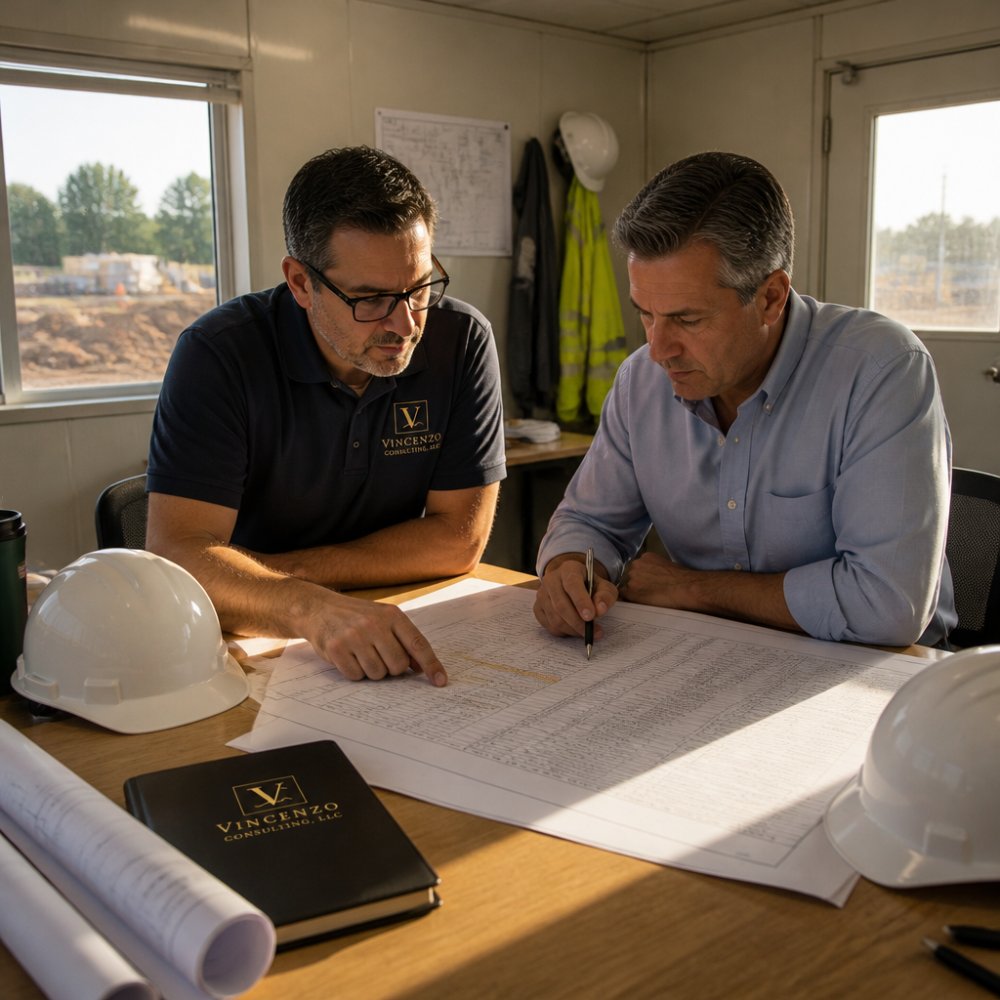
Phase-based population keeps the register honest, because the risk profile changes as the project moves. Preconstruction risks concern design and approvals; construction phase risks concern coordination, sequencing, and delays; closeout risks concern documentation, punch lists, and warranty handoff.
What Belongs in Each Register Row
Every row should carry the same fields so the register stays comparable across phases:
| Field | What It Captures | Example Entry |
|---|---|---|
| Risk ID and phase | Where the risk sits in the project | Preconstruction, utility capacity |
| Description | The specific event, not a category | Delayed power service tie-in |
| Owner | One named person accountable | MEP engineer |
| Likelihood and impact | Scored low, medium, or high | Medium likelihood, high impact |
| Mitigation action | The specific step being taken | Early utility application filed |
| Trigger indicator | What signals the risk is activating | Utility response slipping past target |
| Status | Open, monitored, closed, or realized | Monitored |
Scoring Rules That Keep the Register Honest
A register without scoring rules becomes a wish list. A simple probability-impact matrix helps every row get a consistent score, so the team can see which risks deserve attention first.
- Likelihood: Low (unlikely within the phase), Medium (possible), High (likely or already trending).
- Impact: Low (minor cost or schedule effect), Medium (noticeable but recoverable), High (threatens a milestone or contingency).
- Score: Combine the two into a priority band, Low/Low through High/High. High/High rows get a named owner, a trigger, and a response playbook before the phase starts.
Registers are best reviewed at every phase gate, with open rows re-scored. A risk that was Medium/Medium in preconstruction can become High/High once construction starts and the schedule tightens.
Phase-by-Phase Register Entries
Below is a worked example of how the register evolves. These are illustrative entries, not project-specific data.
Preconstruction phase
- Risk: Geotechnical findings require a foundation redesign. Owner: Structural engineer. Score: Medium likelihood, High impact. Mitigation: Early borings and a design contingency. Trigger: Borings differ from preliminary assumptions. Response: Convene a design review within five business days and price the redesign before permit submission.
- Risk: Permit approval slips past the target date. Owner: Permit expediter. Score: Medium/High. Mitigation: Pre-application meeting and a complete submittal package. Trigger: Agency requests additional information. Response: Assign a dedicated response owner and set a 48-hour turnaround on agency comments.
Construction phase
- Risk: Long-lead mechanical equipment arrives late. Owner: Procurement lead. Score: High/High. Mitigation: Early release package and alternate supplier pre-qualified. Trigger: Lead time extends beyond the approved procurement schedule. Response: Evaluate the alternate supplier and resequence dependent work within one week.
- Risk: Submittal log falls behind. Owner: Contractor's project manager. Score: Medium/Medium. Mitigation: Weekly submittal review. Trigger: More than a set number of submittals past due. Response: Escalate in the next weekly meeting and require a recovery schedule.
Closeout phase
- Risk: Punch list items remain open past substantial completion. Owner: Superintendent. Score: Medium/Medium. Mitigation: Pre-punch walk and a closeout tracker. Trigger: Open items exceed the agreed threshold at the walk. Response: Hold a dedicated punch-list blitz and tie final payment to completion.
- Risk: Warranty documentation is incomplete at handoff. Owner: Owner representative. Score: Low/Medium. Mitigation: Documentation checklist issued at 90% completion. Trigger: Missing O&M manuals or warranties at the pre-handoff review. Response: Delay final acceptance until the package is complete.
Escalation Triggers and Response Playbooks
The register earns its keep when each high-impact row carries a trigger and a response. An early-warning indicator is the observable signal that a risk is starting to happen.
Examples we build into registers:
- Indicator: contractor's submittal log falls behind schedule. Response: escalate in the next weekly meeting and require a recovery schedule within a set number of days.
- Indicator: RFI volume spikes in one trade. Response: review design documents for that scope before the next draw request.
- Indicator: long-lead equipment lead time extends. Response: evaluate alternate suppliers or resequence dependent work.
Pre-agreeing the response removes the delay that kills projects: the two weeks spent deciding who is allowed to react. The register is a living tool, reviewed at every phase gate and updated as triggers appear.
Step 4: Control Budget and Schedule With Quantitative Risk Analysis
Quantitative risk analysis assigns a range of cost and time outcomes to identified risks, so the owner sees a probable range instead of a single hopeful number.
Most project budgets are built as one number. That number is almost always optimistic, because it assumes nothing goes wrong.
In practice, this is typically done with three inputs:
- A base estimate and base schedule from the contractor
- Risk ranges attached to the highest-impact register rows
- A contingency figure sized to cover the modeled exposure, not a round percentage
That contingency number is where discipline pays off. For a deeper method, see how to audit construction project budgets.
Step 5: Tighten Construction Change Order Management Before Costs Land
Construction change order management is the controlled process for reviewing, pricing, and approving scope changes before they affect cost or schedule.
Change orders are where scope creep becomes real money. The pattern is familiar: a verbal direction on site, work performed, and a price presented weeks later with no comparison point.
A disciplined process closes that gap:
- No verbal direction. Any scope change requires written notice and a change order request.
- Independent review. We check the proposed price against the contract's unit rates and the original scope.
- Schedule impact stated. Every change order names its effect on the critical path, not just its cost.
- Documented approval. No work proceeds without written owner authorization.
When general contractor accountability gets murky, change orders are usually the symptom. Our guide on managing general contractor accountability issues covers how to keep that relationship structured.
Step 6: Allocate Risk in Contracts, Insurance, and Authority Limits
Risk allocation is the quietest lever in the entire project. Contract negotiation decides who pays when something goes wrong, long before anything does. An owner representative's job here is not to replace legal counsel but to make sure the owner understands where risk sits and whether the contract matches the project's actual exposure.
Risk Allocation in Contract Clauses
Every construction contract assigns risk, whether the parties discuss it or not. The owner representative reviews the key clauses and flags where responsibility may not match intent.
- Indemnity and liability clauses determine who absorbs third-party claims. Watch for broad-form indemnity language that shifts more risk to the owner than the project warrants, and confirm the clause is enforceable under state law.
- Limitation of liability provisions cap a party's exposure. Check whether the cap is proportionate to the contract value and whether it leaves the owner carrying risks the contractor is better positioned to manage.
- Delay and time-extension provisions set how schedule risk is shared. Confirm what qualifies as a compensable versus non-compensable delay, and whether the contractor is entitled to overhead and profit on time extensions.
Owners often accept contract language because it looks standard. A useful owner representative asks the question the owner did not know to ask: if this risk materializes, who pays, and is that the right party to carry it?
Insurance Requirements That Match Project Scale
Insurance is the financial backstop for allocated risk. The owner representative reviews the insurance requirements alongside the contract terms so coverage and liability align.
- Builder's risk insurance should cover the project during construction, including materials stored off-site and any existing structures being renovated.
- General liability and umbrella coverage limits should be proportionate to the project size and the owner's exposure.
- Professional liability coverage for the design team protects against design errors that surface later.
An owner representative does not interpret policy language or provide legal advice. The role is to confirm that insurance requirements are specific, that certificates are collected and tracked, and that the owner's counsel and broker review anything unusual.
Authority Limits and Decision Rights
Then there is the question owners ask us most often: what authority does the representative actually have? Authority must be defined in writing, not assumed. A clear authority limit schedule states which decisions the representative can make alone, which require owner approval, and which require written sign-off from both.
A practical authority schedule covers:
- Routine field decisions the representative can approve without owner involvement, with a dollar threshold.
- Change orders above a set amount that require owner approval before work proceeds.
- Schedule adjustments that affect the critical path or a milestone.
How Owner Representation Differs From Construction Management
Owners sometimes confuse owner representation with construction management. The distinction matters for risk allocation because the two roles sit on different sides of the table.
- Owner representation is an advocate for the owner. The representative reviews the contractor's work, challenges cost and schedule claims, and reports to the owner. The role is advisory and oversight-focused.
- Construction management is often a delivery method in which the construction manager holds trade contracts and carries responsibility for means and methods. The construction manager may work for the owner, but the role is operational rather than advocacy-focused.
- Design professionals carry professional liability for design and typically do not manage construction risk.
An owner representative clarifies these boundaries in writing so that when a risk materializes, the team knows which party owns the response.
An owner representative should also disclose any conflicts of interest, financial relationships with contractors, designers, or suppliers, and confirm that the engagement letter defines reporting lines, decision rights, and scope of authority.
Step 7: Report Progress and Escalate Decisions on a Fixed Cadence
Progress reporting is only useful if it drives decisions. A report that arrives monthly, describes what already happened, and triggers no action is a receipt, not a management tool.
Reporting on a fixed cadence with a fixed format lets the owner always know where the project stands against budget, schedule, and quality. Each report covers:
- Cost position against the approved budget and contingency status
- Schedule position against milestones, with float and critical path noted
- Open risks from the register, with status changes flagged
The escalation piece is what makes it work.
This is also where the owner representative's role becomes visible to the whole project team. For the full scope of duties, see owner representative responsibilities on commercial projects.
What Owners Should Take Away
Risk on a construction project is not managed by working harder or meeting more often.
The seven methods above form one system: assess early, plan in writing, register by phase, quantify the exposure, control changes, allocate risk in contracts, and report on a fixed cadence. Skip any one and the others weaken.
Vincenzo Consulting, LLC provides discreet owner's representation built on that system, with executive leadership experience across luxury residential, commercial, and infrastructure work.
Vincenzo Consulting, LLC Website: vincenzoconsultingllc.com Email: info@vincenzoconsultingllc.com
Frequently Asked Questions
What does an owner's representative do to manage construction risk?
An owner's representative owns the risk process from preconstruction through closeout. That means running the construction project risk assessment, maintaining the risk register, reviewing change orders before they are approved, and reporting exposure to the owner on a fixed schedule. The rep does not replace the general contractor's safety or quality staff. The rep sits on the owner's side of the table, so cost overruns and schedule impacts get caught while there is still room to respond rather than after the invoice arrives.
What are the most common risks in a construction project?
The recurring ones are scope gaps in the design documents, owner-driven changes after construction starts, contractor cash flow or performance problems, long-lead material delays, permitting and environmental review hold-ups, and unclear contract language on who carries which risk. On luxury residential and complex commercial work, add site conditions, custom fabrication lead times, and coordination between design team and trades. A construction risk register template should list these by phase so each one has a named owner and a response before it becomes a claim.
How does an owner's representative help prevent cost overruns?
Three levers do most of the work. First, a contingency held and released by the owner, not folded into the contractor's bid. Second, change order management that requires written justification, pricing review, and schedule impact analysis before approval. Third, quantitative cost risk analysis that models the range of outcomes rather than a single number. When the representative has authority to reject unsupported change orders and escalate to the owner, cost control becomes a process instead of a negotiation at the end of the job.
When should an owner hire an owner's representative?
Before the design team is fully locked and well before construction starts. The highest-value work happens in preconstruction: reviewing contracts, setting the risk management plan, and building the register while changes are still cheap. Hiring at groundbreaking means the biggest risks are already allocated in documents the owner has signed. For first-time custom builders and family offices new to construction, bringing the representative in at site selection or schematic design avoids the costliest mistakes entirely.