 ultimate-guide
Owner Representative Responsibilities: Duties on Commercial Projects
Last Updated: October 27, 2026
Quick Summary
Owner representative responsibilities include acting as the owner's advocate from planning through closeout, protecting the owner's vision, budget, and schedule. The representative leads planning, design review, procurement, construction monitoring, and closeout, and reports to the owner so that the owner, not the project team, decides what gets built and what it costs.
- Ask your owner's representative to produce the responsibility matrix within the first 30 days.
- Tasks without a named lead and a named approver tend to fall through the gap between designer and contractor.
- Confirm in the engagement agreement which decisions the representative can make and which require the owner's signature.
- Request monthly progress, budget, change order, risk, and decision reports in a consistent format from the first month.
- Schedule 30-, 90-, and 365-day walkthroughs to document warranty items while the contractor's obligation is still active.
Table of Contents
- What an Owner Representative Does on a Commercial Project
- Owner's Representative Duties Across the Project Lifecycle
- Owner's Representative vs Construction Manager: Where the Authority Lines Fall
- Budget, Schedule, and Risk: How Responsibilities Protect the Owner
- Project Reporting Responsibilities and Sample Deliverables
- Contracts, Liability, and Closeout Responsibilities
- Deciding Whether to Engage an Owner Representative for Your Next Project
- Frequently Asked Questions
What an Owner Representative Does on a Commercial Project
An owner representative is the advocate who sits on the owner's side of a commercial construction project and protects the owner's vision, budget, and schedule from the first planning meeting through closeout.
Commercial projects involve many parties with competing incentives. Designers want design freedom, contractors want margin, and lenders want predictable returns. The owner representative's job is to keep the owner's interests visible in every decision and to make sure the owner, not the team, decides what gets built and what it costs.
Owner representation is the practice of managing a construction project on the owner's behalf, through planning, design review, budget and schedule control, and reporting. Readers can see how a specialized luxury estate oversight service is structured in practice. Because this role sits between the owner and a team of specialists, it works best when defined in writing from the start.
Owner's Representative Duties Across the Project Lifecycle
| Phase | Task | Owner | Owner's Rep | Design Team | Contractor |
|---|---|---|---|---|---|
| Planning | Confirm program, budget ceiling, and decision rights | Approves | Leads | Advises | , |
| Planning | Select design team and procurement approach | Approves | Leads | Advises | , |
| Planning | Build milestone schedule tied to financing and occupancy | Approves | Leads | Advises | , |
| Design | Review design development against approved program | Advises | Leads | Executes | , |
| Design | Cost checks at each design milestone | Approves | Leads | Advises | , |
| Design | Coordinate owner, architect, engineers, consultants | , | Leads | Executes | , |
| Procurement | Pre-qualify contractors and issue bid documents | Approves | Leads | Advises | Executes |
| Procurement | Evaluate bids and recommend award | Approves | Leads | Advises | , |
| Construction | Monitor progress against schedule and quality standards | , | Leads | Advises | Executes |
| Construction | Review pay applications against schedule of values | Approves | Leads | , | Executes |
| Construction | Evaluate change orders for necessity, price, and time | Approves | Leads | Advises | Executes |
| Construction | Maintain risk register and update at progress meetings | , | Leads | Advises | Advises |
| Closeout | Verify punch list completion and acceptance | Approves | Leads | Advises | Executes |
| Closeout | Collect warranties, O&M manuals, as-builts | , | Leads | Advises | Executes |
| Closeout | Confirm final pay applications and lien waivers | Approves | Leads | , | Executes |
| Closeout | Coordinate owner facilities staff training | , | Leads | Advises | Executes |
Preconstruction and Planning Responsibilities
A common mistake is treating planning as paperwork. Owners who skip a clear written scope at this stage often discover the gap later as a disputed change order.
Design Review and Team Coordination
The thing most owners miss is that design decisions made for aesthetics often carry large cost consequences. An owner representative who flags those tradeoffs early gives the owner a choice instead of a surprise.
Construction Oversight and Progress Monitoring
Core construction-phase duties include:
- Attending progress meetings and documenting commitments and owners
- Verifying work in place before recommending pay application approval
- Tracking the critical path and flagging delays early enough to recover them
- Maintaining the risk register and updating it at every progress meeting
Closeout and Turnover Responsibilities
Post-occupancy follow-up is worth budgeting for as well. Reviewing warranty claims in the first year helps the owner hold contractors accountable and captures lessons for the next project.
Owner's Representative vs Construction Manager: Where the Authority Lines Fall
Keeping these roles distinct avoids conflicts of interest. For a deeper breakdown of how oversight differs from project management, see our comparison. When one party both manages the work and reports on its quality to the owner, the owner loses an independent check. Owners should confirm in the engagement agreement exactly which decisions the representative can make and which require the owner's signature. Readers weighing this step can follow a step-by-step guide to selecting construction oversight.
Budget, Schedule, and Risk: How Responsibilities Protect the Owner
Risk management sits alongside these duties. A risk register that names specific exposures, such as permitting delays, unforeseen site conditions, or long-lead equipment, gives the owner a basis for contingency decisions. Owners should expect their representative to update that register at every progress meeting, not only when problems appear. Before committing, readers can review infrastructure development consulting pricing to understand typical costs.
Project Reporting Responsibilities and Sample Deliverables
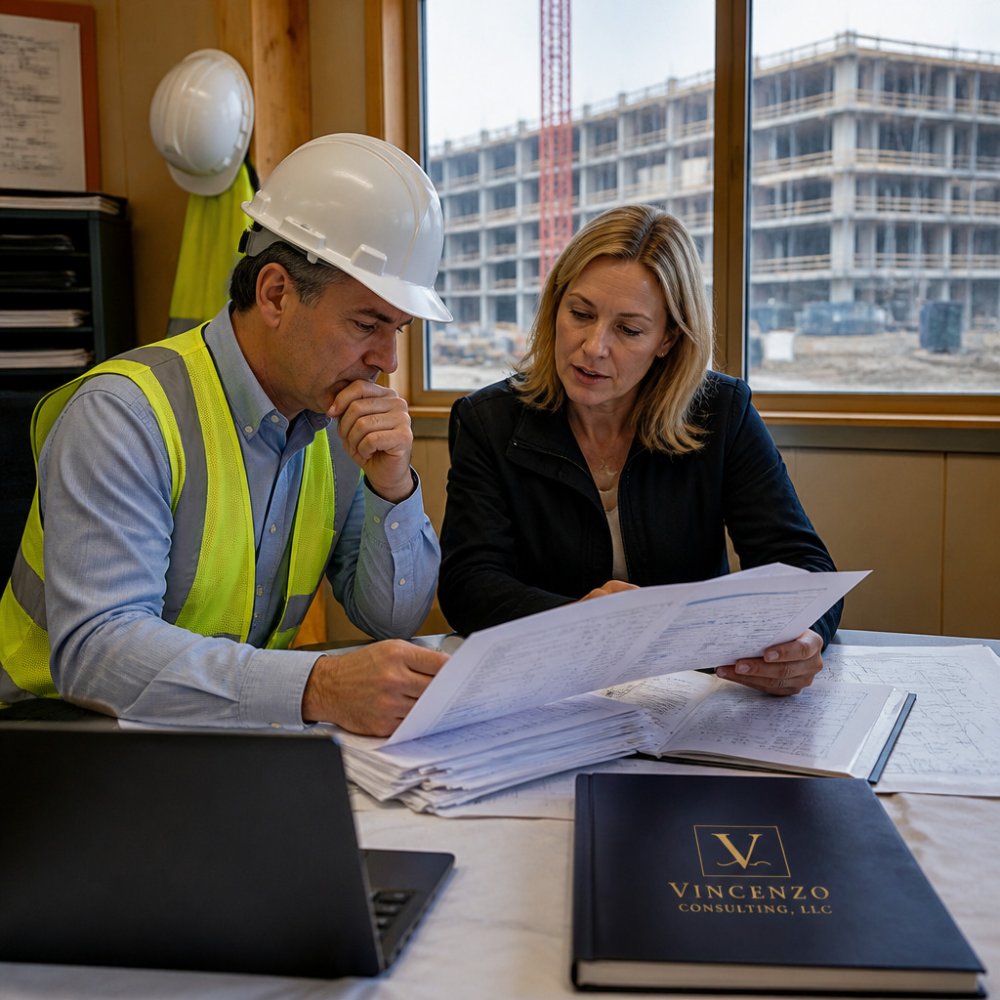
Reporting is how the owner representative turns observation into decisions. A good report tells the owner what has changed, what it costs, what it does to the schedule, and what the owner needs to decide.
Typical deliverables include:
- Monthly progress report: percent complete, schedule status, and key milestones reached or missed
- Budget report: original budget, approved changes, committed cost, and forecast at completion
- Change order log: each proposed change with cost, time impact, and approval status
- Risk register: open risks, likelihood, potential impact, and the mitigation owner
- Decision log: every owner decision requested, with its due date and the consequence of delay
Owners should ask for these documents in a consistent format from the first month. Consistent reporting lets the owner spot trends, such as a steadily growing contingency draw, that a single report might hide.
Contracts, Liability, and Closeout Responsibilities
The owner representative's contractual role should be defined in the owner's agreement, including the scope of services, the authority delegated, and the standard of care expected. Clear contract language protects both the owner and the representative from disputes about who was responsible for a decision.
Authority Boundaries: What the Representative Can and Cannot Do
An owner representative generally advises, reviews, and reports. The representative holds decision rights only where the owner has delegated them in writing. In practice, that means the representative can typically:
- Recommend approval or rejection of pay applications and change orders
- Direct the design team and contractor to produce information or correct documentation
- Convene meetings, set agendas, and require reporting in a consistent format
- Escalate decisions to the owner with a written recommendation
What the representative typically cannot do without explicit delegation:
- Approve changes that increase the guaranteed maximum price or contract sum
- Direct means and methods of construction, which remain with the contractor
- Stamp or seal design documents, which require a licensed architect or engineer
- Bind the owner to a contract or settle a claim
Liability and Standard of Care
Owners should confirm in the agreement:
- The scope of services and any exclusions
- The authority delegated and the limits on that authority
- The standard of care and any limitation of liability
- Insurance requirements, including professional liability coverage
- How disputes between the owner and the representative will be resolved
Closeout Responsibilities
Closeout is often the most neglected phase. The owner representative typically manages:
- Verifying that punch list items are complete and accepted
- Collecting warranties, operation and maintenance manuals, and as-built drawings
- Confirming final pay applications and lien waivers before final payment
- Coordinating training for the owner's facilities staff
- Confirming commissioning results and that systems operate as designed
Post-Occupancy Follow-Up
Post-occupancy follow-up is worth budgeting for as well. Reviewing warranty claims in the first year helps the owner hold contractors accountable and captures lessons for the next project. A common pattern is a 30-, 90-, and 365-day walkthrough with the contractor to document warranty items while the contractor's obligation is still active.
Deciding Whether to Engage an Owner Representative for Your Next Project
Vincenzo Consulting, LLC provides discreet owner's representation and construction oversight for ultra-luxury residential, complex commercial, and infrastructure projects. If your next commercial project needs an advocate who keeps your vision, budget, and schedule aligned, contact us at the email address and website below.
Frequently Asked Questions
What does an owner's representative do in commercial construction?
An owner's representative acts as the property owner's advocate throughout a commercial project. The role covers reviewing the scope of work, monitoring the project budget and schedule, coordinating the design team, contractors, and consultants, and reporting progress to the owner. The representative does not replace the general contractor or architect. Instead, they check that the work matches what the owner approved and flag problems early, when changes are still inexpensive to make.
What are the main responsibilities of an owner's representative?
Core responsibilities include preconstruction planning, design review, contractor selection support, budget development and cost control, schedule tracking, change order review, pay application review, and quality oversight. Owner's representatives also manage communication among stakeholders and maintain documentation. The exact scope depends on the contract, so the owner should define responsibilities and decision authority in writing before work begins.
How does an owner's representative help manage construction risks?
An owner's representative helps identify risks during planning, such as design gaps, unrealistic schedules, and contractor qualification issues. They then track those risks through construction using a risk register, reviewing change orders and schedule impacts as they arise. Early identification and documented decisions give the owner options before problems become expensive delays or disputes.
When should a commercial property owner hire an owner's representative?
Owners commonly consider an owner's representative when a project is large, complex, or involves multiple stakeholders, or when the owner lacks in-house construction staff. Hiring during preconstruction, before design is finalized, usually gives the representative the most influence over budget and schedule. Fees depend on project scope and engagement structure, so owners should request a proposal tailored to their project.