 ultimate-guide
The Role of Project Controls in Large Scale Construction
Last Updated: October 29, 2026
Quick Summary
Project controls are the discipline that keeps a large construction project on track by measuring scope, cost, and schedule against an approved baseline. They give owners an independent view of spending, progress, and forecast completion, so problems can be corrected early. Earned value management ties cost and schedule together into a single performance picture.
- Project controls track scope, cost, and schedule against a locked baseline from start to finish.
- Project controls give owners an independent view separate from the contractor's own reporting.
- Earned value management compares planned value, earned value, and actual cost to show true performance.
- A cost performance index below 1.0 signals spending that exceeds the value of work completed.
- Clear escalation thresholds defined before construction ensure problems reach decision-makers quickly.
Table of Contents
- What Project Controls Means for Large Construction Projects
- Project Controls Versus Project Management
- Building the Project Controls Plan and Baseline
- Cost and Schedule Control Through Earned Value Management
- Risk, Change Orders, and Reporting in Construction Project Controls
- Software and Data Tools That Support Project Controls
- Putting Project Controls to Work on Your Next Project
- Frequently Asked Questions
Project controls are the discipline that keeps a large construction project honest. They track what is being spent, what is being built, when it will be finished, and what risks could push any of those numbers off course. For owners and developers putting significant capital into a build, project controls are often the difference between a project that lands close to plan and one that drifts into overruns and disputes.
What Project Controls Means for Large Construction Projects
Project controls is the set of processes that plan, monitor, and manage a project's scope, cost, and schedule from start to finish.
The core work includes establishing a baseline, collecting actual progress and cost data, comparing that data against the plan, and forecasting where the project is headed.
Many owners assume that a general contractor's reports tell them everything they need. In practice, contractor reporting is usually designed around the contractor's own performance.
Project Controls Versus Project Management
Project management and project controls are related but distinct. Project management directs the work: it coordinates crews, sequences tasks, and solves problems as they arise.
A useful way to separate them: the project manager asks, "What do we do next?" The project controls function asks, "Are we still on plan, and what will it cost us if we are not?"
Both functions matter on a large build, and they should check each other. When controls data reveals a schedule slip, the project manager responds.
Building the Project Controls Plan and Baseline
A project controls plan defines how the work will be measured before construction starts.
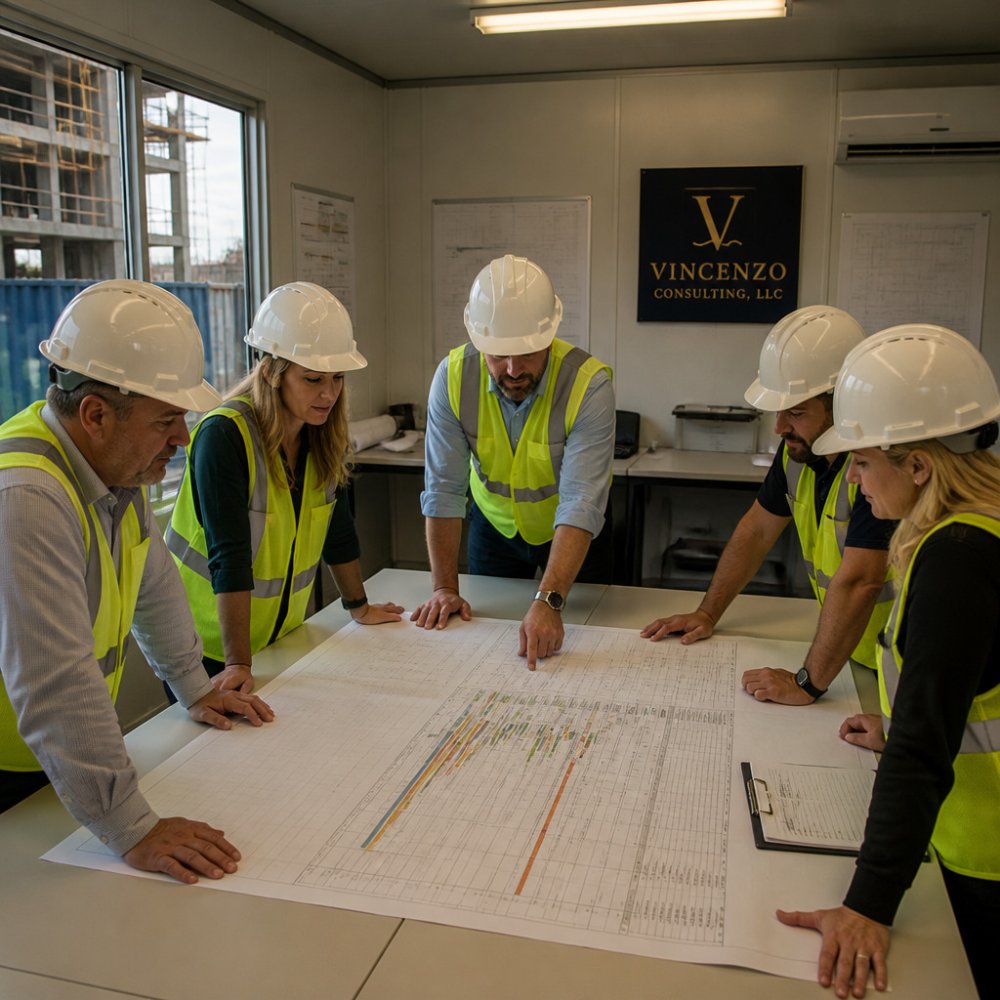
The baseline is the approved plan the project will be measured against: the budget, the schedule, and the scope.
Establishing the baseline early is one of the highest-value steps in project controls. A schedule built on unrealistic durations or a budget missing key allowances will generate false alarms or false comfort for the rest of the job.
Cost and Schedule Control Through Earned Value Management
Earned value management (EVM) is the method that ties cost and schedule into a single performance picture. Instead of reading a cost report and a schedule report separately and guessing how they relate, EVM answers one question: for the work actually completed, how much did we plan to spend, how much value did we earn, and what did we actually spend?
The three core measures are:
- Planned value (PV): the budgeted cost of work scheduled to be done by a given date.
- Earned value (EV): the budgeted cost of work actually completed.
- Actual cost (AC): what was actually spent to complete that work.
From these, the controls team calculates the variances and indices that drive every owner conversation:
- Cost variance (CV) = EV − AC. A negative CV means the project is spending more than the value it has produced.
- Schedule variance (SV) = EV − PV. A negative SV means the project has earned less value than planned for that date.
- Cost performance index (CPI) = EV ÷ AC. A CPI below 1.0 signals cost inefficiency.
Forecast at Completion: Where EVM Pays Off for Owners
The variances tell you where you are. The forecast tells you where you are going. The estimate at completion (EAC) projects final cost based on current performance. The most common formula is EAC = BAC ÷ CPI, where BAC is the budget at completion.
The estimate to complete (ETC) is the remaining work: ETC = EAC − AC. The variance at completion (VAC) is VAC = BAC − EAC; a negative VAC is the projected overrun.
A Worked Example
Suppose a package has a BAC of $10,000,000. At the reporting date, the plan called for $4,000,000 of work (PV), the team has completed work worth $3,600,000 (EV), and $3,900,000 has been spent (AC).
- CV = $3,600,000 − $3,900,000 = −$300,000 (over budget on earned work)
- SV = $3,600,000 − $4,000,000 = −$400,000 (behind plan)
- CPI = 3,600,000 ÷ 3,900,000 ≈ 0.923
That single table tells the owner three things at once: the package is behind, it is spending faster than it is earning, and the current trend points to an overrun of roughly $834,000 if nothing changes. A cost report alone would show only the spend; a schedule report alone would show only the delay. EVM shows the relationship between them.
Reading the Indices Together
A project can be over budget and ahead of schedule, or under budget and behind. Reading CPI and SPI together prevents the most common owner mistake: treating a favorable cost number as good news when it is really the result of work not yet performed.
For large projects with many packages, EVM is applied at the package level and rolled up.
The article's core EVM measures and indices, summarised for quick reference:
| Measure | Formula | What it signals |
|---|---|---|
| Planned value (PV) | Budgeted cost of work scheduled | Work the plan expects done by a date |
| Earned value (EV) | Budgeted cost of work completed | Value actually produced |
| Actual cost (AC) | Money actually spent | Real spend to date |
| Cost variance (CV) | EV − AC | Negative means overspending on earned work |
| Schedule variance (SV) | EV − PV | Negative means behind plan |
| Cost performance index (CPI) | EV ÷ AC | Below 1.0 means cost inefficiency |
| Schedule performance index (SPI) | EV ÷ PV | Below 1.0 means schedule slippage |
| Estimate at completion (EAC) | BAC ÷ CPI | Projected final cost |
Risk, Change Orders, and Reporting in Construction Project Controls
On a large project, risk, change, and reporting are not three separate chores. They are one loop: risk becomes change, change becomes cost and schedule variance, variance becomes the report, and the report drives the next risk decision. The controls operating model is what keeps that loop turning across the many parties on a megaproject.
The Large-Project Controls Operating Model
A large build typically has four controls teams that must share one version of the truth:
- Owner controls: sets the baseline, owns the contingency, and reviews performance independently of the contractor.
- Engineer or designer controls: manages design progress, design change, and the interface between design packages.
- General contractor controls: manages construction schedule, cost commitments, subcontractor progress, and field reporting.
Each party produces data. The operating model defines who owns which data, in what format, on what cadence, and, critically, how a problem escalates. A common pattern is a tiered escalation: package-level issues resolve between the contractor and subcontractor; cross-package issues go to a controls review with the owner and engineer; issues that threaten the baseline go to an executive steering group with a documented decision.
Risk Registers That Actually Get Used
A risk register is only useful if it is current. The operating model should assign each risk an owner, a probability, a cost and schedule impact range, and a response. On large projects, the register is reviewed on a fixed cadence with the owner present, and risks that cross a threshold move into the contingency discussion. Quantitative risk analysis, modeling the range of outcomes rather than a single number, is what turns the register into a contingency figure leadership can defend.
Change Control Across Multiple Packages
Change orders are where budgets most often break down, and on a large project the risk multiplies because changes interact. A design change in one package can trigger schedule float loss in another and a claim in a third. Disciplined change control requires every change to be documented, priced, assessed for schedule impact, and approved through a defined authority level before work proceeds.
Reporting That Drives Decisions
Reporting ties the loop together. Effective reports show the baseline, the current forecast, the trend, and the specific decisions needed, in a consistent format and on a consistent cadence so trends are visible rather than buried in changing presentations. The test of a report is whether a leader can read it and know what to decide. A report that shows variance without a recommended action is a status update, not a controls product.
Learn more at Vincenzo Consulting or reach us by email.
Software and Data Tools That Support Project Controls
Project controls depend on reliable data, and the tools used to collect and analyze it matter. Scheduling software manages the critical path and milestones.
The most important technical requirement is integration. When schedule, cost, and progress data live in separate systems that do not talk to each other, the controls team spends its time reconciling spreadsheets instead of analyzing performance.
Tool choice should follow process, not the reverse. Define the controls methodology and reporting needs first, then select software that supports them.
Putting Project Controls to Work on Your Next Project
If you are planning a large build, start by asking three questions before ground is broken. Is there a locked baseline for scope, budget, and schedule? Is there a risk register that someone is responsible for updating? Can you see cost and schedule performance on the same report, updated on a regular cadence?
If the answer to any of these is no, that gap is where overruns tend to begin. Owners who want that independent view often bring in owner's representation to set up and run the controls function on their behalf.
Project controls will not eliminate every problem on a large job. What they do is make problems visible early enough to act on, and that visibility is what protects both the vision and the value of the property.
Frequently Asked Questions
What is project control in project management?
Project controls is the discipline that measures, forecasts, and manages a project's scope, cost, and schedule against an approved baseline. On large construction projects it gives owners early warning when performance drifts, so corrective action can be taken before small variances become major overruns. Its core activities include baseline development, progress measurement, cost and schedule forecasting, change control, and performance reporting. Owners use these outputs to make funding and scope decisions with current, verifiable information rather than estimates alone.
What is the difference between project management and project controls?
Project management directs the work: it coordinates contractors, resources, and daily execution to deliver the project. Project controls measures that work against the plan and reports whether the project is on track. The two functions depend on each other, but they answer different questions. Project management asks how to get the work done, while project controls asks whether the work is producing the cost and schedule results the baseline requires and what it will cost to finish.
What tools are commonly used for construction project controls?
Most large construction programs rely on scheduling software for critical path analysis and resource planning, cost management systems for budgets, commitments, and change orders, and reporting dashboards that combine both. Earned value tools calculate cost and schedule variance from progress data. The most useful setup is one where schedule, cost, and risk data are connected rather than kept in separate files. Software selection should follow the project's reporting needs, and pricing varies by vendor and license model, so owners should request quotes directly from providers.
How do project controls identify and manage construction project risks?
Project controls teams maintain a risk register that lists identified risks, their likelihood, potential cost and schedule impact, and assigned owners. They run quantitative analysis on schedule and cost data to estimate how much contingency is needed and how likely the project is to finish on time and within budget. Risks are reviewed at regular intervals, and triggered risks feed into change management and corrective action plans so the owner sees exposure before it becomes a claim or delay.
What does earned value management tell an owner about a construction project?
Earned value management compares the value of completed work to the planned value and the actual cost. The resulting cost variance and schedule variance show whether the project is over or under budget and ahead or behind schedule. Forecasting methods then estimate the final cost at completion based on current performance. For an owner, these metrics turn progress reports into measurable indicators, making it easier to spot problems early and ask the right questions of the general contractor.