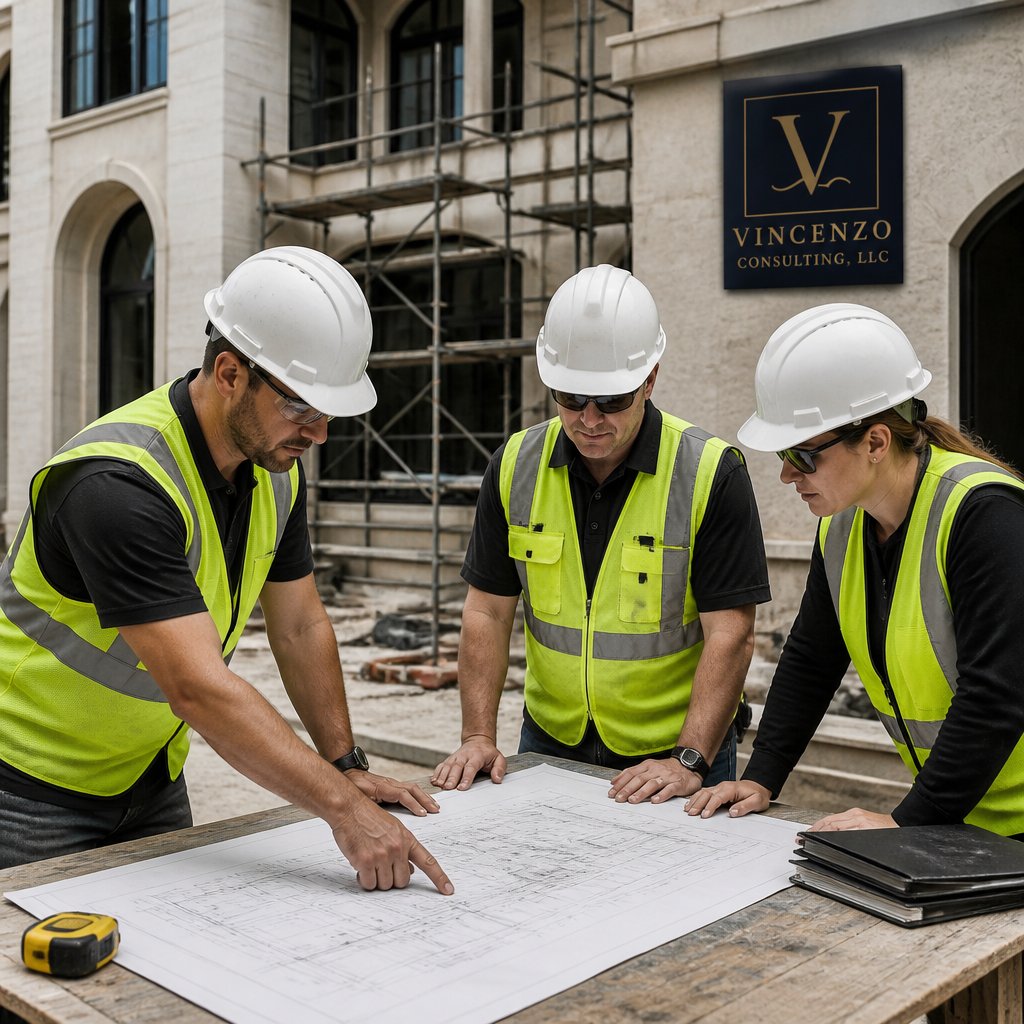
 ultimate-guide
Construction Site Safety Accountability Best Practices
Last Updated: October 25, 2026
Quick Summary
Safety accountability means every role on a construction project owns a defined piece of the safety outcome, not just the safety director or general contractor. Build it with a written checklist assigning a named person, deadline, and proof of completion to each obligation, then verify through documented walks and a corrective action log.
- The owner sets and funds the safety standard; the general contractor enforces it daily.
- A safety accountability checklist assigns a named person, deadline, and proof of completion to each obligation.
- Hazard reporting needs one channel, an anonymous option, and a visible response within 48 hours.
- Incident investigations should find the system failure, not blame the nearest worker.
- The three-tier framework is commitment, verification, and consequence, backed by documentation.
Table of Contents
- Why Safety Accountability Decides Project Outcomes
- Construction Site Safety Responsibilities by Role
- Building a Construction Safety Accountability Checklist
- Construction Hazard Reporting Procedures That Workers Actually Use
- Construction Incident Investigation Procedures for Owners
- Accountability Frameworks and Tools That Enforce Follow-Through
- Legal and Ethical Duties Behind Safety Accountability
- How Owner's Representation Enforces Safety Accountability
- Frequently Asked Questions
Why Safety Accountability Decides Project Outcomes
Construction site safety accountability best practices start with a hard truth: safety programs fail not because workers ignore rules, but because nobody owns the outcome. According to CPWR's research on safety culture and climate in construction, everyone involved in a construction project should be held accountable for safety, not just the safety director or the general contractor.
That distinction matters more than most owners realize. A written policy sitting in a binder changes nothing. Accountability is what turns policy into daily practice, and it is the single variable that separates projects that finish clean from projects that finish with citations, injuries, and litigation.
At Vincenzo Consulting, LLC, we have spent more than 35 years watching how accountability, or the absence of it, shapes project outcomes across luxury residential, commercial, and infrastructure work. The pattern is consistent: projects with clear ownership of safety decisions run predictably. Projects without it drift.
Below, we break down the roles, checklists, reporting systems, and enforcement tools that make safety accountability real rather than rhetorical.
Construction Site Safety Responsibilities by Role
Safety accountability only works when every role knows exactly what it owns. Vague collective responsibility is the same as no responsibility at all.
The owner sets the standard and funds it. The general contractor enforces it daily. Supervisors translate it into task-level instructions. Workers report hazards without fear of retaliation. When any one of these layers goes soft, the whole system degrades.
Associated Builders and Contractors of Southern California describes clear leadership accountability, consistent rule enforcement, and worker engagement as the ways to make written safety policies part of daily practice. That triad is the operating model we recommend to every owner we represent.
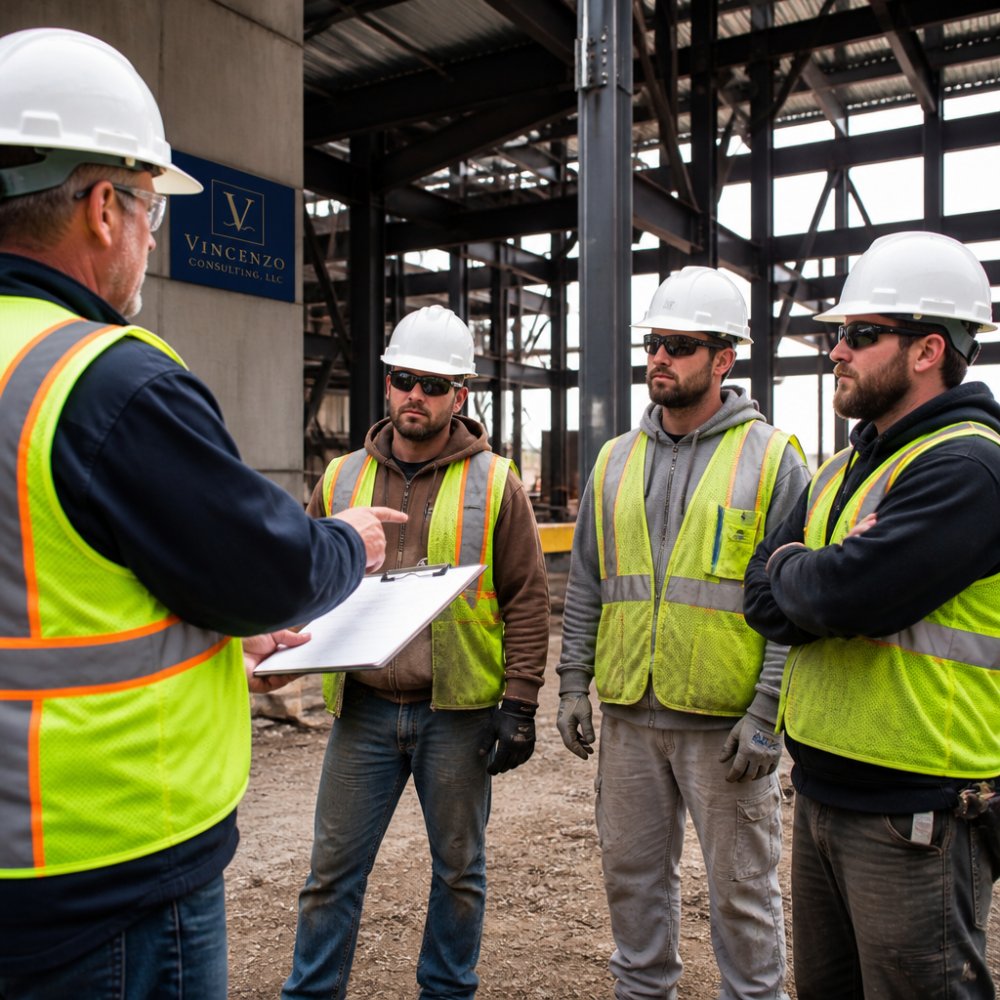
For owners managing a general contractor relationship, the accountability question gets sharper: who verifies that the GC's safety commitments actually happen on site? That is a separate discipline, and we cover it in our guidance on managing general contractor accountability issues.
Building a Construction Safety Accountability Checklist
A construction safety accountability checklist is a written verification tool that assigns a named person, a deadline, and a proof-of-completion item to each safety obligation on the project. It is not a policy document. It is a tracking instrument.
Here is the structure we use:
- Named safety lead for each trade, confirmed in writing before mobilization
- Project-specific hazard list reviewed and updated at each phase change
- Weekly documented site walk with sign-off from owner's rep and GC
- Corrective action log with owner, due date, and close-out evidence
- Worker hazard reporting channel tested and confirmed anonymous
- Incident response roles assigned, including who notifies whom
- Subcontractor safety records verified before contract award
- Monthly accountability review with all parties present
A common mistake is treating the checklist as a one-time onboarding step. It should be a living document reviewed at every phase transition, because the hazards on a foundation pour are not the hazards on a finished interior.
Owners who want a deeper structural model should look at how a formal construction quality control plan builds verification and sign-off into every stage. The accountability logic is the same.
Construction Hazard Reporting Procedures That Workers Actually Use
Construction hazard reporting procedures only work when reporting is faster, safer, and more rewarding than staying quiet. Most site programs fail this test.
The barriers are predictable. Workers fear retaliation. They doubt anything will change. They do not know who receives the report. Remove those barriers and reporting volume rises, which is exactly what you want, because near-miss data is the cheapest safety intelligence available.
Able Safety's guidance on construction site safety plans recommends identifying hazards specific to the project, including electrical and fall risks and equipment operation, and addressing each hazard in the plan. Reporting procedures should map directly to that hazard list so workers recognize what they are reporting.
What works in practice:
- A single reporting channel, not four
- Anonymous option with a visible response within 48 hours
- Written feedback to the reporter on what changed
- Zero tolerance for retaliation, stated by the owner, not just the GC
The thing nobody tells you about hazard reporting is that closure matters more than capture. A worker who reports three hazards and sees three fixes becomes your best safety asset. A worker who reports three and hears nothing stops reporting.
Construction Incident Investigation Procedures for Owners
Construction incident investigation procedures exist to find the system failure, not to assign blame to the nearest worker. Owners who understand that distinction get better data and fewer repeat incidents.
An investigation should answer four questions: what happened, what conditions allowed it, what controls failed, and what changes prevent recurrence. Root cause analysis that stops at "employee error" is an incomplete investigation, and it guarantees the same incident happens again.
Research published through the American Society of Civil Engineers examined health and safety management systems in construction and was motivated by a lack of uniformity in contractors' programs. That inconsistency is precisely why owners need their own investigation standard rather than accepting whatever format the contractor prefers.
Watch out: investigating only recordable injuries and skipping near misses. Near misses are free lessons. Ignore them and you pay tuition later.
Accountability Frameworks and Tools That Enforce Follow-Through
The best accountability framework is the one that creates a paper trail nobody can talk their way out of. Documentation is the enforcement mechanism.
We recommend a three-tier structure: commitment, verification, consequence. Commitments are written into contracts and pre-construction plans. Verification happens through scheduled inspections with photographic evidence. Consequences are defined in advance, including payment holds and stop-work authority for repeat violations.
A study in the Journal of Safety Research used an ethnographic case-study approach with semi-structured interviews of construction firm owners to examine safety practices in small construction businesses. The finding that resonates with our experience: safety behavior tracks the owner's actual priorities, not the written policy.
| Framework Layer | What It Does | Who Owns It | Verification Method |
|---|---|---|---|
| Commitment | Defines safety obligations in contract | Owner | Signed pre-construction plan |
| Verification | Confirms work matches commitments | Owner's rep | Weekly documented walk |
| Consequence | Enforces follow-through | Owner | Payment hold, stop-work |
Legal and Ethical Duties Behind Safety Accountability
Safety accountability carries legal weight well beyond moral expectation. Owners, contractors, and supervisors each hold distinct duties, and the lines between them are tested after every serious incident.
The ethical dimension is simpler to state: an owner who funds a schedule that makes safe work impossible has created the hazard, regardless of what the safety manual says. Schedule pressure is a safety decision, and it belongs on the accountability ledger alongside inspections and training.
Practically, owners should confirm that contract language assigns safety responsibility explicitly, that insurance and indemnification terms match actual site authority, and that documentation would survive scrutiny. Legal counsel should review these terms, not the construction team alone.
How Owner's Representation Enforces Safety Accountability
An owner's representative enforces safety accountability by putting a dedicated advocate on site whose only loyalty is to the owner's interests. That independence is the entire value proposition.
A general contractor manages safety to protect the project and its own exposure. An owner's rep verifies safety to protect the owner. Those incentives overlap most of the time, and diverge exactly when it matters most: schedule pressure, change orders, and disputed incidents.
This is where Vincenzo Consulting, LLC operates. Our white-glove construction oversight places experienced eyes on site, aligned to the owner's scope, budget, and schedule, with the authority to escalate when commitments slip. Owners who want to understand the role in depth can read why hire construction owner representation, and those weighing who enforces what should review owner representative vs general contractor roles.
The distinction between a full-time staff project manager and an owner's rep comes down to independence and range. We bring more than 35 years of executive leadership across luxury residential, commercial, and infrastructure work, and we are not embedded in the contractor's reporting chain.
For owners who want to see how accountability strategies extend across an entire project lifecycle, our breakdown of construction project accountability strategies covers the broader playbook.
Safety accountability is not a program you launch; it is a discipline you verify, week after week, with named owners and documented proof. Owners who build that structure into contracts, checklists, and reporting channels get predictable projects. Owners who leave it to the contractor's discretion get surprises. Vincenzo Consulting, LLC exists to close that gap, with discreet, disciplined owner's representation that keeps safety accountability where it belongs: with the party paying for the outcome.
Vincenzo Consulting, LLC Website: Vincenzoconsultingllc.com Email: info@vincenzoconsultingllc.com
Frequently Asked Questions
What does accountability mean in construction site safety?
Accountability means every person on the project, from the owner and general contractor to each subcontractor and trade worker, has a named duty, knows the standard they are measured against, and faces a defined consequence when that standard is not met. CPWR notes that everyone involved in a construction project should be held accountable for safety. In practice, accountability ties written policy to daily behavior through documented roles, inspections, and follow-up, so safety stops being a binder on a shelf and becomes a condition of doing business on the site.
Who is responsible for safety on a construction site?
Responsibility is shared but not equal. The owner sets expectations and funds safety, the general contractor enforces the site safety plan, supervisors run daily checks, and every worker reports hazards. Associated Builders and Contractors of Southern California describes clear leadership accountability, consistent rule enforcement, and worker engagement as the ways written safety policies become daily practice. A construction safety accountability checklist should name each role, its specific duties, and who verifies that the duties were performed, so no task falls between two companies.
What should a construction safety accountability checklist include?
A working checklist covers role assignments and signatures, daily and weekly inspection records, hazard reporting logs with closure dates, toolbox talk attendance, corrective action tracking, and incident investigation sign-offs. Able Safety recommends identifying project-specific hazards, including electrical and fall risks and equipment operation, and addressing each one in the safety plan. Build the checklist around those hazards so every line item maps to a real risk on your site rather than a generic form that gets initialed without review.
How should construction teams respond to safety violations?
Respond the same day, in writing, with a defined escalation path. Document the violation, assign a corrective action and a deadline, verify the fix, and record who confirmed it. Repeat violations should trigger a documented conversation with the subcontractor's leadership, not just the worker. Consistent enforcement is what separates a safety policy from a suggestion, and it protects the owner if a dispute or claim arises later. Keep the record factual and store it with the project's safety file so the response history is available for review.
How can construction managers improve safety accountability?
Managers improve accountability by making expectations visible and measurable. Review leading indicators such as hazard reports filed, corrective actions closed on time, and toolbox talk attendance, not just recordable incident counts. Researchers publishing in the Journal of Safety Research found that small construction businesses face distinct stresses that shape how safety practices get adopted, so tailor the system to the actual crew size and schedule. Pair that with leadership walking the site, asking about open items, and following up on the same day.