 ultimate-guide
Construction Project Accountability Strategies That Work
Table of Contents
- Why Construction Project Accountability Breaks Down
- Defining Roles with a Responsibility Assignment Matrix
- Setting Performance Expectations from Day One
- KPIs for Construction Project Success and Real-Time Monitoring
- Construction Financial Oversight Strategies That Prevent Cost Overruns
- Construction Project Risk Management and Accountability Culture
- Digital Tools That Make Construction Project Accountability Visible
- How Owner's Representation Enforces Accountability at Every Phase
Last Updated: August 26, 2026
Construction projects fail at the accountability layer long before they fail at the structural one. At Vincenzo Consulting, LLC, we've spent more than 35 years watching high-value developments unravel not because of bad materials or poor design, but because no one could answer a simple question: who owns this decision? Construction project accountability strategies are the operational infrastructure that prevents that ambiguity from metastasizing into cost overruns, schedule collapse, and contractor disputes.
Why Construction Project Accountability Breaks Down
The most common failure point is diffusion of responsibility. On a complex project with a general contractor, multiple subcontractors, an architect, an owner, and possibly a lender, every party assumes someone else is tracking the problem. Nobody is.
A second cause is the gap between what contracts specify and what actually gets enforced on site. Contracts articulate workmanship standards in precise language, but enforcement requires someone with both authority and presence to act on them. Without that, the contract becomes a document used only in litigation.
The third cause is cultural. When flagging problems invites blame rather than solutions, problems stay hidden until they're catastrophic. Construction project accountability, properly structured, is not a blame mechanism, it is a system for surfacing issues early enough to fix them cheaply. According to the Construction Industry Institute's research on project performance, projects with clearly defined accountability structures consistently outperform those without them on both schedule and budget metrics.
Defining Roles with a Responsibility Assignment Matrix
A Responsibility Assignment Matrix (RACI) is a project governance tool that maps every task or decision to four roles: Responsible, Accountable, Consulted, and Informed. On a construction project, it is the single most effective structural intervention available to an owner before a shovel touches the ground.
Most project teams confuse "responsible" with "accountable." Responsible means the person doing the work. Accountable means the person who owns the outcome and answers for it. A subcontractor's foreman may be responsible for waterproofing installation. The general contractor's project manager is accountable for whether that installation meets specification. Conflating these roles creates the accountability vacuum that drives disputes.
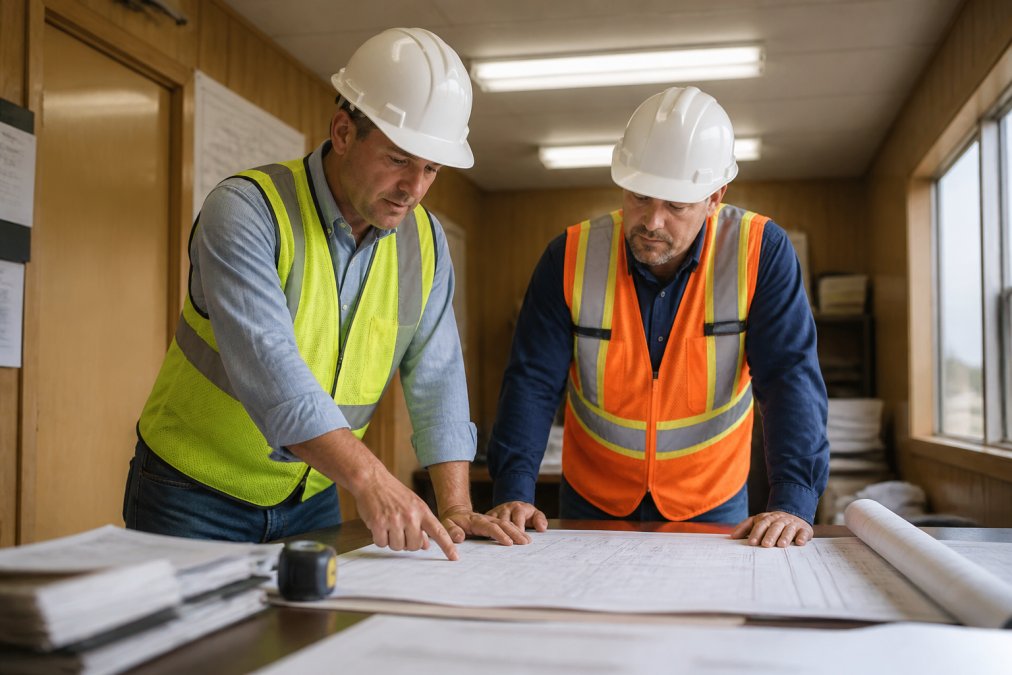
How to Build a RACI Chart for a Complex Project
Start with a complete scope decomposition. Every major deliverable, inspection milestone, and approval gate needs a row. Then assign RACI designations across the columns: owner, owner's representative, GC, architect, MEP engineer, and relevant subcontractors.
A practical RACI for a luxury residential or commercial project typically looks like this:
| Task / Decision | Owner | Owner's Rep | GC | Architect | Subcontractor |
|---|---|---|---|---|---|
| Budget approval | A | C | C | I | I |
| Specification compliance review | I | A | R | C | R |
| Subcontractor selection | C | A | R | C | I |
| Change order approval | A | R | C | I | I |
| Punch list sign-off | I | A | R | A | R |
| Final inspection | I | A | R | A | I |
The "A" column should never have two entries in the same row. Shared accountability is no accountability.
Extending the RACI to Subcontractors
Subcontractor management is where accountability frameworks most commonly collapse. Extend the matrix explicitly to every subcontractor tier that touches a critical path item. Require subcontractors to sign an acknowledgment confirming they understand their designated responsibilities.
Setting Performance Expectations from Day One
Vague expectations are the enemy of construction project accountability. "Build it right" is not a performance standard. "Install per ASTM C1107 with a 28-day compressive strength of 4,000 psi, inspected and documented by a third-party testing laboratory" is a performance standard.
Every KPI for construction project success should be established before mobilization. This includes schedule milestones tied to payment, quality benchmarks tied to inspection sign-offs, and safety metrics tied to continued site access. When performance expectations carry financial consequences, they are taken seriously.
The Kickoff Meeting as an Accountability Anchor
The kickoff meeting is the first and most important accountability event in the project lifecycle. A well-run kickoff surfaces the completed RACI so every stakeholder sees their designation. It establishes the reporting cadence, communication protocol for issues and change orders, and documents attendance so no party can claim unawareness of baseline expectations.
Require every party to confirm their understanding of their accountability obligations in writing before leaving the kickoff. This is the moment accountability becomes real.
KPIs for Construction Project Success and Real-Time Monitoring
KPIs are only useful if tracked in real time and reviewed on a fixed cadence. A KPI reviewed quarterly on a 14-month project tells you almost nothing actionable. The same KPI reviewed weekly creates the feedback loop that allows course correction before deviation becomes crisis.
The core KPI set for most complex projects includes:
- Schedule performance index (SPI): Earned value versus planned value, measured weekly
- Cost performance index (CPI): Budgeted cost of work performed versus actual cost
- RFI response time: Days from submission to resolution
- Change order cycle time: Days from submission to approval or rejection
- Deficiency closure rate: Open punch list items closed per week as a percentage of total open items
- Safety incident rate: Recordable incidents per 200,000 hours worked, per OSHA standards
According to the Project Management Institute's guidance on earned value management, earned value metrics are among the most reliable leading indicators of project outcome available to project owners.
Construction Financial Oversight Strategies That Prevent Cost Overruns
Construction financial oversight strategies begin with the schedule of values. Every pay application the GC submits should be evaluated against the approved schedule of values, actual work in place, and stored materials on site. The most effective financial oversight structure combines a detailed cost-loaded schedule, a rigorous change order management protocol, and an independent cost-to-complete projection updated monthly. The cost-to-complete projection forces the team to look forward, not just backward. A project that is on budget today may have a known scope gap that makes a future overrun inevitable. Catching that gap in month three is recoverable. Catching it in month eleven is not.
The American Institute of Architects' guidance on owner-contractor agreements provides useful frameworks for structuring payment terms and retainage provisions that reinforce financial accountability throughout the project lifecycle.
Legal and Contractual Levers That Reinforce Accountability
Contracts are accountability documents. Several contractual provisions carry significant accountability weight. Liquidated damages clauses establish a pre-agreed daily cost for schedule delay, removing the need to prove actual damages in a dispute. Performance bonds require the GC's surety to complete the project or compensate the owner if the GC defaults. Retainage provisions, typically 5-10% of each pay application held until substantial completion, give the owner financial leverage to ensure punch list completion.
Construction Project Risk Management and Accountability Culture
Construction project risk management and accountability culture are not separate disciplines. Risk management identifies what could go wrong. Accountability culture determines whether people will tell you when something is going wrong.
Most project teams are good at the first and terrible at the second. A project manager who fears career consequences for surfacing a problem will suppress that information until suppression is no longer possible. By that point, the cost of resolution has multiplied.
The mitigation strategy is a structured risk register maintained by the owner's representative, reviewed at every project meeting, and updated with owner visibility. Each risk item should carry an owner, a probability rating, a potential cost impact, and a mitigation action. This creates a blame-free culture through structure: problems are expected, tracked, and managed rather than hidden and punished.
Psychological Safety on the Job Site
Psychological safety in construction is the condition in which workers, foremen, and subcontractors feel safe raising concerns without fear of retaliation. A subcontractor's foreman who notices a waterproofing deficiency but stays silent because he fears the GC's reaction is a direct liability for the owner. Conversely, a site culture where issues are surfaced immediately, addressed without blame, and documented systematically produces better outcomes at every level.
Building that culture requires explicit owner leadership. The owner's representative must reinforce a clear message: the cost of finding a problem early is always lower than the cost of finding it late. That message must be consistent across every site meeting, inspection, and change order conversation.
OSHA's guidance on safety culture and worker participation establishes the federal framework within which construction safety culture operates, and the principles align directly with broader accountability objectives.
Digital Tools That Make Construction Project Accountability Visible
Digital tool integration has fundamentally changed what construction project accountability looks like in practice. Cloud-based project management platforms mean that accountability data is now real-time, searchable, and auditable in ways that were impossible a decade ago.
The most effective digital accountability stack for a complex project typically includes a construction management platform for RFIs, submittals, and daily reports; a cost management module for pay application tracking and change order workflow; and a document control system that maintains a complete, timestamped record of every decision made on the project.

What these tools do not do automatically is interpret the data. Real-time monitoring only creates value when someone with expertise to recognize a deviation is reviewing the data and acting on it. A dashboard showing a schedule slip of three weeks is only useful if someone with authority contacts the GC, identifies the cause, and drives a recovery plan. The tool creates visibility. The owner's representative creates accountability.
| Digital Tool Category | Primary Accountability Function | Key Data Output |
|---|---|---|
| Construction management platform | RFI and submittal tracking | Response time, open item count |
| Cost management module | Pay app and change order workflow | CPI, budget variance |
| Document control system | Decision and approval records | Timestamped audit trail |
| Field inspection app | Daily reports and deficiency logs | Deficiency closure rate |
| Scheduling software | Critical path and SPI tracking | Schedule performance index |
How Owner's Representation Enforces Accountability at Every Phase
Owner's representation is the most direct mechanism available to a project owner for enforcing construction project accountability across the full project lifecycle. An owner's representative acts as the owner's eyes, ears, and decision-making authority on site, independent of the GC and the design team.
The distinction matters. An architect's primary obligation is to the design intent. A GC's primary obligation is to complete the scope within their contract. An owner's representative's sole obligation is to the owner's interests: protecting the vision, preserving quality, aligning scope, budget, and schedule with the original objectives, and enforcing accountability at every phase.
At Vincenzo Consulting, LLC, that function is executed with more than 35 years of executive leadership experience across ultra-luxury residential, complex commercial, and infrastructure developments. The approach is active, on-site, and operationally engaged: reviewing pay applications independently, managing the risk register, enforcing the RACI, and maintaining the financial discipline that keeps projects on track from groundbreaking to closeout.
Construction project accountability doesn't happen by accident, and it doesn't happen through goodwill alone. It requires structure, documentation, financial discipline, and someone with the authority and presence to enforce it. Vincenzo Consulting, LLC brings more than 35 years of white-glove owner's representation experience to every engagement, providing independent financial oversight, active risk management, and site-level accountability that protects your investment from contract execution through final closeout. Contact Vincenzo Consulting, LLC to discuss how disciplined project governance translates into predictable outcomes on your next development.
Frequently Asked Questions
How do you establish clear accountability in a construction team?
Start at the kickoff meeting by assigning every deliverable to a named individual using a RACI chart. Document who is Responsible, Accountable, Consulted, and Informed for each task. Pair that with written performance expectations in the contract and a reporting cadence that surfaces problems early. When every team member knows their ownership boundaries and the consequences of missing them, accountability becomes a structural feature of the project rather than a management afterthought.
What are the most effective KPIs for tracking construction project accountability?
The five KPIs that matter most for construction project accountability are schedule variance, cost variance, defect rate, request-for-information response time, and subcontractor milestone completion rate. Each one should be measured against a baseline set before mobilization. Real-time monitoring through a construction management platform lets the project owner spot negative trends within days rather than weeks, which is the difference between a correctable variance and an unrecoverable cost overrun.
What are the common causes of accountability failure in large-scale construction?
The most common causes are overlapping or undefined roles, contracts that lack measurable performance standards, infrequent reporting cadences that hide problems until they are expensive, and a blame-heavy site culture that discourages early disclosure of issues. On complex commercial and ultra-luxury residential projects, inadequate subcontractor management compounds every one of these problems. Addressing all four through a structured accountability framework before construction begins is far less costly than resolving disputes mid-project.
How does owner's representation improve project accountability?
An owner's representative sits on the owner's side of every decision, independent of the general contractor. That independence closes the information gap that allows cost overruns and schedule slippage to go unreported. The representative enforces contract terms, reviews pay applications against verified progress, monitors KPIs, and escalates non-compliance before it becomes a legal dispute. For ultra-luxury and high-value commercial projects, this layer of construction project accountability often prevents losses that far exceed the cost of representation itself.
This article was written using GrandRanker