 comparison
Control4 vs Savant for Luxury Estates: Which Smart Home System Wins?
Last Updated: November 4, 2026
Quick Summary
The best luxury smart home systems for luxury residences depend on your estate: Control4 suits sprawling properties with complex subsystems, while Savant suits media-driven, design-led homes where audiovisual performance leads. Both are dealer-installed platforms, so plan infrastructure and cybersecurity before drywall goes up.
- Control4 is generally regarded as suited to complex layouts and a broad range of third-party devices.
- Savant fits Apple-centric households and homes where theater and whole-home audio are central.
- Design the network first, standardize on Matter-compatible hardware, and map scenes before purchase orders.
- Structured wiring and network infrastructure is typically the largest single line item on a sprawling estate.
- Require the integrator to document network topology and hand over credentials at project close.
Table of Contents
- Control4 vs Savant: Quick Comparison for Luxury Residences
- Control4: The Scalable Backbone for Whole-Estate Automation
- Savant: Interface-First Design for Media-Driven Estates
- Luxury Smart Home Integration Best Practices for Complex Estates
- Smart Home System Installation Costs: What Drives the Investment
- Cybersecurity and Post-Installation Maintenance: The Overlooked Pillars
- Which System Fits Your Estate? A Decision Framework
- Planning Your Luxury Smart Home with Vincenzo Consulting, LLC
- Frequently Asked Questions
Control4 vs Savant: Quick Comparison for Luxury Residences
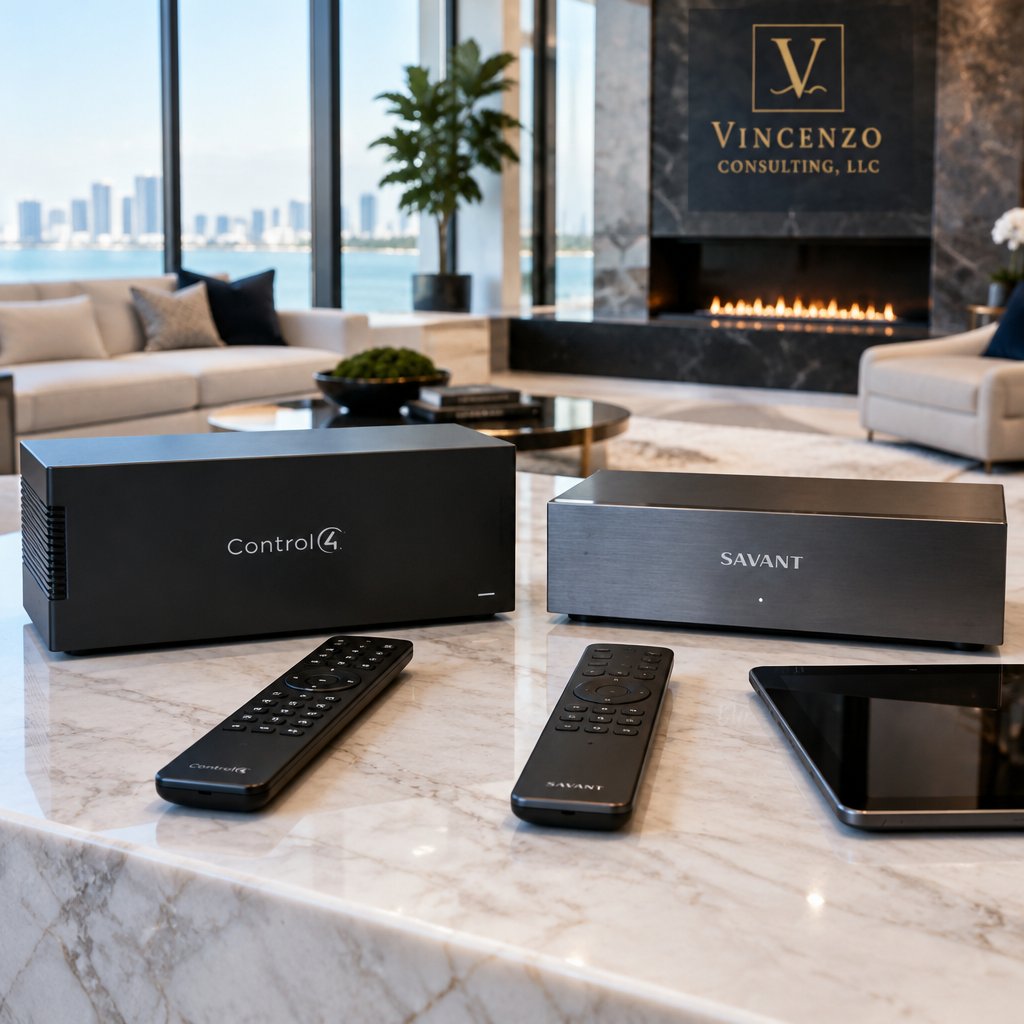
The smart home device market is projected to grow from $180.12 billion in 2026 to $848.47 billion by 2034, according to Home Improvement Research Institute market projections, and luxury estates sit at the center of that spending. Choosing the best smart home systems for luxury residences comes down to a single question: do you want a platform that scales quietly behind the walls, or one that puts a polished interface in every room? Control4 leans toward the first. Savant leans toward the second.
Owner's representation for estate builds means these decisions carry real budget consequences. The short answer: Control4 suits sprawling properties with complex subsystems, while Savant suits media-driven homes where design and audiovisual performance lead. Below, we break down where each wins, what each costs in practice, and how to decide before walls close.
| Factor | Control4 | Savant |
|---|---|---|
| Core strength | Scalable whole-estate backbone | Interface-first design and AV |
| Best for | Large, complex properties | Media-driven, design-led homes |
| User interface | Touch panels and remotes | High-resolution app and wall panels |
| Ecosystem fit | Broad third-party integration | Apple-centric households |
| Changes after install | Dealer-dependent | Dealer-dependent |
Control4: The Scalable Backbone for Whole-Estate Automation
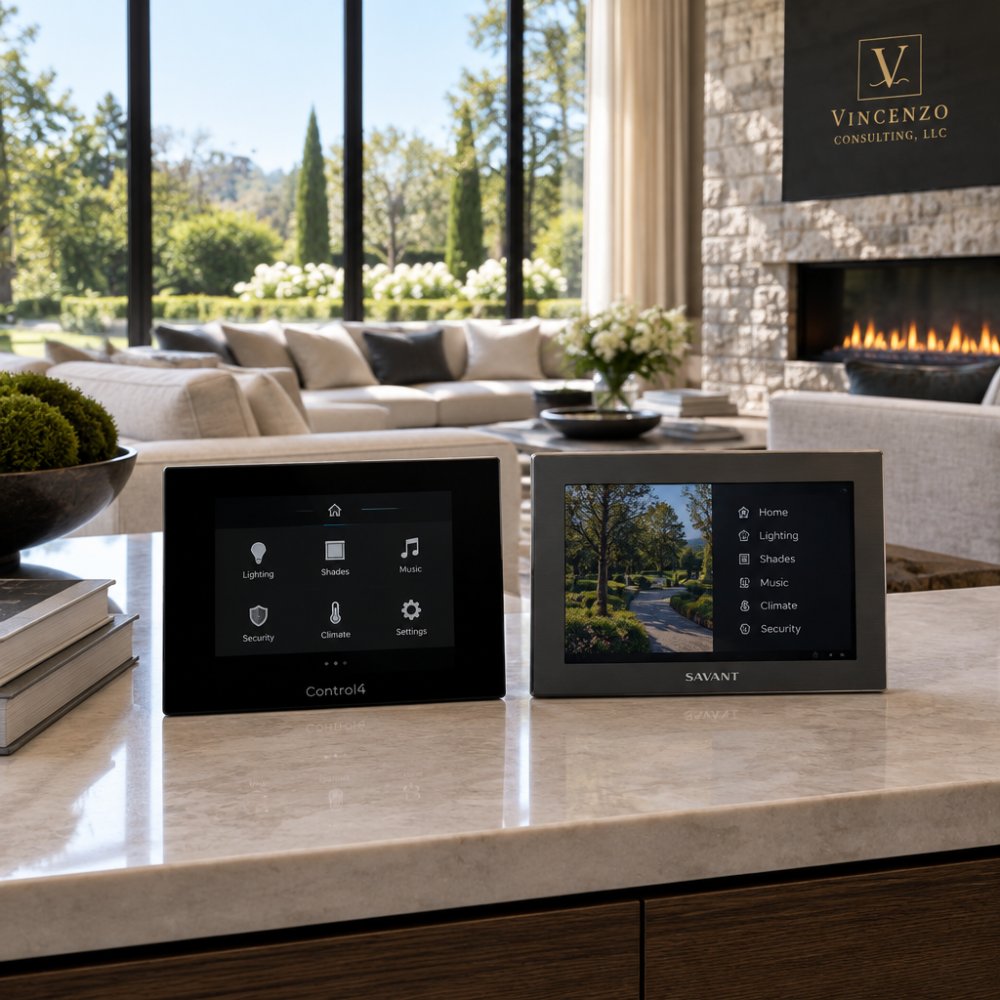
Control4 is a professional automation platform that unifies lighting, audio, video, and security into one interface, installed and supported through a dealer network. For estates with dozens of rooms and subsystems, that centralized architecture matters more than any single feature.
Where Control4 Excels in High-End Projects
Control4 is generally regarded as suited to complex layouts and a broad range of third-party devices. One interface, one app, one place to manage it all.
Limitations to Weigh Before Committing
Most system changes require dealer intervention. That is fine for owners who want white-glove service, less so for anyone who expects to reprogram scenes themselves. Budget for ongoing dealer support, not just installation.
Savant: Interface-First Design for Media-Driven Estates
Savant is a premium home automation ecosystem built around its user interface and high-fidelity media distribution. If your estate revolves around a home theater, whole-home audio, and rooms designed to be seen, Savant's polish is the point.
Savant's Strengths in Aesthetic and AV Integration
Apple-centric households find the ecosystem familiar. Lighting and energy management integrate cleanly into the same elegant control layer.
Trade-Offs of a Premium Ecosystem
The investment is significant compared with consumer alternatives, and like Control4, most changes run through a dealer. Pay for the design and AV performance only if those are priorities. Otherwise, you are funding polish you will not use.
Luxury Smart Home Integration Best Practices for Complex Estates
Luxury smart home integration best practices start with infrastructure, not devices. Hardwired network connectivity, adequate latency headroom, and a scalable architecture designed before drywall goes up separate systems that last from systems that frustrate. Retrofitting a sprawling estate later costs far more than planning early.
Three practices to consider:
- Design the network first. Every device depends on it.
- Standardize on interoperability, including Matter-compatible hardware, so systems talk to each other.
- Map lighting scenes, climate zones, and security layers on paper before any purchase order.
As Strategic Market Research's 2026 smart home trends analysis notes, development this year centers on better interoperability, more capable sensors, and stronger energy-management tools. Build for that, not for a single vendor's catalog.
For estates with multiple structures and phased construction, our guide to managing luxury home construction covers the broader sequencing that keeps integration on schedule.
Smart Home System Installation Costs: What Drives the Investment
Smart home system installation costs depend on project scope, and pricing varies by project. Contact Vincenzo Consulting, LLC for current pricing or a quote. What separates a disciplined budget from a runaway one is understanding the line-item anatomy before the first purchase order.
The Five Cost Buckets on a Luxury Integration
Most dealer proposals decompose into five buckets. Ask for each one separately; bundled quotes hide where overruns originate.
- Structured wiring and network infrastructure: Cat6A or fiber backbone, network racks, PoE switching, and wireless access point placement. On a sprawling estate this is typically the largest single line item because it scales with square footage and wall count, not device count.
- Head-end and control hardware: the automation processor, I/O modules, network video recorder, and distributed audio/video matrix. These are fixed-cost items that do not shrink with room count.
- Field devices: keypads, touch panels, motorized shades, cameras, door stations, speakers, and thermostats. This bucket scales linearly with room count and is where scope creep most often hides.
- Programming and commissioning: dealer labor to build scenes, logic, and integrations. Complex conditional logic, say, shading that responds to both sun angle and occupancy, consumes hours fast.
- Contingency and service: a reserve for change orders plus the first year of a service agreement.
What Moves the Number Most
- Wiring and infrastructure: hardwired connectivity throughout a large estate is the largest line item, and retrofitting after drywall is dramatically more expensive than roughing in during construction.
- Device count: motorized shades, distributed audio zones, and camera coverage add up quickly, and each zone carries its own programming time.
- Programming complexity: custom scenes and logic take dealer hours, and every change after commissioning is billable unless covered by a service contract.
- Ongoing service: maintenance contracts and updates are a recurring cost, not a one-time fee. Budget it as an annual operating expense, not a capital line.
When reviewing a quote, ask for a line-item breakdown that shows programming hours separately.
Phasing and Value
The Home Improvement Research Institute reports that smart home features can lift property values by roughly 3%, which reframes the spend as asset preservation rather than gadgetry. For phased builds, sequence infrastructure first, head-end second, and field devices room by room so each phase is functional on its own. For the full cost picture across a luxury build, see our guide to luxury home construction management.
Cybersecurity and Post-Installation Maintenance: The Overlooked Pillars
Cybersecurity and maintenance are where most smart home projects quietly fail. Every connected device is an entry point, and SafeHome.org's 2026 research warns that home automation introduces significant cyber risks that must be managed deliberately. For a high-net-worth household, the threat model is different: the concern is not a hacked light bulb but network reconnaissance that maps occupancy patterns, camera feeds, and access-control schedules.
A Practical Cybersecurity Baseline for a Connected Estate
- Network segmentation: put cameras, thermostats, and other IoT devices on a separate VLAN from work computers, personal devices, and the automation controller. A compromised device then cannot pivot to sensitive systems.
- Credential hygiene: change every default credential at commissioning, use a password manager, and enable multi-factor authentication on any cloud-connected account.
- Firmware discipline: track firmware versions across every device class and schedule updates rather than waiting for failures. Unpatched devices are the most common entry point.
- Remote access control: limit which accounts can reach the system remotely, log access, and revoke dealer credentials when a relationship ends.
- Vendor accountability: require the integrator to document the network topology and hand over credentials at project close. You should own your system, not rent access to it.
Why Service Contracts Are Not Optional
Maintenance deserves equal weight. A service agreement typically covers firmware updates, device replacement, remote diagnostics, and reprogramming when a room changes use. Without one, a five-year-old estate system drifts out of date while the owner assumes it still works, and the first sign of trouble is usually a failed scene during a dinner party.
Ask for these terms in writing:
- Response-time commitments: a defined window for remote and on-site response, not a vague "promptly."
- Update cadence: scheduled firmware and software reviews, at least annually.
- Programming allowance: a set number of reprogramming hours per year for room changes and scene adjustments.
- Hardware refresh path: a stated policy for replacing end-of-life devices.
- Cybersecurity review: an annual network and credential audit as part of the contract.
When reviewing a service contract, confirm whether programming hours are included.
Build both cybersecurity and maintenance into the budget from day one, and treat the service agreement as a condition of the warranty rather than an upsell.
Which System Fits Your Estate? A Decision Framework
Use this framework to settle the Control4 versus Savant question before you commit:
- Property scale: more than 8,000 square feet with multiple structures? Lean Control4.
- Media priority: dedicated theater and whole-home audio central to daily life? Lean Savant.
- Ecosystem: Apple-heavy household? Savant fits more naturally.
- Change frequency: expect frequent reprogramming? Confirm dealer response times for either.
- Cybersecurity plan: network segmentation and monitoring defined? Required for both.
If your smart home plans keep expanding mid-build, our guide to preventing scope creep in luxury builds will help you hold the line.
Planning Your Luxury Smart Home with Vincenzo Consulting, LLC
The right system is only half the decision. The other half is oversight that keeps integration aligned with your budget, schedule, and long-term property value. Vincenzo Consulting, LLC provides discreet owner's representation and construction oversight for ultra-luxury residences, led by Paul V. Facchina Jr. with more than 35 years of executive leadership experience.
Before you select a dealer, read our guide to hiring luxury construction consultants to understand how independent oversight protects your interests through the integration phase.
Technology choices age. Disciplined execution does not. Choose the platform that fits how you actually live, plan the infrastructure before construction, and hold every vendor to the same standard.
Frequently Asked Questions
What are the top-rated luxury home automation systems for large estates?
Control4 and Savant are the two most frequently specified professional platforms for large estates. Control4 offers broad third-party integration and a scalable architecture, while Savant leads with an intuitive interface and high-fidelity media distribution. Both require professional installation and ongoing dealer support. The right choice depends on whether your priority is device compatibility and future expansion or a polished, design-forward user experience. A construction oversight consultant can help align the platform with your project's scope and budget.
How do professional-grade smart home systems differ from consumer-grade options?
Consumer ecosystems like Alexa or Google Home work well for apartments or a handful of devices, but they lack the robustness required for full-scale luxury automation. Professional systems such as Control4 and Savant provide hardwired connectivity, centralized control, and custom programming tailored to complex layouts. For high-net-worth households, the difference shows up in daily performance and long-term property value.
What should be included in a comprehensive luxury smart home infrastructure?
A robust infrastructure includes intelligent lighting control, automated climate and HVAC systems, high-end security and surveillance, whole-home audio and video distribution, motorized shading, and a reliable network backbone. Voice-activated assistants and a home theater automation layer are common additions. Planning for interoperability and future device additions is critical. Smart home infrastructure decisions are a long-term investment.
What are the essential security and privacy considerations for high-end smart homes?
High-net-worth households face elevated cybersecurity risks because IoT and AI introduce potential entry points. Essential measures include network segmentation, local processing where possible, regular firmware updates, and strict access controls. A service contract that includes cybersecurity reviews and system audits is also advisable. These steps protect both data and physical security, which is a core concern for luxury property owners.
How does professional integration impact the long-term value of a luxury property?
Professional integration ensures that disparate systems communicate reliably, reducing the risk of downtime and costly retrofits. Smart home features are often considered a factor in property value. Beyond resale value, a professionally integrated system with documented maintenance and cybersecurity protocols preserves operational integrity. For developers and family offices, that translates into predictable performance and asset preservation over the hold period.