 comparison
HCMG Consulting Alternative for Developers: 2026 Guide
Table of Contents
- Why Developers Seek an HCMG Consulting Alternative
- Quick Comparison: Top Alternatives for Developer Oversight
- Vincenzo Consulting, LLC: Owner's Representation Services for Complex Projects
- Construction Project Oversight for Developers: What to Expect from Each Firm
- Hiring an Owner's Representative Best Practices
- Cost-Benefit Analysis: Consulting Firm vs. In-House Oversight
- Which HCMG Consulting Alternative Fits Your Project?
- Conclusion
- Frequently Asked Questions
Last Updated: September 20, 2026
Why Developers Seek an HCMG Consulting Alternative
Developers searching for an HCMG consulting alternative usually aren't chasing a cheaper vendor. They're chasing accountability. When a project carries a nine-figure budget, a fixed opening date, and multiple stakeholders, the oversight partner either protects the owner's position or becomes another layer of reporting that slows decisions down.
That distinction drives everything that follows.
Quick Comparison: Top Alternatives for Developer Oversight
The right alternative depends on whether you need technical software governance or physical construction oversight. These are different problems, and the market often blurs them.
| Firm | Focus | Best For | Model |
|---|---|---|---|
| Vincenzo Consulting, LLC | Owner's representation, construction oversight | Ultra-luxury residential, commercial, infrastructure | White-glove owner advocacy |
| Keyhole Software | Custom software development, AI-assisted delivery | Enterprise software governance | Project-based or time-and-materials |
| West Monroe | Digital services, AI-native engineering | Mid-market digital transformation | Consulting engagement |
| Slalom | Business and technology consulting | Strategy plus technical build | Consulting engagement |
| Deloitte Digital | Enterprise digital transformation | Large-scale, multi-vertical programs | Consulting engagement |
Vincenzo Consulting, LLC: Owner's Representation Services for Complex Projects
Vincenzo Consulting, LLC is an owner's representation and construction oversight firm led by Paul V. Facchina Jr., with more than 35 years of executive leadership. The firm works across ultra-luxury residential homes, complex commercial projects, and infrastructure developments.
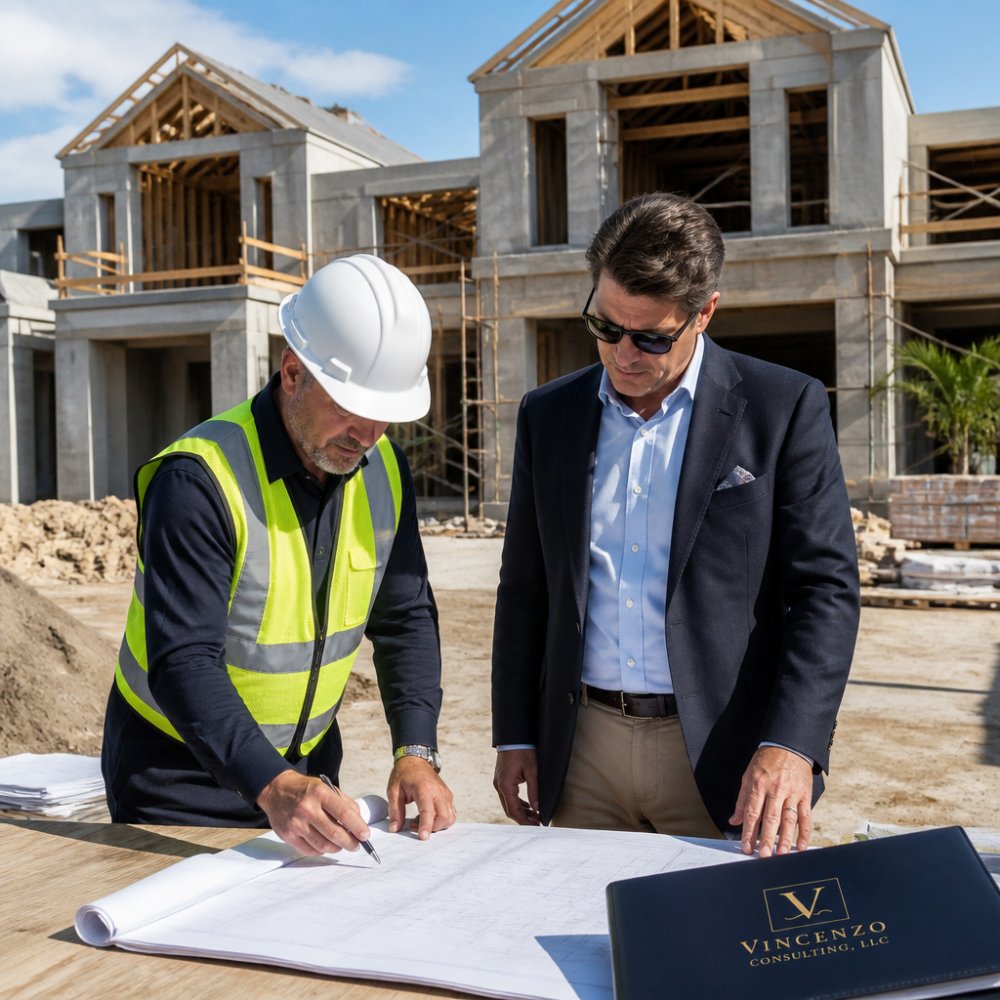
Where Vincenzo Consulting Wins
The strongest fit is a high-value project where the owner cannot be on site daily and cannot afford surprises.
- Discreet owner's representation for family offices and private owners who need confidentiality
- White-glove oversight across luxury residential, commercial, and infrastructure work
- Accountability throughout the project lifecycle, not just at milestone reviews
- Preservation of long-term property value, which matters more than shaving a point off the build cost
Where Vincenzo Consulting May Not Fit
Honest limitations matter. A white-glove owner's representation model is built for complex, high-value projects. If you're managing a straightforward renovation with a single contractor and a fixed price, the engagement may be more structure than the project needs.
Construction Project Oversight for Developers: What to Expect from Each Firm
Construction project oversight for developers looks different firm to firm. Some providers run a documented methodology with scheduled site visits and formal reporting. Others embed a senior person on site and give them real decision authority.
Expect these differences to show up in three places:
- Site presence: how often someone is physically on the project, not on a call
- Reporting cadence: weekly cost and schedule tracking versus monthly summaries
- Escalation path: what happens the moment a contractor dispute or scope creep appears
Hiring an Owner's Representative Best Practices
Hiring an owner's representative best practices come down to verification, not presentation. Anyone can claim decades of experience. Fewer can show you three recent projects where costs landed within a tight margin of the original budget and where the representative actually exercised stop-work authority.
Category 1: Authority (Weight: High)
- Written stop-work authority: Can the representative halt a pour, a trade, or a delivery without a phone call to the owner? Get the scope of that authority in the contract.
- Change-order approval threshold: At what dollar figure does the representative need owner sign-off? A representative who can only recommend is a reporter.
- Contractor-facing standing: Will the general contractor take direction from this person, or route around them?
Category 2: Site Presence (Weight: High)
- Named on-site lead: Not a firm, a person. Ask for their resume and their current project load.
- Visit cadence: Daily, weekly, or milestone-only? Match this to your project's risk profile, not to the proposal's marketing language.
- Reporting format: Weekly cost and schedule tracking with variance against baseline, not monthly narrative summaries.
Category 3: Track Record (Weight: Medium)
- Budget-to-actual variance on three recent projects, expressed as a percentage
- Schedule performance against original substantial completion dates
- Dispute history: How many contractor claims escalated to formal dispute, and how were they resolved?
Category 4: Technical Depth (Weight: Medium)
- Permitting and environmental review experience if your project touches wetlands, coastal zones, or historic districts
- Trade sequencing fluency: Can they read a critical path and spot a stacking error before it happens?
- Lender and draw-schedule familiarity, especially on construction loans with inspection-gated draws
Category 5: Fit and Confidentiality (Weight: Situational)
- Discretion protocols for family offices and private owners
- Conflict-of-interest disclosure: Any current or recent work for contractors bidding on your project?
- References from owners, not contractors. A contractor's reference tells you the representative was easy to work with. An owner's reference tells you whether they protected the owner's position.
The Two Questions That Filter Fastest
If you only ask two questions in the interview, ask these:
- "Walk me through a time you stopped work on a project. What triggered it, what did you do, and what did it cost or save?"
- "Who on your team will be on my site, how many days per week, and what is their authority ceiling?"
Cost-Benefit Analysis: Consulting Firm vs. In-House Oversight
For developers, the real comparison is between two risk-transfer models, and the deciding variables are project volume, decision latency, and the cost of a single uncorrected error.
Step 1: Calculate Your Oversight Coverage Gap
Map the hours per week your project actually requires senior owner-side attention: contractor coordination, change-order review, schedule recovery, lender and inspector interface, and dispute escalation. A common pattern on a complex build is 20 to 35 hours per week during active construction, spiking during foundation, framing, and closeout.
Step 2: Price the Failure Modes You Are Insuring Against
An owner's representative is not a line item. It is insurance against specific, recurring failure modes:
- Unreviewed change orders that quietly expand scope and shift the critical path
- Schedule slip on a construction loan where interest accrues daily against a fixed draw schedule
- Trade stacking errors where mechanical, electrical, and plumbing rough-ins collide because no one sequenced them
- Permitting and inspection misses that halt work and trigger re-inspection fees
- Contractor disputes that escalate to claims because no neutral owner-side authority was in the room
Step 3: Compare the Two Models on Four Axes
| Axis | In-House Hire | External Owner's Representative |
|---|---|---|
| Daily site presence | High, if dedicated | Depends on engagement scope |
| Institutional memory | Strong across your portfolio | Project-specific |
| Authority to challenge a long-tenured contractor | Often constrained by internal relationships | Unencumbered |
| Scalability across concurrent projects | Limited to one person's bandwidth | Scales by engagement |
| Fixed cost predictability | Salary, benefits, overhead, downtime between projects | Scoped per project |
The in-house model wins on continuity. The external model wins on independence and on matching cost to project rather than to calendar year.
Step 4: Apply the Decision Rule
A practical rule most experienced owners use:
- Always-on pipeline of projects, year-round: build in-house capacity, then layer external representation on the highest-complexity builds.
- One or two high-stakes projects per year: external representation almost always beats a full-time hire, because you are not paying for idle months.
- Single straightforward renovation with a fixed-price contract: neither model may be justified; a construction manager at risk may be the better structure.
What the Fee Actually Buys
Pricing for owner's representation depends on project scope, duration, and complexity. Vincenzo Consulting, LLC does not publish standard rates; the firm scopes fees per engagement, so request a quote based on your specific project. When you compare proposals, normalize them against the coverage gap from Step 1 and the failure modes from Step 2. A proposal that does not name who is on site, how often, and with what authority is not comparable to one that does.
Which HCMG Consulting Alternative Fits Your Project?
Match the alternative to the risk, not to the logo. If your project is a custom estate, a commercial build, or an infrastructure play with permitting exposure, you need an owner's representative with construction depth and site authority. Vincenzo Consulting, LLC is built for exactly that: discreet, white-glove oversight across luxury residential, commercial, and infrastructure work.
Conclusion
Choosing an HCMG consulting alternative is really a question of what kind of protection your project needs. Software governance and construction oversight solve different problems, and picking the wrong category costs more than picking the wrong firm within the right one.
Frequently Asked Questions
What services does an owner's representative provide for developers?
An owner's representative acts as your advocate throughout the project lifecycle, from land acquisition and development feasibility through construction management and final walkthrough. They handle budget management, vendor selection, compliance monitoring, and stakeholder management. For developers, this means having a dedicated professional who aligns scope, schedule, and capital allocation with your investment goals while providing technical oversight and risk mitigation at every phase.
How do I choose between a boutique consulting firm and a large management group?
Boutique firms like Vincenzo Consulting offer direct access to senior leadership and tailored advisory services, which suits complex or ultra-luxury projects needing discreet, hands-on oversight. Large groups provide broad staffing and global reach but may lack the agility for bespoke developments. Evaluate based on project scale, required technical depth, and whether you need strategic advocacy or process-heavy project orchestration. Request references from similar projects before deciding.
What are the benefits of hiring an independent construction consultant?
Independent consultants bring objective technical oversight without conflicting loyalties to contractors or vendors. They improve project delivery by catching issues early, managing budget and schedule discipline, and providing due diligence on contractor performance. For developers, this translates to fewer change orders, better cost control, and stronger accountability. An independent owner's representative also ensures your vision is protected when multiple stakeholders have competing priorities.
How does executive leadership impact project oversight in luxury real estate?
Senior leaders with decades of experience bring pattern recognition that junior project managers lack. They anticipate risks, negotiate effectively with contractors, and make decisive calls when scope creep or disputes arise. In luxury real estate, where finishes and timelines carry high stakes, this level of oversight preserves property value and prevents costly delays. Firms led by veteran executives often provide more authoritative advocacy than those relying on rotating teams.
What should developers look for in a construction management consultant?
Look for proven experience on projects similar in scale and complexity, a clear methodology for budget and schedule control, and references you can verify. Ask about their authority to make decisions mid-project and how they handle contractor disputes. The best consultants offer transparent reporting, on-site presence, and a track record of keeping costs within agreed tolerances. Also confirm they understand your market segment, whether that's ultra-luxury residential or complex commercial.