 listicle
How to Spot Signs of Project Mismanagement in General Contracting
Quick Summary
Signs of project mismanagement in general contracting include schedule slippage that repeats across updates, budget reports that show only total spend, unanswered requests for information, and work started without written change orders. Owners can catch these early by tracking milestones against a signed baseline and reviewing open items weekly. Repeated patterns, not single delays, are the clearest signal.
- Treat a milestone that slips across two consecutive updates as a pattern worth escalating.
- Ask for monthly reports comparing budget, committed cost, and actual spend by line item.
- Flag any request for information that stays open across two consecutive meetings.
- Require a written change order, with cost and schedule impact, before any out-of-scope work begins.
- Confirm every on-site decision in writing the same day to avoid later disputes.
Table of Contents
- Why Mismanagement Often Goes Unnoticed Until It Is Expensive
- Warning Signs in Planning and Scheduling
- Budget Overruns and Weak Cost Control
- Communication Breakdowns and Lack of Project Visibility
- Scope Creep and Unmanaged Change Orders
- How to Monitor General Contractor Performance Without Micromanaging
- Building Accountability Into Your Next Construction Project
- Frequently Asked Questions
Why Mismanagement Often Goes Unnoticed Until It Is Expensive
Project mismanagement rarely announces itself. A general contractor can miss a milestone, stretch a schedule, or let a change order slip through, and the owner may not see the damage until the bill arrives. Industry research points to contract management, coordination and communication as frequent weak spots in construction projects.
The gap between what is reported and what is happening on site is the core issue. Owners often receive polished progress updates while the real status sits in daily logs, unsigned change requests and subcontractor disputes. Early visibility into problems makes them far easier to correct than discovering them late in a project.
This guide shows how to spot the signs of project mismanagement in general contracting early. It also explains practical steps to respond without micromanaging the people doing the work.
Warning Signs in Planning and Scheduling
Planning problems are the earliest and most reliable indicator of trouble. A schedule that looks complete on paper may still omit the steps that cause the most delay. A schedule that omits closeout activities often leaves those steps unfunded and unattended as well.

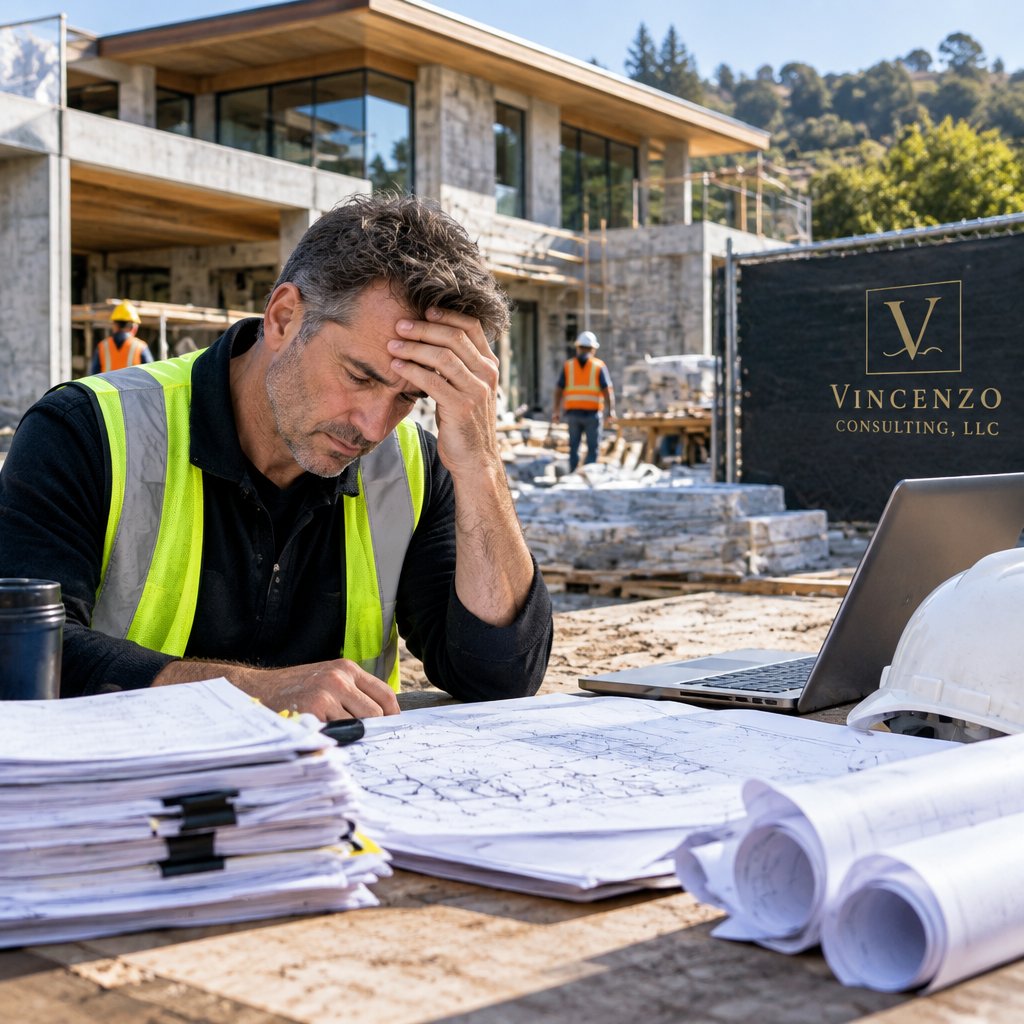
!An owner's representative and a general contractor reviewing a printed project schedule on a jobsite trailer table, with a partially framed luxury home visible through the window
Schedule Slippage and Missed Milestones
Watch for milestones that move a little with each update. A single slipped date may be a normal adjustment. A pattern of small slips across several phases usually signals weak sequencing or overcommitted trades.
Prevention starts with a baseline schedule that the general contractor signs off on. Ask for updates against that baseline every week, not just a revised completion date. Watch out: a schedule that is quietly rebaselined after every delay hides the true cost of the slippage.
Unrealistic or Incomplete Schedules
An unrealistic schedule is often a sales tool rather than a planning tool. Look for schedules that show no float, compress inspections into a single day, or omit lead times for custom materials. Ask the general contractor to walk you through the critical path and to explain which activity would delay the finish date if it slipped.
Budget Overruns and Weak Cost Control
Cost problems tend to appear late, when the options for correction are narrow. Warning signs include a budget that is never reconciled against committed costs, contingency that disappears without explanation, and invoices that arrive without matching purchase orders.
Ask for a monthly report that compares budget, committed cost, and actual cost by line item. If the report only shows total spend, the general contractor may not be tracking the details that matter. Owners who review this report regularly catch overruns while there is still room to decide what to cut or defer.
Communication Breakdowns and Lack of Project Visibility
Poor communication rarely looks dramatic. It shows up as a request for information that sits unanswered for a week, a decision made in a hallway conversation, or a progress report that lists activities performed but never states whether the project is ahead or behind. Project information often stays trapped in email threads, text messages, and personal files rather than a shared system.
The practical problem for an owner is that communication failures are hard to separate from ordinary project noise. The way to tell the difference is to track observable signals rather than impressions. Three signals matter most: how long requests for information stay open, how often submittals are returned for correction, and whether meeting decisions are written down and assigned to a named person with a due date. A common pattern is that unresolved requests for information and overdue submittals quietly hold up work in other trades, so the schedule slips even though no single activity looks late.
A useful threshold is to review the open-items log every week and flag anything past its promised response date. If the same request has been open across two consecutive meetings, treat it as a management problem rather than a scheduling inconvenience. Most practitioners find that a small number of stuck decisions cause a disproportionate share of delay, and those decisions are usually visible in the log long before they appear in the schedule.
A practical response is to require one shared source of truth for requests for information, submittals, and approvals, with a named owner and a response deadline for each item. Set a fixed weekly meeting with written minutes that record decisions, owners, and dates. If decisions are not written down within a day, treat that gap as a risk to the project. When you raise a concern, keep it specific and factual: state the item, the date it was requested, the date it was promised, and the work it is holding up. That framing keeps the conversation on the project rather than on personalities.
Watch out: verbal approvals and side conversations are the most common source of disputes later, because each side remembers the agreement differently. Confirm every decision in writing the same day, even when the decision itself was made on site.
Scope Creep and Unmanaged Change Orders
Scope creep rarely comes from one large request. It builds through many small changes that are approved informally, priced later, or never priced at all. Change orders that lack clear descriptions, cost breakdowns, and schedule impacts are a common sign that the scope is no longer under control.
Require a written change order before any work outside the contract begins, including a stated cost and time impact. Keep a running log that the owner can review at any time. Watch out: verbal approvals on site are the most common source of disputes later, because each side remembers the agreement differently.
How to Monitor General Contractor Performance Without Micromanaging
Monitoring does not mean standing over the crew. It means setting measurable indicators, reviewing them on a steady rhythm, and knowing in advance what you will do when a number moves the wrong way. The table below turns broad warnings into trackable signals an owner can review without needing to interpret daily field activity.
| Area | What to Track | Review Frequency | Warning Threshold |
|---|---|---|---|
| Schedule | Milestones versus baseline | Weekly | Any milestone variance that grows across two consecutive updates |
| Cost | Budget, committed, and actual spend | Monthly | Forecast-to-budget change without an approved change order |
| Changes | Open and priced change orders | Weekly | Work started before a written change order is issued |
| Communication | Overdue requests and decisions | Weekly | Same item open across two consecutive meetings |
| Quality | Inspection failures and rework | Monthly | Repeat failures on the same trade or assembly |
These thresholds matter because they separate an isolated issue from a pattern. A single slipped date, one late submittal, or one failed inspection is ordinary project life. The signal to act on is repetition: the same milestone slipping update after update, the same request staying open, or the same trade failing inspection more than once. That pattern is what distinguishes a management problem from a bad week.
Not every warning sign is mismanagement, and an owner who treats every disruption as a contractor failure will damage a working relationship. Weather, owner-directed changes, permitting delays, and supply-chain constraints can all move a schedule without any management failure. Before escalating, ask three questions: was the cause within the general contractor's control, was it foreseeable, and did the contractor give timely notice and propose a recovery step? A contractor who flags a risk early and offers a plan is behaving differently from one who reports a surprise after the fact.
When a pattern does appear, escalate in proportion. Start with a written request for a recovery plan that states the cause, the corrective action, the responsible party, and the date the project returns to baseline. If the pattern continues, move to a formal meeting with written minutes and a corrective-action plan with dated commitments. If commitments are still missed, seek professional advice on contract remedies. Keeping a simple evidence file as you go makes each step easier: schedules and updates, meeting minutes, change orders, payment records, inspection reports, and written notices. Preserve them in one place from the first month, because reconstructing a paper trail after a dispute begins is far harder than maintaining one as the project runs.
Owners still need clear reporting standards to tell good performance from poor performance, whatever the market for general contractors looks like. Consider a structured review with the general contractor each month using this table as the agenda, and record the commitments made in that meeting alongside your evidence file.
Building Accountability Into Your Next Construction Project
Accountability is easiest to build before construction starts. Put the reporting requirements, change order process, and schedule baseline into the contract. Define who approves what, how quickly responses are expected, and what happens when milestones are missed.
Vincenzo Consulting, LLC provides owner's representation with a focus on financial discipline, clear scope, and disciplined schedule management, so problems stay visible while they are still manageable.
For a deeper look at managing general contractor accountability, read our guide on managing general contractor accountability issues. Owners worried about delays can also review how to prevent luxury construction delays, and those tracking budget risk can see how to mitigate risks in commercial construction. When scope changes start piling up, how to control construction change orders explains the process in detail, and how owners and GCs can communicate better covers the reporting habits that keep projects visible.
Contact Vincenzo Consulting, LLC at Vincenzoconsultingllc.com or by email to discuss how owner's representation can protect your next project.
Frequently Asked Questions
What are the primary red flags of construction project mismanagement?
The most reliable red flags are schedules that slip without a recovery plan, cost reports that do not reconcile with invoices, change orders that arrive after work is already underway, and a general contractor who cannot explain the critical path in plain terms. Any one of these deserves a direct question. Two or more together usually signal that planning, cost control, or communication is failing. Document each issue with dates and written responses so you can measure whether the contractor corrects it.
How can an owner identify if a general contractor is failing to manage the schedule?
Ask for the current schedule and compare it to the baseline schedule signed at contract. Look for milestones that have moved without a written change request, activities with no logical predecessors, and float that disappears over several reporting periods. A contractor managing the schedule well can show exactly which activities drive the completion date and what is being done to protect it.
How do you distinguish between minor delays and serious project mismanagement?
Minor delays are usually caused by weather, late deliveries, or permit timing and are reported early with a recovery plan. Mismanagement shows up as repeated delays with the same root cause, delays discovered late, or no change to the approach after problems are raised. The pattern and the response matter more than any single slipped date.
What role does owner's representation play in preventing construction mismanagement?
An owner's representative works for the owner, not the contractor, which lets them verify schedule, cost, and quality claims independently. Vincenzo Consulting, LLC provides this oversight for ultra-luxury residential, commercial, and infrastructure projects. Pricing depends on project scope and schedule, so contact Vincenzo Consulting, LLC through its website at https://vincenzoconsulting.com/ or email for a quote. Contact details: Vincenzo Consulting, LLC, https://vincenzoconsulting.com/.