 how-to
Independent Construction Advocate for Developers
Table of Contents
- What an Independent Construction Advocate Does for Developers
- When Developers Need Independent Construction Expertise and Advisory Support
- Owner's Representative Responsibilities Explained
- Construction Project Oversight: Progress Verification and Technical Review
- Construction Budget and Schedule Management for Developers
- Owner's Representative Selection Criteria: How to Vet an Advocate
- Fees, Engagement Models, and Cost Control
- Conclusion
- Frequently Asked Questions
Last Updated: October 6, 2026
What an Independent Construction Advocate Does for Developers
An independent construction advocate is a third-party professional who represents the developer's interests across a project's full lifecycle, from planning through closeout.
Most developers hire a general contractor and assume the contract protects them. It doesn't. The contract sets the rules; someone still has to enforce them daily.
The distinction matters because the person managing construction usually works for the builder, not for you.
Advocate vs. Owner's Representative: Key Differences
The two terms overlap, and plenty of firms use them interchangeably. In practice, an advocate is the broader role.
- Independent construction advocate: Represents only the owner. Reviews budgets, schedules, contracts, and site conditions. Flags risk early.
- Owner's representative: A specific engagement model. Acts as your authorized agent with the contractor, architect, and vendors.
- Project manager: Often employed by the contractor. Manages the work, not the owner's exposure.
An advocate can serve as your owner's representative, but the reverse isn't always true. Some representatives are tied to a builder or a development partner. That's a conflict, not representation.
When Developers Need Independent Construction Expertise and Advisory Support
You need independent construction expertise the moment a project's cost, complexity, or stakes outgrow your ability to verify what you're being told. For a $12M custom estate or a multi-stakeholder commercial build, that point arrives before the first shovel hits the ground.
The U.S. Small Business Administration's guide to construction contracting notes that unclear scope and payment terms are recurring sources of disputes for small and mid-size developers. An advocate closes that gap before it becomes a claim.
Here's the practical trigger list.
Red Flags That Signal It's Time to Bring in an Advocate
- Change orders arriving without backup documentation
- Schedule updates that slip quietly, week after week
- Draw requests that don't match observed progress
One or two of these is normal noise. Three or more means you're already exposed.
Owner's Representative Responsibilities Explained
Owner's representative responsibilities center on four things: budget, schedule, quality, and accountability. The representative is your single point of authority on the project, translating your objectives into instructions the builder must follow.
In practice, that means:
- Reviewing and approving contractor pay applications
- Tracking the project schedule against milestones
- Verifying that work meets the contract and drawings
- Managing change order review and negotiation
The role is not to run the job. It's to hold everyone accountable to the job you paid for.
Construction Project Oversight: Progress Verification and Technical Review
Construction project oversight is the discipline of confirming that what's billed is what's built. Progress verification and technical review are the two mechanisms that make it work.
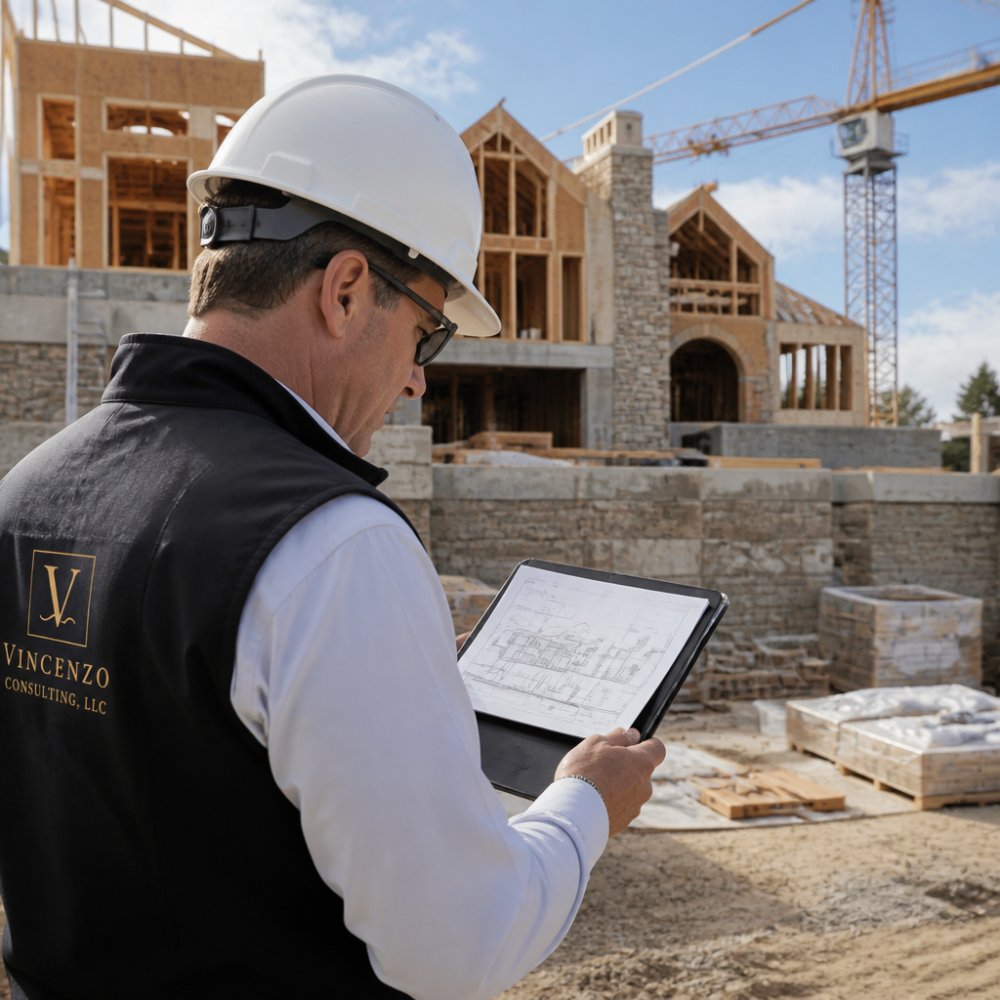
Progress verification means walking the site, comparing installed work to the schedule and the pay application, and documenting the gap.
A common mistake is treating the contractor's own report as verification. It isn't. It's a claim, and claims need independent confirmation.
Delay Analysis and Claims Documentation
Delay analysis identifies what actually caused a schedule slip and who owns the cost. Good documentation, daily logs, photo records, and dated correspondence, is what makes a claim defensible or dismissible.
Without it, every delay becomes a negotiation you lose by default.
Construction Budget and Schedule Management for Developers
Construction budget and schedule management is where advocacy pays for itself. Contingency is not a cushion for the contractor's mistakes; it's your reserve for genuine unknowns.
We track three numbers on every project:
| Metric | What It Tracks | Why It Matters |
|---|---|---|
| Committed cost | Signed contracts and POs | Shows real exposure, not estimates |
| Forecast to complete | Remaining work at current pricing | Reveals overruns before they land |
| Schedule float | Days of slack per milestone | Tells you how much delay you can absorb |
When committed cost plus forecast to complete exceeds budget, you need to know that in the same month it happens, not at closeout.
Owner's Representative Selection Criteria: How to Vet an Advocate
Most ranking pages tell you to "hire someone experienced." That is not a selection criterion, it is a wish.
Start by defining the engagement before you interview anyone. Write a one-page scope that states the project type, contract delivery method (design-bid-build, design-build, or construction management at risk), budget range, schedule, and the specific decisions you want the advocate to own.
A Practical Scoring Framework
Score each finalist on a 1-5 scale across six weighted categories. The weights below reflect what most developers find drives outcomes; adjust them to your project.
| Category | Weight | What a 5 Looks Like |
|---|---|---|
| Independence | 25% | No current or recent financial ties to any contractor, subcontractor, vendor, or lender on your project; disclosed in writing |
| Relevant project experience | 20% | Has overseen at least two projects of similar type, size, and delivery method in the last five years |
| Technical and contractual depth | 20% | Can read drawings, specs, submittals, schedules, and pay applications, and can explain contract risk allocation |
| Reporting and communication | 15% | Provides a sample monthly report and a defined escalation path |
| Authority and decision rights | 10% | Clear written limits on what they can approve, direct, or commit you to |
| References and reputation | 10% | Verifiable references from owners, not just contractors |
A candidate who scores below a 3 in Independence should be eliminated regardless of total score. Independence is not a nice-to-have; it is the product.
The Conflict Check You Must Run Yourself
Do not rely on a candidate's verbal assurance of independence. Ask for a written conflict disclosure that lists:
- Every contractor, subcontractor, and vendor they have worked for in the last three years
- Any ownership interest, referral fee, or revenue-sharing arrangement with any project participant
- Any lender, surety, or insurance relationship that could influence their advice
- Any family or business relationship with anyone on your project team
Then verify. Call the contractor they list and ask how the engagement ended. Call the references they did not list. A pattern of short engagements that ended in disputes is a signal.
Questions That Separate Real Advocates From Salespeople
- "Walk me through a project where you told the owner something they did not want to hear. What happened?"
- "Show me a monthly report you actually delivered, with the owner's name redacted."
- "What is your authority when a contractor refuses to correct nonconforming work?"
- "How do you handle a change order you believe is unjustified?"
Listen for specifics. A real advocate will describe a mechanism, a document, or a decision. A salesperson will describe a philosophy.
Fit for Project Type Matters More Than Firm Size
A firm that is excellent on infrastructure may be wrong for a waterfront estate, and vice versa. Ask for the names of two projects in your asset class and call the owners directly. If the advocate cannot provide owner references, that is your answer.
The American Institute of Architects' guidance on owner-architect-contractor relationships is a useful reference for understanding how the parties should interact before you engage anyone.
Fees, Engagement Models, and Cost Control
The ranking pages either ignore fees or wave at them. That is a gap, because a developer cannot approve an engagement without understanding how it is priced, what drives the number, and how to tell whether it is working. What follows is the structure of the market, not a quote.
The Three Engagement Models
Monthly retainer. A fixed monthly amount for a defined scope of oversight: site visits, report production, pay application review, and availability for decisions.
Percentage of project cost. A fee calculated as a percentage of hard or total project cost. This scales with project size and is common on large builds.
Fixed-fee phases. A price per stage: feasibility, procurement, construction, handover, or dispute.
Many engagements blend these.
What Actually Drives the Number
- Project size and duration. Longer builds mean more reporting cycles and more site visits.
- Number of site visits. Weekly visits cost more than monthly; agree the cadence up front.
- Complexity of the delivery method. Design-build and construction management at risk shift risk in ways that require more contract review.
- Number of pay applications and change orders. High transaction volume means more review hours.
How to Compare Proposals
Do not compare headline numbers. Compare scope. Two proposals at the same monthly figure can differ enormously in site visit frequency, report depth, and who does the work. Ask each candidate to price the same written scope, then compare line by line.
Require these in every proposal:
- A written scope of services with deliverables named
- The reporting cadence and a sample report
- Site visit frequency and who attends
- Named personnel and their roles
Cost Control Comes From Early Detection
Cost control is not negotiating the advocate's fee down. It is catching problems while they are still cheap to fix. A change order caught before work is performed is a conversation; the same change order caught after is a claim. The value of oversight shows up in the change orders that never happen and the pay applications that get corrected before payment.
Track three indicators monthly and ask your advocate to report them:
- Change order volume and value as a percentage of original contract
- Pay application variance between amount requested and amount verified
- Schedule float consumed versus float remaining
If those numbers are not moving in your favor, the engagement is not working, regardless of the fee.
Vincenzo Consulting, LLC | [website] | [email] | [Logo]
Conclusion
An independent construction advocate protects the one thing a developer can't recover once it's gone: use. The right oversight catches cost overruns, delays, and quality gaps while they're still cheap to fix. Vincenzo Consulting, LLC brings more than 35 years of executive leadership to owner's representation, with discreet, white-glove oversight built around financial discipline and accountability. For developers who want predictable results, the advocate isn't a cost, it's the control system.
Frequently Asked Questions
What does an independent construction advocate do for a developer?
An independent construction advocate represents the developer's interests throughout a project, from pre-construction planning through closeout. They verify construction progress, review technical documents, monitor budget and schedule adherence, and provide an independent report on contractor performance. Unlike a general contractor or project manager employed by the builder, the advocate has no financial ties to the construction team, so their recommendations serve only the owner. This independence helps catch cost overruns, scope creep, and quality issues before they escalate.
How is a construction advocate different from an owner's representative?
The terms often overlap, but an independent construction advocate typically operates with a narrower, conflict-free mandate focused on protecting the developer from contractor-side pressures. An owner's representative may handle broader project management duties and could be embedded in the project team. The advocate's role emphasizes independent verification, technical review, and accountability. In practice, many developers use the titles interchangeably, but the key distinction is independence: an advocate has no stake in the contractor's profitability or schedule claims.
When should a developer hire an independent construction advocate?
Bring in an advocate before breaking ground on complex or high-value projects, especially when the developer lacks in-house construction expertise or when multiple stakeholders are involved. Warning signs include vague contractor estimates, missing schedule updates, frequent change orders, or a general contractor who resists third-party review. For ultra-luxury residential or large commercial builds, early engagement during design and contract negotiation often prevents disputes that would cost far more to resolve later.
What should developers look for when choosing an owner's representative?
Prioritize direct construction leadership experience, a track record on projects of similar scale and complexity, and clear independence from contractors and suppliers. Ask for references from recent engagements and specific examples of how they resolved budget or schedule disputes. The best advocates combine technical knowledge with financial discipline and can produce written reports that hold up in negotiations or legal proceedings. Also confirm their authority: will they advise, or can they make binding decisions on your behalf?