 how-to
Managing Climate-Resilient Infrastructure Projects
Last Updated: October 23, 2026
Quick Summary
Managing climate-resilient infrastructure requires embedding climate resilience into planning, design, construction, and operations rather than treating it as an afterthought. Climate-resilient infrastructure is designed to anticipate, prepare for, and adapt to climate hazards while maintaining essential services during extreme weather events and long-term climate shifts.
- The global climate resilience infrastructure market was valued at USD 159.4 billion as of 2025, with projected growth at 9.8% CAGR from 2026 to 2034.
- Conduct climate risk assessment using three to four scenarios, conservative, moderate, and aggressive warming, to guide design decisions.
- Convert resilience design intent into measurable specifications with acceptance criteria, and protect resilience-critical items from value engineering through contract controls.
- Define six to ten resilience indicators with baselines and targets before operations begin, tied to design scenarios and reviewed on a fixed cadence.
- Establish trigger points in advance that force management response when stress events exceed design assumptions or indicators miss targets in consecutive periods.
Table of Contents
- Understanding Climate-Resilient Infrastructure Development
- Conducting Climate Risk Assessment for Infrastructure Projects
- Climate-Resilient Infrastructure Planning and Programming
- Climate-Resilient Infrastructure Design and Construction
- Climate Resilience Monitoring and Evaluation Throughout Operations
- Cross-Sector Coordination and Stakeholder Management
- Managing Costs, Timelines, and Risk Mitigation
- Frequently Asked Questions
Understanding Climate-Resilient Infrastructure Development
Managing climate-resilient infrastructure development projects requires a fundamental shift in planning, design, and execution. At Vincenzo Consulting, LLC, we guide complex infrastructure initiatives through the full lifecycle, embedding climate resilience in every decision rather than bolting it on as an afterthought.
Climate-resilient infrastructure is designed and managed to anticipate, prepare for, and adapt to climate hazards while maintaining essential services during extreme weather events and long-term climate shifts. The sector is projected to expand at a CAGR of 9.8% from 2026 to 2034 Growth Market Reports climate resilience projections.
The real challenge is executing resilience systematically across planning, design, construction, and operations while managing competing stakeholder interests, budget constraints, and tight timelines. Below is the practical end-to-end workflow.
Conducting Climate Risk Assessment for Infrastructure Projects
Climate risk assessment is the foundation of any resilient infrastructure project. Without a rigorous understanding of exposure and vulnerability, you're building blind.
Identifying Exposure and Vulnerability
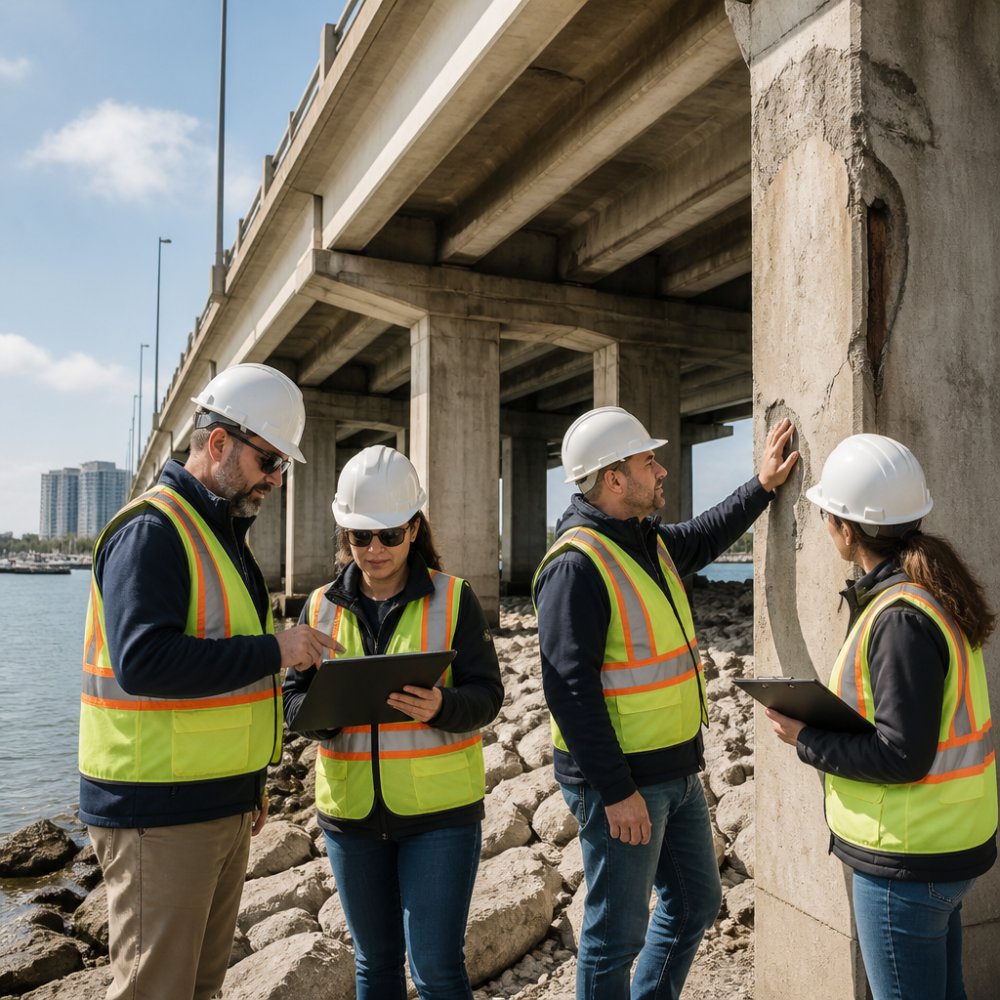
Start by mapping what your infrastructure faces. Exposure asks which climate hazards affect this location; vulnerability asks how susceptible the asset is to them.
Exposure includes flood risk from extreme precipitation or storm surge, drought stress on water supply, heat waves affecting energy demand and material performance, and extreme wind.
Vulnerability depends on design, materials, age, and maintenance state: a 50-year-old water treatment plant differs from a new one.
Selecting Climate Scenarios and Data Tools
Don't rely on a single climate projection. Most climate-resilient infrastructure projects use three to four scenarios, conservative, moderate, and aggressive warming, sometimes adding a "business as usual" baseline for comparison.
Access climate data through established sources: the National Climate Assessment, NOAA, or downscaled regional models. Tools like the World Bank's CREWS and the Climate Resilience Toolkit offer structured frameworks for scenario selection; the choice depends on project scale, budget, and technical capacity.
Climate-Resilient Infrastructure Planning and Programming
Once you understand your climate risks, translate that knowledge into your project pipeline and investment strategy.
Integrating Resilience Into Project Proposals
Every project proposal should answer three questions: What climate hazards does this asset face? How does the project reduce exposure or vulnerability to them? What is the cost-benefit of the resilience measures included?
Frame resilience as a core project objective, not an optional add-on. In your project charter, define resilience performance targets, for example, "This water system will maintain 95% service continuity during a 100-year flood event." These targets drive design decisions and clarify what resilience means for stakeholders.
Document the climate scenarios your design team used and the adaptation measures chosen to address them. According to OECD infrastructure investment guidance, an annual investment of USD 6.9 trillion in sustainable infrastructure is needed globally by 2030, underscoring the scale of capital required and the importance of clear business cases.
Alignment Across Scope, Budget, and Schedule
Resilience measures often add cost and complexity. Your job is to align scope, budget, and schedule so climate adaptation doesn't derail the project.
Work with design and construction teams early to identify cost drivers.
Build contingency into budget and schedule. Climate-resilient infrastructure projects often require additional budget for resilience measures beyond standard design.
Climate-Resilient Infrastructure Design and Construction
This is where resilience becomes tangible, and where most projects lose it. Design intent not written into specifications, contracts, and verification steps will be value-engineered away or built incorrectly. The discipline is translating climate risk assessment into enforceable requirements and verifying them on site.
Design Strategies Mapped to Specific Hazards
Match the design response to the dominant hazard and the failure mode that matters most:
- Flood: elevate critical equipment above the design flood elevation, specify flood-resistant materials below that elevation, and use green infrastructure such as bioswales and rain gardens to slow and absorb stormwater before it reaches critical assets. Add backflow prevention and sealed penetrations.
- Drought: design storage capacity, recycling loops, and demand-management controls; specify low-flow fixtures and leak-detection systems; plan for source redundancy.
- Extreme heat: specify concrete mixes and asphalt binders rated for projected peak temperatures, design passive cooling through shading and ventilation, and protect heat-sensitive equipment with rated enclosures.
Nature-based solutions, wetland restoration, mangrove protection, urban tree canopy, often deliver resilience at lower cost than gray alternatives while providing co-benefits such as recreation and habitat. Match the strategy to the hazard and context; a coastal flood design looks nothing like an inland drought design.
Turning Resilience Intent into Specifications
A design narrative is not a specification. Convert each resilience measure into a written requirement with a measurable acceptance criterion:
- Design intent: "Protect the pump station from design flood." Specification: "All electrical and mechanical equipment shall be installed at or above elevation [X], with flood-resistant enclosures rated to [standard], and backflow prevention on all discharge lines."
- Design intent: "Withstand projected heat." Specification: "Asphalt binder grade shall be [grade] per [standard]; concrete mix shall be rated for [temperature]; expansion joints shall accommodate [movement]."
- Design intent: "Maintain service during event." Specification: "Backup power shall provide [hours] of autonomy at full load, with automatic transfer within [seconds] and monthly testing."
Reference applicable design and material standards so contractors and inspectors have an objective benchmark. Where no standard exists, define the acceptance criterion in measurable terms and require test or certification evidence.
Resilience measures are frequent targets in value-engineering exercises because their benefit is invisible in normal operations. Protect them by listing resilience-critical items as non-substitutable in the contract and requiring owner approval for any substitution.
Procurement and Contract Mechanisms
Translate resilience requirements into procurement documents and the contract itself:
- Specifications: include resilience requirements in the technical specifications, not in a separate appendix that gets ignored.
- Contractor responsibilities: assign explicit responsibility for installing, testing, and commissioning resilience-critical systems, with named deliverables and acceptance criteria.
- Submittals: require shop drawings, material certifications, and test reports for resilience-critical components before installation.
These mechanisms convert resilience from an aspiration into a contractual obligation with evidence.
Construction Verification and Acceptance
Inspection during construction is where resilience is confirmed or lost. Build a verification plan identifying resilience-critical components, inspection methods, and acceptance criteria.
At substantial completion, require a resilience commissioning report documenting each measure, the verification performed, the results, and any open items with a closure schedule. Hand it to the operations team as the baseline for monitoring.
Resilience survives construction only when it is specified, contracted, and verified. Write measurable acceptance criteria, protect resilience-critical items from substitution, and require commissioning evidence at handover.
Coordinating Design and Construction Teams Early
Bring design and construction teams together before specifications are finalized.
For foundational risk management frameworks that support these decisions, see 5 Best Practices for Infrastructure Risk Management and Managing Complex Infrastructure Project Risks in 2026. For stakeholder coordination across sectors during design and construction, consult Managing Multiple Stakeholders in Construction.
Vincenzo Consulting, LLC supports owners through design review, specification development, procurement, and construction verification for climate-resilient infrastructure. Contact us at [website] or [email] to discuss your project.
[Logo] Vincenzo Consulting, LLC [website] [email]
Match design strategies to the specific climate hazards your infrastructure faces, with tailored measures for each threat.
| Hazard | Design Strategy | Key Measures |
|---|---|---|
| Flood | Elevate and protect critical assets | Elevate equipment above design flood elevation, use flood-resistant materials, add backflow prevention |
| Drought | Ensure water availability and efficiency | Design storage capacity, recycling loops, low-flow fixtures, source redundancy |
| Extreme heat | Manage temperature stress on materials | Specify concrete and asphalt rated for peak temperatures, design passive cooling, protect equipment |
| Extreme wind | Reinforce structural integrity | Specify reinforced connections, higher wind-load ratings, impact-resistant envelopes |
Climate Resilience Monitoring and Evaluation Throughout Operations
Resilience doesn't end at project handover. It must be measured, maintained, and updated throughout the asset's operational life. Treat monitoring as the feedback loop that keeps the asset performing as climate conditions change.
Defining a Measurable Resilience Indicator Set
A resilience metric is only useful with a clear definition, data source, baseline, and target. Before operations begin, agree on a small set of indicators across four dimensions: service continuity, exposure, recovery, and avoided loss. A practical starter set:
- Service continuity: percentage of customers or users served during and immediately after a design hazard event. Target example: 95% of water customers retain service during a 100-year flood.
- Downtime: hours or days of partial or full service interruption per event, tracked separately for planned and unplanned outages.
- Recovery time: elapsed time from event onset to restoration of full service. Target example: full roadway capacity restored within 72 hours of a major hurricane.
Keep the set small enough to sustain. Six to ten indicators with clear owners beat a forty-metric dashboard nobody maintains.
Establishing Baselines and Targets
A target without a baseline is a wish. Establish baselines during normal operations and the first full seasonal cycle after commissioning.
Set targets that are specific, time-bound, and tied to the design scenarios used during planning. If the design assumed moderate warming, the monitoring plan should state which indicators are tracked against that scenario and what trigger points require intervention.
Write each indicator as a sentence with a number, a timeframe, and an owner: "Recovery time for the main pump station will not exceed 48 hours after a design flood event; owner: operations manager; reviewed quarterly." This format survives audits, budget reviews, and staff turnover.
Data Collection and Reporting Cadence
Match cadence to the indicator. Service continuity and downtime should be logged continuously through SCADA, work-order, or customer-service systems.
Report to three audiences on different rhythms: operational staff weekly, management monthly or quarterly, and governing boards or funders annually. Funders increasingly ask for resilience performance evidence, so keep the format consistent year to year.
Adaptive Management and Trigger Points
Define in advance the conditions that force a management response. Common triggers include a stress event exceeding design assumptions, two or more indicator misses in consecutive periods, or updated hazard data showing exposure above the design envelope.
This feedback loop separates a resilient asset from a resilient project. The asset that learns from each event and updates its maintenance, operations, and capital plans will outperform one built to a static design assumption.
Resilience monitoring works when it is small, owned, and wired to decisions. Pick six to ten indicators, set baselines and targets before handover, report on a fixed cadence, and pre-agree the triggers that force a management response.
Tying Monitoring to Maintenance and Capital Planning
Monitoring data should feed directly into the O&M budget and multi-year capital plan. If flood-barrier inspections show declining compliance, the maintenance budget must reflect it.
For a structured project management approach that connects monitoring to delivery, reference Infrastructure Project Management: A How-To Guide. For ongoing performance oversight practices, see 7 Ways to Improve Infrastructure Project Oversight.
At Vincenzo Consulting, LLC, we help owners design resilience monitoring frameworks that survive handover and produce evidence funders and boards can act on.
Cross-Sector Coordination and Stakeholder Management
Climate-resilient infrastructure rarely exists in isolation. Transportation depends on energy, water systems depend on transportation for supply chains, and energy grids depend on water for cooling.
Coordinate across sectors to identify interdependencies and shared vulnerabilities. A flood that disrupts transportation affects water operations; a heat wave stresses energy and water simultaneously. Map these dependencies and design measures that address system-level risks, not just individual assets.
Engage stakeholders early and often. Transparent communication about climate risks and resilience trade-offs builds trust and secures support for necessary investments. World Wildlife Fund ecosystem integration guidance emphasizes that stakeholder engagement and ecosystem service integration are critical to long-term resilience outcomes.
Managing Costs, Timelines, and Risk Mitigation
Climate-resilient infrastructure projects face unique cost and schedule pressures. Resilience measures add expense. Climate risk creates uncertainty.
On schedule, build in time for climate risk assessment, scenario analysis, and stakeholder engagement.
For risk mitigation, diversify your approach. Don't rely on a single adaptation strategy.
Engage 5 Best Practices for Infrastructure Risk Management and Managing Complex Infrastructure Project Risks in 2026 for foundational risk management frameworks. For stakeholder coordination across energy, transport, and water sectors, consult Managing Multiple Stakeholders in Construction. For a structured project management approach, reference Infrastructure Project Management: A How-To Guide. Finally, for ongoing performance oversight, see 7 Ways to Improve Infrastructure Project Oversight.
Managing climate-resilient infrastructure development projects demands discipline, foresight, and systematic execution.
Frequently Asked Questions
What makes infrastructure climate-resilient?
Climate-resilient infrastructure is designed and operated to withstand climate hazards, extreme weather, flooding, drought, and temperature shifts, while maintaining service continuity. Resilience combines robust design (elevated structures, reinforced materials), adaptive operation (flexible maintenance schedules), and recovery capacity (redundant systems). The goal is to reduce disruption, protect long-term asset value, and ensure critical services remain available during climate shocks.
How do you assess climate risks for an infrastructure project?
Start by identifying exposure (which climate hazards affect your site) and vulnerability (how sensitive your infrastructure is to those hazards). Use climate scenario tools and historical data to model future conditions. Document critical failure points, where disruption would harm service or safety most. Assess both direct physical risks and indirect cascading effects across connected systems. This structured climate risk assessment forms the foundation for all downstream design and operational decisions.
How can climate resilience be incorporated into infrastructure project planning?
Integrate resilience early in the planning phase, not as an afterthought. Define resilience objectives alongside cost and schedule targets. Screen project proposals for climate risk before committing capital. Identify adaptation measures, green infrastructure, nature-based solutions, or structural upgrades, that reduce vulnerability. Build resilience requirements into procurement contracts and technical specifications. Engage cross-sector partners (energy, water, transport) to coordinate interdependent systems and avoid creating new vulnerabilities elsewhere.
How do project managers balance resilience, budget, and schedule?
Resilience investments often pay for themselves through avoided losses and reduced maintenance costs over the asset's lifetime. Conduct lifecycle cost-benefit analysis to compare upfront resilience spending against long-term recovery and repair costs. Prioritize high-impact, cost-effective measures first. Use phased implementation to spread costs across multiple budget cycles. Establish clear accountability through contracts and performance metrics. White-glove project oversight ensures every dollar aligns with your resilience and financial objectives, preventing scope creep and cost overruns.