 blog
How to Manage Commercial Construction Risk on Complex Projects
Quick Summary
Construction risk management is the process of spotting problems early, judging how serious they are, and taking steps to limit the damage. On complex commercial projects it means identifying risks by phase, scoring them by likelihood and cost, assigning an owner to each, and reviewing the register regularly.
- Score each risk by likelihood and cost impact, then rank by expected value.
- Assign a named owner to every risk and require a status update at each progress meeting.
- Choose from four levers: avoid, reduce, transfer, or accept each risk.
- Require multi-factor authentication and an incident response plan for project systems in every contract.
- Run a pre-mortem workshop with owner, design team, and key contractors before construction starts.
Table of Contents
- Why Commercial Construction Risk Management Matters Now
- Common Risks in Commercial Construction Projects
- Building a Construction Risk Management Plan
- Risk Identification, Assessment, and Mitigation Strategies
- Construction Risk Assessment Checklist for Owners
- Case Study: Risk Management in a Complex Commercial Project
- Where Owner Representation Fits in Your Risk Strategy
- Frequently Asked Questions
How to Manage Commercial Construction Risk on Complex Projects
Last Updated: November 5, 2026
Why Commercial Construction Risk Management Matters Now
Construction risk management is the process of spotting problems early, judging how serious they are, and taking steps to limit the damage.
Right now, the pressure is building. According to ABC Carolinas 2026 contractor risk playbook, input costs for construction projects are rising 3.6% year over year. The same source reports that the Construction Backlog Indicator has reached a four-year low.
Costs and workloads are not the only concern. The Arch Construction Risk Report 2026 found that 85% of organizations reported higher risk exposure over the previous 12 months. Geopolitical instability was the top concern for 59% of respondents.
Owners who treat risk as a planning task, not a reaction, are better placed to absorb these shocks.
Common Risks in Commercial Construction Projects
Most commercial projects face the same core risks. Knowing them in advance makes them easier to control.
- Cost risk: Material and labor prices rise between bid and build.
- Schedule risk: Permits, deliveries, and weather push milestones back.
- Safety risk: Work at height, heavy equipment, and crowded sites raise incident rates.
- Contract risk: Vague scope and weak change order rules invite disputes.
- Coordination risk: Multiple contractors and stakeholders often work against each other.
- Insurance and liability risk: Gaps in coverage can leave the owner exposed.
Complex projects add their own layer. Megaprojects face extreme uncertainties that standard risk models can miss, according to StudyCorgi analysis of megaproject risk. Plan for the risks you can see, and also for the ones that do not fit a template.
Building a Construction Risk Management Plan
A written risk management plan turns good intentions into a working process. Start with the project's goals, then list every risk you can think of.
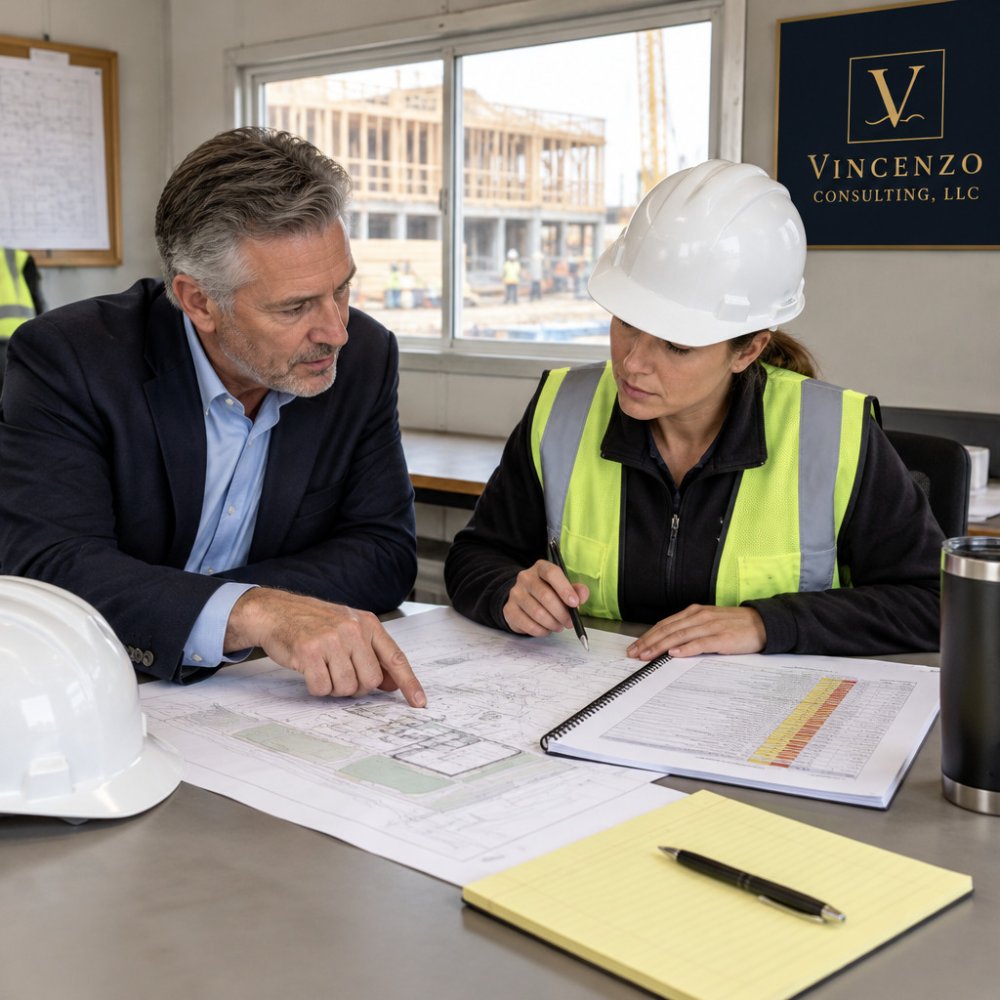
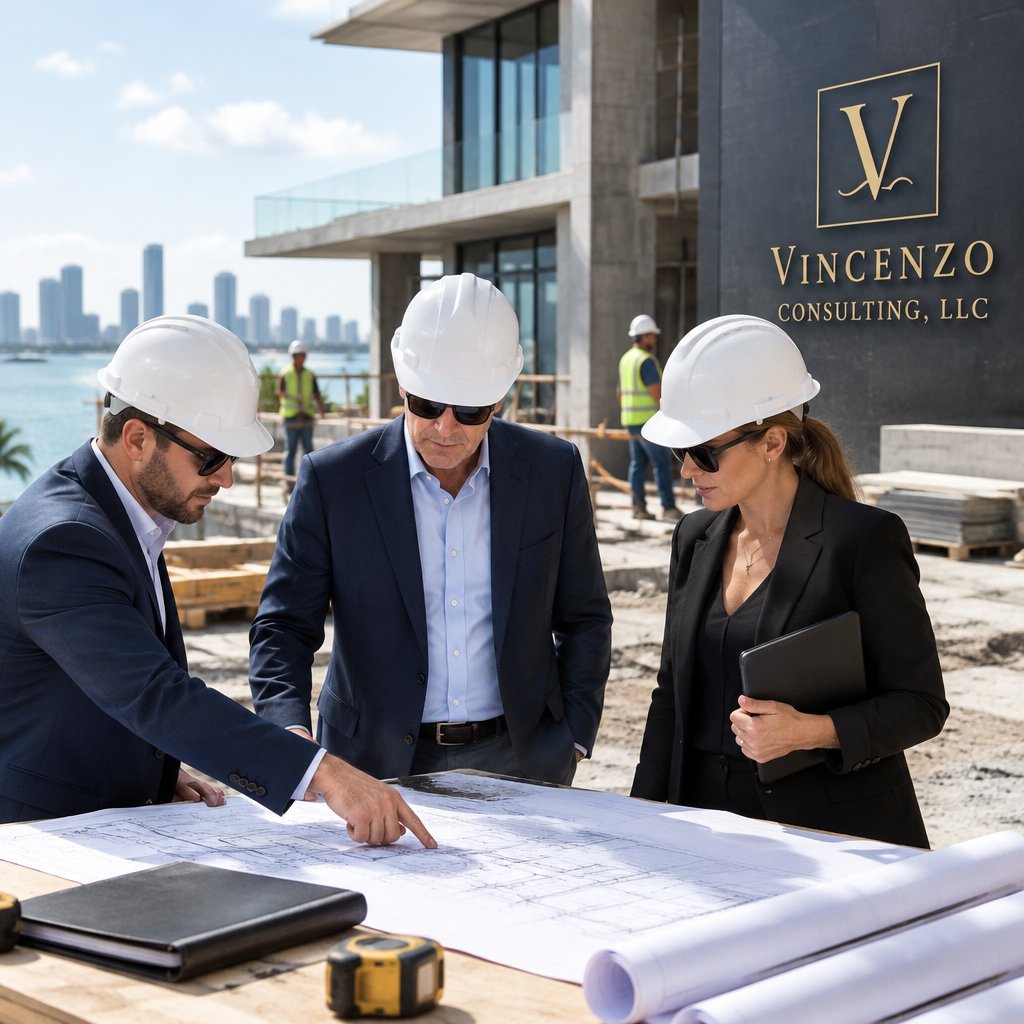
!A project owner and construction manager reviewing a printed site plan and risk register together at a jobsite trailer table
Build the plan around four steps:
- Identify risks for each phase, from design through closeout.
- Assess each risk by how likely it is and how much it would cost.
- Assign an owner to every risk who is responsible for watching it.
- Review the register at regular intervals and after major changes.
The plan should live in one place that all parties can access. A risk register that nobody reads does not protect anyone. For practical examples of how an owner representative runs this work, see our guide to 7 Ways an Owner Representative Manages Construction Risk.
Risk Identification, Assessment, and Mitigation Strategies
Identification finds the risks. Assessment ranks them. Mitigation reduces them. The sections below show how the process runs on a modern commercial project.
Identification: go beyond the standard risk list
Start with a structured prompt list organized by phase (design, procurement, construction, closeout) and by category (cost, schedule, safety, contract, coordination, insurance). Then push past the obvious. Most practitioners find that the highest-impact risks on complex projects are the ones that cross categories, such as a permit delay that cascades into a schedule slip and then into a labor cost overrun.
Two identification techniques separate strong teams from weak ones:
- Pre-mortem workshops. Before construction starts, gather the owner, design team, and key contractors and ask: "It is 18 months from now and this project failed. Why?" The exercise surfaces risks that a checklist misses because it forces the team to reason backward from failure.
Watch out: a risk register that is updated only at phase gates goes stale within weeks on a fast-moving commercial job. Assign a named owner to each risk and require a status update at every progress meeting, not just at milestones.
Assessment: rank by expected value, not by gut feel
Score each risk on two axes: likelihood and cost impact. Multiply them to get an expected value, then rank. A risk with a 20% chance of a $500,000 overrun has an expected value of $100,000 and should outrank a near-certain $20,000 issue. This simple math forces the conversation away from the loudest voice in the room.
For schedule risk, run a simple Monte Carlo simulation on the critical path. Free and low-cost tools can model the range of completion dates rather than a single date. Owners who see a P50 and P80 completion date make better decisions about contingency than owners who see one number.
Mitigation: four levers, applied deliberately
- Avoid: Change the design or scope so the risk no longer exists. Example: specify a pre-fabricated system that removes a weather-sensitive site activity.
- Reduce: Add inspections, safety training, design reviews, or mock-ups. This is the most common lever and the easiest to overuse.
- Transfer: Use contracts, bonds, and insurance to move cost to another party. Transfer works only when the other party can actually bear the risk; a subcontractor with thin capitalization cannot absorb a large claim.
- Accept: Keep small, known risks and set aside a contingency budget sized to the expected value of the accepted risks.
A federal framework can help structure this work. Federal Highway Administration SHRP2 R09 risk management case studies describes applying the R09 risk management process to infrastructure projects. Its central lesson is that a structured approach to identifying and mitigating risks improves project outcomes.
The risk most guides miss: cybersecurity
As construction becomes more digitized, project data, BIM models, payment systems, and subcontractor portals become targets. A ransomware attack on a project management platform can halt progress, expose confidential bid data, and trigger contractual disputes over delay.
Practical steps owners can require in every contract:
- Multi-factor authentication on all project management and payment systems.
- A written incident response plan that names who calls whom when a breach occurs.
- Cyber liability coverage reviewed alongside general liability, with limits sized to the project's data exposure.
- Vendor security requirements for any subcontractor or software provider that touches project data.
Research on construction risk management points to a systematic approach as the key to success, as shown in the Chalmers University risk management study. Risk becomes easier to manage once it is written down, scored, assigned, and reviewed against real project data rather than memory.
The four mitigation levers the article describes, each with its use and its main caution.
| Lever | Best for | Key caution |
|---|---|---|
| Avoid | Removing a risk by changing design or scope | Changes the design or scope itself |
| Reduce | Inspections, safety training, design reviews, mock-ups | Easy to overuse |
| Transfer | Moving cost via contracts, bonds, insurance | Only works if the other party can bear the risk |
| Accept | Small, known risks covered by contingency | Contingency must match expected value of accepted risks |
Construction Risk Assessment Checklist for Owners
A checklist is only useful if it drives decisions. The version below is organized by the phase in which each item matters most, so owners can use it as a working tool rather than a one-time read. Pair it with the risk register described earlier and review it at every phase gate.
Pre-design and design phase
- Are scope, budget, and schedule documented and agreed by all parties?
- Has a pre-mortem workshop been held with the owner, design team, and key contractors?
- Have all permits and approvals been identified, with realistic timelines and named owners?
- Is there a plan for long-lead materials, including early procurement or pre-order clauses?
- Has a digital twin or predictive schedule model been scoped, with a named person responsible for data quality?
Procurement and contracting phase
- Is the change order process written into every contract, with clear pricing rules and time limits?
- Does each contractor carry the insurance the project requires, and have certificates been verified?
- Are cyber liability and incident response requirements included in every contract that touches project data?
- Have subcontractor financials been reviewed so risk transfer actually holds?
- Is there a contingency budget sized to the expected value of accepted risks?
Construction phase
- Has site safety been reviewed with every crew, including new hires and subcontractors?
- Is someone responsible for tracking each open risk, with a status update at every progress meeting?
- Are cost and schedule reports reviewed at least monthly against the predictive model?
- Is there a documented process for supply chain disruptions, including alternate suppliers and material substitution approvals?
- Are mental health and labor availability risks tracked alongside schedule and cost?
Closeout phase
- Are punch list items tracked with owners and deadlines?
- Have warranties, as-builts, and O&M manuals been collected and verified?
- Has final insurance and lien release documentation been confirmed?
- Has a lessons-learned review been scheduled to update the risk register for the next project?
The checklist is a starting point, not a substitute for judgment. Adjust it to the size and type of your project, and treat any unchecked box as an open risk with an assigned owner.
For a downloadable version of this checklist and a sample risk register template, contact Vincenzo Consulting, LLC through our website or email below.
Vincenzo Consulting, LLC
[Logo]
Website: [your website]
Email: [your email]
Case Study: Risk Management in a Complex Commercial Project
Consider a mixed-use commercial build with several contractors and tight deadlines. Early in design, the owner's team listed the top risks: permit delays, steel price swings, and coordination between trades. Each risk received an owner and a monthly review.
When steel prices rose mid-project, the team had already written procurement clauses that allowed early ordering. The schedule absorbed the change without a major delay. The lesson is that the value of risk management lies in acting before a problem becomes a crisis, not in predicting every event.
Where Owner Representation Fits in Your Risk Strategy
Many owners lack the time or in-house staff to run this process daily. For a clear definition of what that role covers, read What Is Owner's Representation for Complex Commercial Developments?.
Owners weighing this role should compare how providers select and oversee projects. Our guide on how to select construction oversight covers what to look for. You can also check whether the investment fits your project in Is Owner Representation Worth It? 2026 Guide.
The right partner strengthens the risk plan you build here. The owner stays in control, while a dedicated advocate keeps the plan working day to day. Vincenzo Consulting, LLC, led by Paul V. Facchina Jr., brings more than 35 years of executive leadership to that work.
Frequently Asked Questions
What is construction risk management?
Construction risk management is the ongoing process of identifying, assessing, and responding to events that could affect a project's cost, schedule, safety, or quality. On commercial projects it covers financial exposure, subcontractor performance, permitting delays, design gaps, and supply chain disruption. Effective programs assign each risk an owner, a response, and a review date, so issues are handled before they reach the budget or the schedule.
What are the top safety risks in commercial construction?
The most serious safety risks on commercial sites include falls from height, struck-by incidents from materials or equipment, electrocution, trench collapse, and caught-in or caught-between hazards around heavy machinery. Each of these is governed by OSHA construction standards, which require documented hazard assessments and training. A risk plan should name the responsible safety lead for each hazard and require inspections before high-risk work begins.
What are some effective risk mitigation strategies in construction?
Common mitigation strategies include transferring risk through insurance and well-drafted contracts, avoiding risk by changing design or sequencing, reducing exposure with contingency funds and early procurement, and accepting small, well-understood risks with a reserve set aside for them. Strong contracts clarify who bears delay and change costs, and regular schedule reviews catch slippage early enough to correct it.
What role does an owner's representative play in construction risk management?
An owner's representative acts on the owner's behalf to monitor budget, schedule, quality, and contractor performance throughout the project. They review change orders, verify pay applications, challenge assumptions in reports, and escalate problems before they become disputes. Because the representative works for the owner rather than the contractor, they can give independent judgment on risk decisions that affect the owner's investment.