 ultimate-guide
What Is Owner's Representation for Complex Commercial Developments?
Table of Contents
- Owner's Representation Scope of Work in Complex Commercial Developments
- Owner's Representative vs Project Manager: Key Differences
- Managing Complex Commercial Construction Risks
- Hiring an Owner's Representative Checklist
- Benefits of Engaging an Owner's Representative
- Conclusion
- Frequently Asked Questions
Last Updated: September 25, 2026
Owner's Representation Scope of Work in Complex Commercial Developments
Owner's representation for complex commercial developments is the practice of hiring an independent advocate to manage a construction project on the owner's behalf, protecting the owner's financial and strategic interests from design through closeout. At Vincenzo Consulting, LLC, we define the role by one standard: the representative answers to the owner, never to the contractor. That single distinction changes how every decision gets made.
The scope typically spans four phases:
- Pre-construction: feasibility review, design coordination, contractor prequalification, and contract negotiation
- Procurement: bid leveling, scope gap analysis, and award recommendations
- Construction: schedule monitoring, payment application review, change order scrutiny, and site observation
- Closeout: punch list management, warranty tracking, and final cost reconciliation
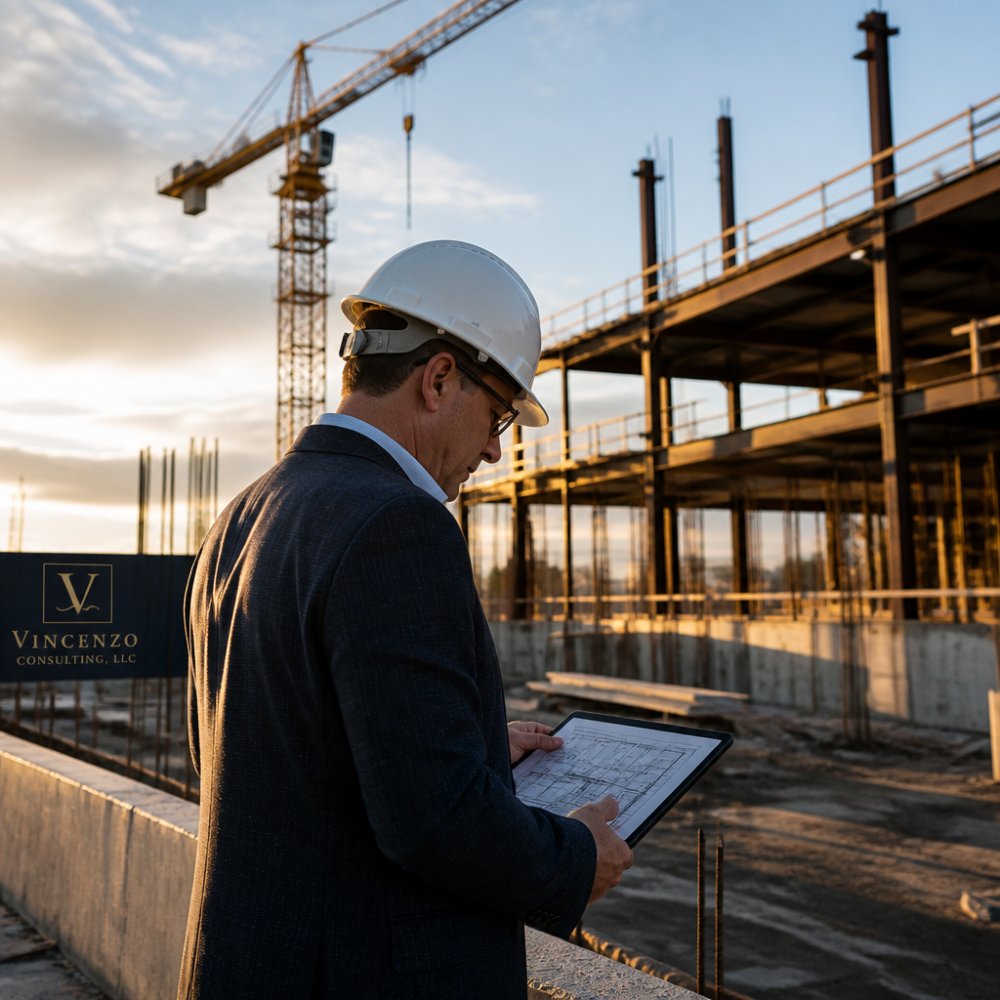
Core Responsibilities Beyond Traditional Project Oversight
A representative's real value sits in the decisions a project manager rarely controls. Reviewing and approving change orders before they hit the budget. Challenging a contractor's schedule logic when float disappears. Confirming that monthly payment applications match actual installed work. On a complex development, those three functions alone determine whether the project stays inside its financial guardrails.
The scope also extends to stakeholder management: lenders, equity partners, municipal reviewers, and design consultants all need a single point of accountability. The representative provides it.
Owner's Representative vs Project Manager: Key Differences
The owner's representative vs project manager distinction comes down to who holds the fiduciary duty. A project manager is typically employed by the contractor or construction manager and reports up that chain. An owner's representative is retained directly by the owner and reports only to the owner.
| Factor | Owner's Representative | Project Manager |
|---|---|---|
| Reports to | Owner | Contractor or CM |
| Primary duty | Protect owner's interests | Deliver the contracted scope |
| Budget authority | Reviews and challenges costs | Manages to approved budget |
| Contract control | Advises on awards and claims | Administers the contract |
| Best for | Complex, high-value projects | Straightforward builds |
When You Need an Owner's Representative Instead of a Project Manager
Complexity drives the decision. Multi-stakeholder capital structures, phased occupancy requirements, unusual site conditions, and projects where the owner lacks construction expertise all point toward independent representation. A first-time luxury builder and a family office deploying capital into an industrial asset face the same core problem: no internal team with the experience to audit what the contractor is telling them.
Managing Complex Commercial Construction Risks
Managing complex commercial construction risks means controlling three exposures simultaneously: money, time, and relationships. Financial risk shows up as scope creep and undocumented change orders. Schedule risk hides in optimistic sequencing and unverified float. Stakeholder risk emerges when lenders, partners, and contractors operate from different versions of the truth.
Mitigation follows a disciplined pattern:
- Require written change orders before any work proceeds
- Reconcile payment applications against observed progress each month
- Independently verify schedule updates rather than accepting them
- Issue a single weekly report to all stakeholders from one source
Financial, Schedule, and Stakeholder Risk Mitigation
The financial controls matter most. Every change order represents a negotiation, and owners who lack representation usually negotiate from behind. Independent review catches duplicated charges, unsubstantiated time-and-material tickets, and scope items already covered in the base contract. The American Institute of Architects contract documents provide the standard frameworks most commercial projects use, and familiarity with them is essential to catching unfavorable terms before they are signed.
Schedule risk requires the same skepticism. Contractors update schedules; owners should verify them. A representative who reads the critical path and questions disappearing float prevents the delays that later become claims.
Hiring an Owner's Representative Checklist
The hiring an owner's representative checklist below covers what separates a strong candidate from a credentialed one. Experience across the specific project type matters more than general construction tenure. Someone who has delivered industrial facilities may not be the right fit for a luxury waterfront estate.
- Direct experience on projects of similar scale and complexity
- Verifiable track record of cost control on past engagements
- Clear authority to review, challenge, and approve expenditures
- Familiarity with the contract forms and delivery method in use
- Capacity to be on site, not just reviewing reports remotely
- References from owners, not contractors
- Defined reporting cadence and escalation path
- Independence from the contractor and design team
Qualifications, Experience, and Authority to Look For
Authority is the qualification most owners overlook. A representative who can only advise, and not approve or reject, adds a layer of reporting without adding protection. Ask directly: what decisions can you make without my sign-off, and what is your process when you disagree with the contractor?
Experience signals worth probing include how candidates handled prior disputes, what they did when a schedule slipped, and how they structured their reporting. The Project Management Institute's risk management guidance offers useful context on how disciplined risk processes should be structured.
Benefits of Engaging an Owner's Representative
The clearest benefit is alignment. Scope, budget, and schedule get managed against the owner's objectives rather than the contractor's margin. Vincenzo Consulting, LLC has built its practice around that principle for more than 35 years of executive leadership, providing discreet oversight across luxury residential, commercial, and infrastructure work.
Secondary benefits compound over time. Owners gain a documented record of every decision, which protects them in disputes and simplifies future financing. Property value is preserved because quality issues get caught during construction rather than after. And owners recover their own time, which on a complex development is often the scarcest resource of all.
A final consideration: the fee for independent representation is a fraction of the cost of a single unresolved claim. Owners who have been through a difficult project rarely go back to managing one alone.
Conclusion
Complex commercial development rewards owners who build in independent scrutiny from the start. The right representative protects the vision, the budget, and the long-term value of the asset, and does it without adding bureaucracy. Vincenzo Consulting, LLC provides that disciplined, white-glove oversight for owners and investors who need accountability across the full project lifecycle.
Frequently Asked Questions
What are the primary responsibilities of an owner's representative?
An owner's representative manages the owner's interests throughout a project, from design through closeout. Core duties include overseeing the scope of work, monitoring budget and schedule adherence, coordinating with architects and contractors, reviewing change orders, and providing regular status reports. They serve as the owner's single point of accountability, ensuring decisions align with the owner's vision and financial objectives rather than the contractor's convenience.
How does an owner's representative differ from a project manager?
A project manager typically works for the contractor or construction firm, managing day-to-day execution on their employer's behalf. An owner's representative works directly for the property owner, advocating solely for the owner's interests. This distinction matters in complex commercial developments where competing priorities can arise between the builder's profit motives and the owner's long-term value goals. The owner's representative has authority to challenge decisions and protect the owner's position.
When should you hire an owner's representative for a commercial project?
Engage an owner's representative before design begins on complex commercial developments involving multiple stakeholders, significant capital, or regulatory approvals. Early involvement allows them to help define scope, establish budget controls, and vet the project team. For projects with significant capital or intricate permitting requirements, early representation prevents costly misalignments that are difficult to correct once construction starts.
What should be on a hiring an owner's representative checklist?
A hiring checklist should verify the candidate's track record on similar project types and scales, their experience with the specific regulatory environment, and references from past clients. Confirm they have authority to make decisions on your behalf, carry appropriate insurance, and can provide regular on-site presence. Ask for examples of how they resolved contractor disputes or budget overruns on prior engagements.