 ultimate-guide
Managing Waterfront Estate Construction Projects: 2026 Guide
Table of Contents
- Why Waterfront Estate Construction Projects Fail Without Owner Advocacy
- Environmental Permitting for Waterfront Homes: The Approval Gauntlet
- Geotechnical Risk and Soil Stability Before You Break Ground
- Marine Construction Risk Management: Bulkheads, Docks, and Dredging
- Owner's Representation for Luxury Construction: What White-Glove Oversight Actually Does
- Budget Discipline and Value Engineering on Waterfront Estate Construction
- Climate Resilience, Sustainable Materials, and Insurance Strategy
- Conclusion: Protecting Vision and Long-Term Value
- Frequently Asked Questions
Last Updated: September 15, 2026
Why Waterfront Estate Construction Projects Fail Without Owner Advocacy
Managing waterfront estate construction projects is less about supervising a builder and more about defending an owner's interests against a system of permits, soils, tides, and contractors that each pull in a different direction. This guide from Vincenzo Consulting, LLC breaks down the sequence that determines whether a waterfront build finishes on budget or spirals. Waterfront estate construction fails most often for one reason: no single party owns the outcome.
Owner advocacy is the practice of retaining an independent representative whose only loyalty is the owner's scope, budget, and schedule. General contractors manage their own risk. Architects protect design intent. Neither is paid to challenge a change order that quietly benefits the builder.
At Vincenzo Consulting, LLC, we've watched projects stall not because the work was too hard, but because nobody with authority was watching the money and the schedule at the same time.
The sections below cover the full gauntlet: environmental permitting, geotechnical risk, marine construction, budget discipline, and the resilience planning most owners skip until it's too late.
Environmental Permitting for Waterfront Homes: The Approval Gauntlet
Environmental permitting for waterfront homes is the single longest-lead item on the schedule, and it is the one owners most consistently underestimate. A waterfront parcel typically sits inside overlapping jurisdictions: local zoning, state wetlands protection, floodplain management, and federal dredge-and-fill review. Each layer has its own application, its own reviewer, and its own clock.
A practical permit checklist for a waterfront estate usually includes:
- Local zoning and site plan approval
- State wetlands and waterways permit
- Floodplain development permit
- Federal authorization for any fill, dock, or dredging
- Stormwater management approval
- Riparian rights confirmation with adjacent owners
What most guides miss is sequencing. Filing these in parallel rather than in dependency order is the fastest way to trigger a resubmittal. Reviewers at the state level often will not act until the local approval is issued, and the federal layer waits on the state.
An owner's representative tracks each application's status, keeps the design team aligned with reviewer comments, and escalates stalled files before they become critical path. Regulatory compliance is not a paperwork exercise; it is schedule management.
Geotechnical Risk and Soil Stability Before You Break Ground
Geotechnical risk is the probability that subsurface conditions differ from what the design assumed, and on waterfront sites that probability runs high. Coastal soils shift between dense sand, soft organic silt, and filled ground within a single lot. Soil bearing capacity can vary enough across a footprint to change your foundation type entirely, and in the worst case, to force a redesign after the building envelope is already permitted.
A geotechnical investigation for a waterfront estate should be scoped to the structure, not to a template. A practical scope includes:
- Borings at every proposed structural column line, advanced to refusal or to a depth where stresses from the foundation are negligible, typically at least two to three times the footing width below the bearing elevation.
- Standard Penetration Test (SPT) and Cone Penetration Test (CPT) soundings to characterize density, strength, and stratigraphy. CPT is especially useful on coastal sites because it detects thin soft layers that a widely spaced boring program can miss.
- Groundwater monitoring across at least one full tidal cycle, plus a seasonal high-water reading. Tidal fluctuation changes effective stress in the soil and drives buoyancy and uplift loads on basements, pools, and buried utilities.
- Slope stability analysis for any bluff, bank, or dune edge, using both static and pseudo-static (seismic) loading where the site is in a region with meaningful seismic hazard.
- Corrosion and sulfate testing on soil and groundwater to select the right cement type and buried steel protection. Chloride exposure near saltwater is aggressive to ordinary reinforcing steel.
- Liquefaction screening for saturated, loose, granular soils. A waterfront site with a shallow water table and loose fill is a candidate, and the consequences for a heavy estate structure are severe.
A common mistake is treating one boring as representative of the whole parcel. It isn't. On waterfront sites, a single boring tells you what's under one point and almost nothing about the rest. The American Society of Civil Engineers' ASCE 7 and the International Building Code both tie foundation design to site-specific geotechnical parameters, and a reviewer will expect the report to justify the values used (ASCE 7-22).
The findings drive real decisions: pile depth and type, mat versus spread footing, retaining structures, dewatering approach, and how close the structure can sit to the shoreline without undermining structural integrity. Discovering this after excavation is the most expensive surprise in waterfront development. Value engineering belongs here, before contracts are signed, not after the foundation is poured.
FEMA flood map service and building code resources
Marine Construction Risk Management: Bulkheads, Docks, and Dredging
Marine construction risk management covers the in-water and near-water work: bulkhead installation, seawall repair, dock construction, and dredging. These components carry concentrated risk because they combine heavy equipment, tidal windows, and environmental exposure, and because a failure here can undermine the upland structure the rest of the project is built to protect.
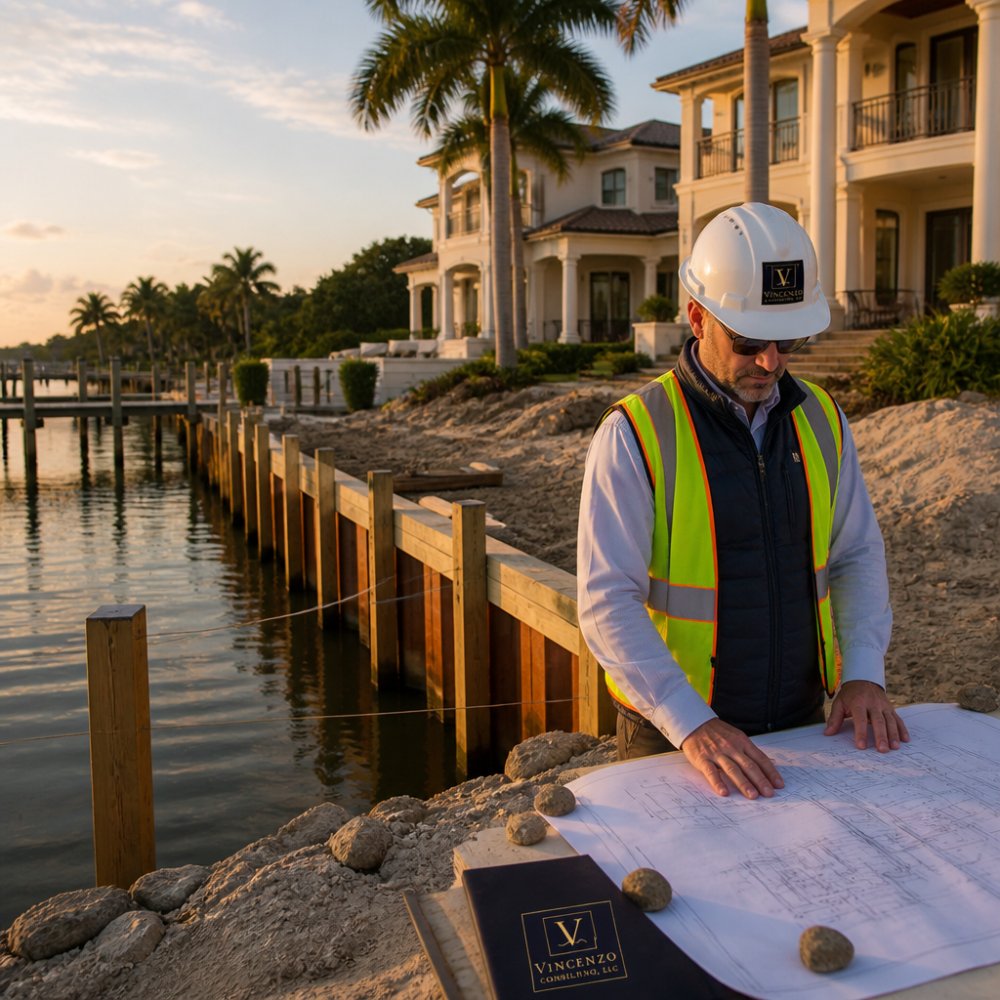
Bulkheads and seawalls. A failing bulkhead rarely announces itself. Owners discover it when the bank behind it starts slumping, or when a surveyor notes that the wall has rotated toward the water. Common failure mechanisms include loss of soil through corroded sheet piling, anchor tieback corrosion, toe scour from wave action, and overtopping during storm surge.
U.S. Army Corps of Engineers permit program overview
Owner's Representation for Luxury Construction: What White-Glove Oversight Actually Does
What that looks like in practice:
Budget Discipline and Value Engineering on Waterfront Estate Construction
A working budget framework for waterfront projects:
| Cost Category | Contingency Approach | Review Frequency |
|---|---|---|
| Site work and foundations | Higher, driven by geotechnical findings | Before contract award |
| Marine components | Moderate, tied to tidal and permit windows | At permit issuance |
| Finishes and interiors | Lower, owner-controlled | Monthly |
| Permitting and soft costs | Fixed allowance, tracked weekly | Weekly |
Climate Resilience, Sustainable Materials, and Insurance Strategy
Conclusion: Protecting Vision and Long-Term Value
Frequently Asked Questions
What permits are required for building on a waterfront estate?
Waterfront estate construction typically triggers a stack of federal, state, and local approvals. At the federal level, the U.S. Army Corps of Engineers issues permits under Section 404 of the Clean Water Act and Section 10 of the Rivers and Harbors Act. States add coastal zone management certifications, and local jurisdictions layer on zoning, floodplain, and building permits. A permit checklist should be assembled before design is finalized, since sequencing errors can stall a project for months.
How do you mitigate risks in complex marine-adjacent construction?
Marine construction risk management starts with a geotechnical site assessment to confirm soil bearing capacity and slope stability. Contractors then sequence bulkhead installation, dredging, and dock work around tide windows and weather forecasts. Insurance and liability strategy should be locked in early, with builder's risk and marine-specific coverage reviewed against the construction footprint. On-site oversight catches deviations before they become structural integrity problems.
What is the role of an owner's representative in estate construction?
An owner's representative acts as the owner's advocate throughout the project lifecycle, from site assessment and permitting through project closeout. For waterfront estate construction, that means coordinating architects, coastal engineers, and general contractors, holding the budget contingency, and enforcing schedule discipline. Owner's representation for luxury construction also includes reviewing pay applications, managing change orders, and protecting the owner's vision when trade-offs arise.
How does waterfront location impact long-term property value and maintenance?
Waterfront property commands a value premium but also carries higher maintenance obligations. Salt air, storm surge, and floodplain management requirements accelerate wear on finishes, decks, and marine infrastructure. Climate resilience planning, including elevated foundations and sustainable material selection, reduces long-term repair exposure. Buyers and appraisers increasingly weigh flood insurance costs and shoreline stabilization history when pricing coastal estates.
How do you manage budget discipline in ultra-luxury estate projects?
Budget discipline starts with a realistic pre-construction estimate that includes a defined contingency, typically 10 to 15 percent for waterfront work. Value engineering should be applied during design, not after bids return. An owner's representative reviews every change order against scope, tracks draws against schedule progress, and flags cost creep early. Marine construction risk management and permitting delays are the two largest hidden cost drivers on waterfront projects.
What environmental regulations apply to waterfront construction?
Key federal regulations include Section 404 of the Clean Water Act, Section 10 of the Rivers and Harbors Act, and the National Environmental Policy Act for projects with federal nexus. Wetlands protection falls under Corps jurisdiction, and the Endangered Species Act may apply in coastal habitats. State and local rules add shoreline stabilization standards, stormwater management requirements, and riparian rights limitations. An environmental impact assessment is often required before permits are issued.