 ultimate-guide
Strategic Oversight for Complex Commercial Real Estate Development
Table of Contents
- Why Strategic Oversight Decides Complex Commercial Development Outcomes
- Construction Project Accountability Strategies That Hold Every Party to Scope and Schedule
- Commercial Real Estate Risk Management Best Practices for Interdependent Risks
- Owner's Representation for Commercial Projects: Authority, Advocacy, and On-Site Presence
- Financial Viability, Capital Flows, and Budget Discipline Across the Project Lifecycle
- Regulatory Frameworks, Compliance Monitoring, and Development Feasibility
- Post-Development Lifecycle Oversight and Crisis Management for Complex Assets
- Interdisciplinary Team Governance and Portfolio Optimization
- Conclusion: Making Strategic Oversight a Competitive Advantage
- Frequently Asked Questions
Last Updated: September 27, 2026
Why Strategic Oversight Decides Complex Commercial Development Outcomes
Strategic oversight for complex commercial real estate development is the disciplined, owner-side management of scope, budget, schedule, and risk across every phase of a project, from feasibility through post-occupancy. At Vincenzo Consulting, LLC, we've watched too many well-funded developments drift off course not because the construction was bad, but because nobody with real authority was watching the whole board.
Construction Project Accountability Strategies That Hold Every Party to Scope and Schedule
Construction project accountability strategies work only when decision rights are documented before the first change order lands. Vague expectations are where budgets go to die.
The Accountability Charter: Roles, Decision Rights, and Escalation Paths
The most effective accountability tool we've seen is a written charter that names who approves what, at what dollar threshold, and who breaks a tie when the general contractor and architect disagree. Without it, decisions stall or get made twice.
A workable charter covers three things:
- Who owns scope changes, and at what approval level
- How disputes escalate, with a defined timeline
- What documentation triggers a formal review
Commercial Real Estate Risk Management Best Practices for Interdependent Risks
Commercial real estate risk management best practices treat financial, regulatory, and reputation exposure as connected rather than separate line items. A permitting delay isn't just a schedule problem; it can trigger lender covenants and shift your reputation with anchor tenants.
Building the Risk Register: Financial, Regulatory, and Reputation Exposure
A functional risk register tracks each exposure with an owner, a trigger, and a mitigation plan. Interdependent risks deserve special attention because one failure cascades into the next.
| Risk Category | Typical Trigger | Mitigation Owner |
|---|---|---|
| Financial | Lender covenant breach | Owner's rep / CFO |
| Regulatory | Permit or zoning delay | Compliance lead |
| Reputation | Anchor tenant withdrawal | Leasing / PR lead |
| Schedule | Long-lead material slip | Construction manager |
Owner's Representation for Commercial Projects: Authority, Advocacy, and On-Site Presence
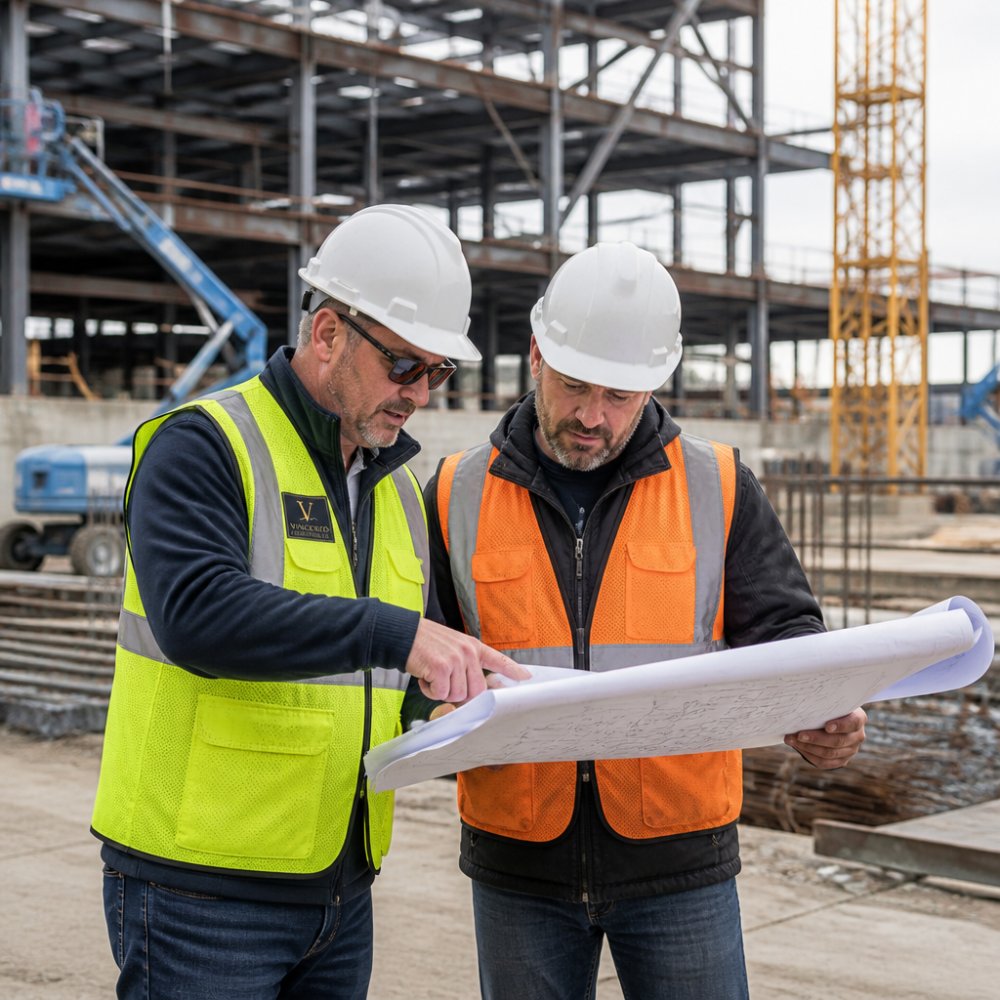
Owner's representation for commercial projects gives the owner a dedicated advocate with the authority to make decisions on site, not a passive reviewer waiting for reports. That on-site presence is what catches problems while they're still cheap to fix.
Financial Viability, Capital Flows, and Budget Discipline Across the Project Lifecycle
Financial viability depends on watching capital flows continuously, not just at closing. On a complex commercial project, the capital stack typically layers senior debt, mezzanine or subordinate debt, and sponsor equity, each with its own draw conditions, coverage tests, and reporting covenants. Oversight means knowing which layer is exposed first when a variance appears, and acting before that exposure triggers a lender conversation you did not schedule.
The Variance Threshold Framework
The most useful oversight tool here is a tiered variance threshold that pre-authorizes small deviations and forces escalation on larger ones. A common pattern is:
- Under 2% of the affected trade package: field-level resolution, logged but not escalated
- 2-5%: owner's representative review with written justification before the next draw
- Above 5%: formal change order with re-underwriting of the affected pro forma line
Draw-Request Verification Mechanics
A draw request is not a payment instruction; it is a claim that needs evidence. Effective verification pairs each line item with one of three proofs: a signed inspection report, a lien waiver from the subcontractor tier being paid, or a stored-materials certificate for off-site components. When a line item cannot be matched to one of those, it holds.
Contingency, Escalation, and the Owner's Reserve
Hard-cost contingency and owner's contingency are different pools with different rules. Hard-cost contingency covers trade-scope surprises and is typically controlled by the construction manager under a defined approval ladder. Owner's contingency covers scope changes, entitlement shifts, and market-driven cost moves, and should be released only by the owner or the owner's representative.
Cash-Flow Forecasting and the Look-Ahead
Capital flow oversight also means maintaining a rolling 90-day cash forecast that reconciles committed costs, pending change orders, and scheduled draws. When the forecast and the actuals diverge by more than a set tolerance, that gap is itself a signal, usually of unlogged commitments or slow approvals, not of accounting error. Catching that signal early is what keeps a project financeable through the back half of construction.
Regulatory Frameworks, Compliance Monitoring, and Development Feasibility
Regulatory frameworks and compliance monitoring determine whether a project stays feasible once construction starts. Zoning, environmental review, and permitting requirements can shift mid-project, and a stalled approval can freeze financing.
Post-Development Lifecycle Oversight and Crisis Management for Complex Assets
Post-development lifecycle oversight is the phase most owners underinvest in, and it's where long-term value is either protected or quietly lost. Once construction closes, the discipline often disappears exactly when asset management, facility management, and warranty enforcement begin. Most guides stop at certificate of occupancy. The oversight work that determines whether the asset performs for the next twenty years starts the day after.
The Handover Is a Phase, Not an Event
A clean transition from development to operations requires a structured handover with its own governance, not a folder of PDFs dropped on a property manager's desk. The elements that matter most:
- Warranty register: every manufacturer and subcontractor warranty logged with start date, duration, coverage scope, and the specific contact for claims. Warranties that are not tracked expire unused.
- Commissioning and retro-commissioning records: documented baseline performance for HVAC, electrical, and life-safety systems, so future deviations can be measured against something real.
- As-built and O&M documentation: reconciled drawings and operating manuals, indexed by system, not by contractor.
- Punch-list closeout and latent-defect window: a defined period during which the owner's representative retains authority to call back trades for defects that surface after occupancy.
- Reserve study and capital plan: a funded reserve schedule tied to the actual component ages and expected replacement cycles, not a rule-of-thumb percentage.
Operational Oversight Metrics That Actually Signal Trouble
Once the asset is operating, oversight shifts from schedule and cost to performance and risk. The metrics that most reliably surface problems early are:
- Net operating income variance against the stabilized pro forma, reviewed monthly, with explanations for any line deviating beyond a set tolerance
- Occupancy and lease-roll exposure: how much square footage rolls in the next 12, 24, and 36 months, and at what mark-to-market
- Capital expenditure actuals against the reserve study, because deferred capital is a silent liability that compounds
- Tenant satisfaction and renewal intent, tracked as a leading indicator rather than waiting for non-renewal notices
- Energy and utility consumption per square foot, which often reveals equipment degradation before a failure
Crisis Management: Protocols Before the First Incident
Crisis management planning belongs in the oversight scope from day one, not after the first incident. A contingency plan for contractor disputes, system failures, or tenant emergencies should exist before occupancy. Teams that plan for crises before they occur recover faster and protect their reputation risk profile.
A workable crisis protocol has four parts:
- Trigger definitions. What specific event activates the protocol, a system failure affecting a defined percentage of rentable area, a contractor default, a financing covenant breach, a tenant emergency. Vague triggers produce vague responses.
- Decision authority. Who has the authority to commit funds, halt operations, or communicate publicly during the event, and who is the backup if that person is unavailable.
- Communication tree. Who is notified, in what order, with what message, and through what channel, including tenants, lenders, insurers, and, where required, regulators.
- Recovery and post-mortem. A defined process for documenting what happened, what it cost, and what changes to the oversight framework it should trigger.
Why This Phase Belongs in the Original Oversight Mandate
Vincenzo Consulting, LLC brings more than 35 years of executive leadership to owner's representation, aligning scope, budget, and schedule with your objectives and protecting long-term property value from feasibility through post-occupancy. Learn more at [website] or reach us at [email].
Interdisciplinary Team Governance and Portfolio Optimization
Interdisciplinary team governance keeps architects, engineers, contractors, and consultants aligned around one set of business goals instead of competing priorities. When each discipline optimizes for itself, space use and project lifecycle outcomes suffer.
Conclusion: Making Strategic Oversight a Competitive Advantage
Complex development rewards owners who treat oversight as an operating discipline rather than an afterthought. The difference between a project that lands on budget and one that drifts comes down to documented accountability, continuous risk tracking, and someone with real authority watching the whole lifecycle.
Frequently Asked Questions
What are the primary risks in complex commercial real estate development?
Complex commercial developments carry interdependent risks: capital flow disruption, regulatory and permitting delays, contractor disputes, scope creep, and reputation exposure. Because these risks overlap, a single delay in financing can push back construction, trigger change orders, and strain stakeholder relationships. Strategic oversight maps these interdependencies early through a living risk register, assigns ownership for each exposure, and builds contingency plans before problems escalate. Owners who treat risk management as an ongoing discipline rather than a one-time review protect both financial viability and long-term property performance.
How does owner's representation improve project accountability?
Owner's representation places a dedicated advocate on the owner's side of the table, with the authority to question change orders, verify progress against schedule, and hold contractors to contractual scope. Instead of relying on reports filtered through the general contractor, the owner's rep walks the site, reviews pay applications, and documents decisions in real time. This construction project accountability strategy reduces information gaps, speeds up dispute resolution, and keeps every party aligned with the owner's business goals from pre-construction through closeout.
What is the role of strategic oversight in budget and schedule management?
Strategic oversight connects day-to-day construction decisions to the owner's financial viability targets. It starts with a disciplined budget baseline, tracks capital expenditure against commitments, and flags variances before they compound. On schedule, oversight means monitoring critical-path activities, anticipating long-lead procurement, and coordinating stakeholders so decisions do not stall progress. When scope, budget, and schedule are governed together rather than in silos, owners gain predictable outcomes and fewer costly surprises during construction and turnover.
How do you mitigate construction delays in large-scale commercial projects?
Delay mitigation begins before mobilization. A realistic schedule accounts for permitting timelines, environmental reviews, utility coordination, and material lead times. During construction, oversight teams run weekly look-ahead reviews, track float on critical activities, and escalate slippage immediately. Contingency planning for weather, labor shortages, and supplier disruptions keeps recovery options ready. Documenting every delay event with cause and cost also protects the owner's position in contract claims, preserving both schedule and budget discipline across the project lifecycle.
What are the best practices for maintaining financial discipline during development?
Financial discipline rests on three habits: a locked budget baseline with controlled contingency, monthly reconciliation of draws against verified work in place, and early warning thresholds for variances. Owners should require detailed pay application backup, independent cost reviews at major milestones, and change-order approval workflows with clear dollar thresholds. Tying capital flows to demonstrated progress keeps lending activities and equity contributions synchronized. This approach protects financial viability and gives investors confidence that capital expenditure matches actual construction progress.
How do you manage regulatory compliance and permitting on complex projects?
Regulatory management starts with a compliance matrix that lists every applicable federal, state, and local requirement, the responsible party, and the submission deadline. For projects involving environmental reviews or public infrastructure, early agency engagement shortens approval timelines. During construction, compliance monitoring covers inspections, safety standards, and permit conditions. Documenting each approval and inspection creates an audit trail that supports occupancy requirements and reduces reputation risk when regulators, lenders, or community stakeholders request verification.
What happens to oversight after construction is complete?
Post-development lifecycle oversight protects the investment after punch list and certificate of occupancy. It includes warranty administration, tracking deferred maintenance, verifying as-built documentation, and monitoring facility management performance against the owner's asset management plan. Owners who extend oversight into operations catch warranty claims before they expire, keep capital expenditure predictable, and preserve property performance. This phase is where strategic oversight shifts from construction delivery to long-term value protection for commercial property.